

198
12 The Einstein Field Equations for Cosmology
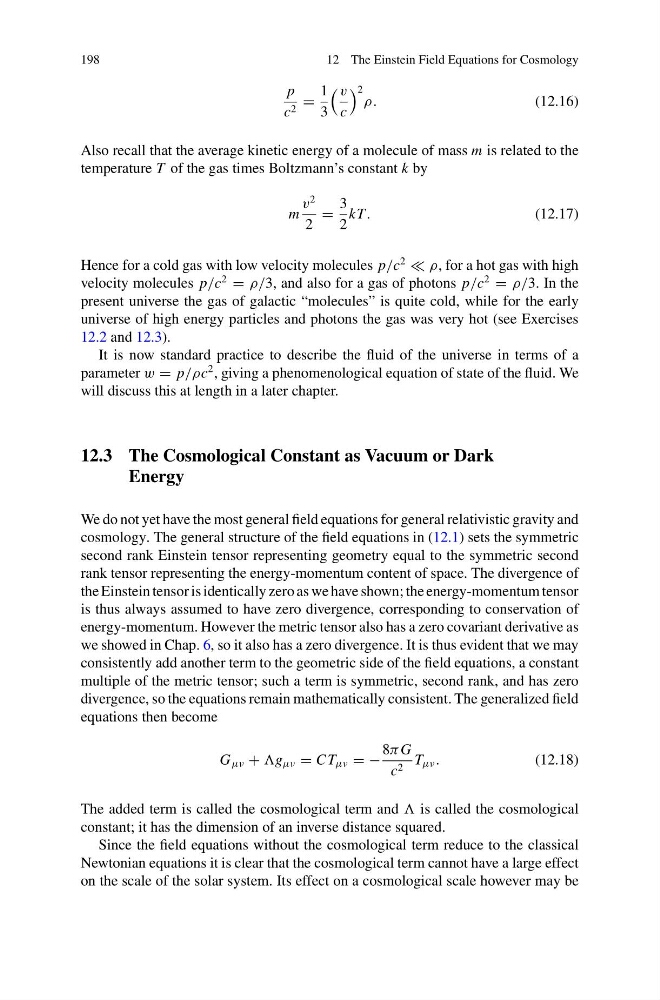
p
c 2 =
1
3
v
c
2 ρ.
(12.16)
Also recall that the average kinetic energy of a molecule of mass m is related to the
temperature T of the gas times Boltzmann’s constant k by
m
v
2
2
=
3
2
kT.
(12.17)
Hence for a cold gas with low velocity molecules p/c
2
ρ, for a hot gas with high
velocity molecules p/c
2
= ρ/3, and also for a gas of photons p/c
2
= ρ/3. In the
present universe the gas of galactic “molecules” is quite cold, while for the early
universe of high energy particles and photons the gas was very hot (see Exercises
12.2 and 12.3).
It is now standard practice to describe the fluid of the universe in terms of a
parameter w = p/ρc
2 , giving a phenomenological equation of state of the fluid. We
will discuss this at length in a later chapter.
12.3 The Cosmological Constant as Vacuum or Dark
Energy
We do not yet have the most general field equations for general relativistic gravity and
cosmology. The general structure of the field equations in (12.1) sets the symmetric
second rank Einstein tensor representing geometry equal to the symmetric second
rank tensor representing the energy-momentum content of space. The divergence of
the Einstein tensor is identically zero as we have shown; the energy-momentum tensor
is thus always assumed to have zero divergence, corresponding to conservation of
energy-momentum. However the metric tensor also has a zero covariant derivative as
we showed in Chap. 6, so it also has a zero divergence. It is thus evident that we may
consistently add another term to the geometric side of the field equations, a constant
multiple of the metric tensor; such a term is symmetric, second rank, and has zero
divergence, so the equations remain mathematically consistent. The generalized field
equations then become
G μν + g μν = CT μν = −
8π G
c 2 T μν .
(12.18)
The added term is called the cosmological term and is called the cosmological
constant; it has the dimension of an inverse distance squared.
Since the field equations without the cosmological term reduce to the classical
Newtonian equations it is clear that the cosmological term cannot have a large effect
on the scale of the solar system. Its effect on a cosmological scale however may be
12 The Einstein Field Equations for Cosmology
p
c 2 =
1
3
v
c
2 ρ.
(12.16)
Also recall that the average kinetic energy of a molecule of mass m is related to the
temperature T of the gas times Boltzmann’s constant k by
m
v
2
2
=
3
2
kT.
(12.17)
Hence for a cold gas with low velocity molecules p/c
2
ρ, for a hot gas with high
velocity molecules p/c
2
= ρ/3, and also for a gas of photons p/c
2
= ρ/3. In the
present universe the gas of galactic “molecules” is quite cold, while for the early
universe of high energy particles and photons the gas was very hot (see Exercises
12.2 and 12.3).
It is now standard practice to describe the fluid of the universe in terms of a
parameter w = p/ρc
2 , giving a phenomenological equation of state of the fluid. We
will discuss this at length in a later chapter.
12.3 The Cosmological Constant as Vacuum or Dark
Energy
We do not yet have the most general field equations for general relativistic gravity and
cosmology. The general structure of the field equations in (12.1) sets the symmetric
second rank Einstein tensor representing geometry equal to the symmetric second
rank tensor representing the energy-momentum content of space. The divergence of
the Einstein tensor is identically zero as we have shown; the energy-momentum tensor
is thus always assumed to have zero divergence, corresponding to conservation of
energy-momentum. However the metric tensor also has a zero covariant derivative as
we showed in Chap. 6, so it also has a zero divergence. It is thus evident that we may
consistently add another term to the geometric side of the field equations, a constant
multiple of the metric tensor; such a term is symmetric, second rank, and has zero
divergence, so the equations remain mathematically consistent. The generalized field
equations then become
G μν + g μν = CT μν = −
8π G
c 2 T μν .
(12.18)
The added term is called the cosmological term and is called the cosmological
constant; it has the dimension of an inverse distance squared.
Since the field equations without the cosmological term reduce to the classical
Newtonian equations it is clear that the cosmological term cannot have a large effect
on the scale of the solar system. Its effect on a cosmological scale however may be