

12.2 Field Equations and the Cosmic Fluid Source
197
= v
j
∂
∂t
(ρ + ap) +
∂
∂ x k
(ρ + ap)v
k
+ (ρ + ap)
∂v
j
∂t
+ v
k ∂v
j
∂ x k
= bc
2 d p
dx j .
(12.12)
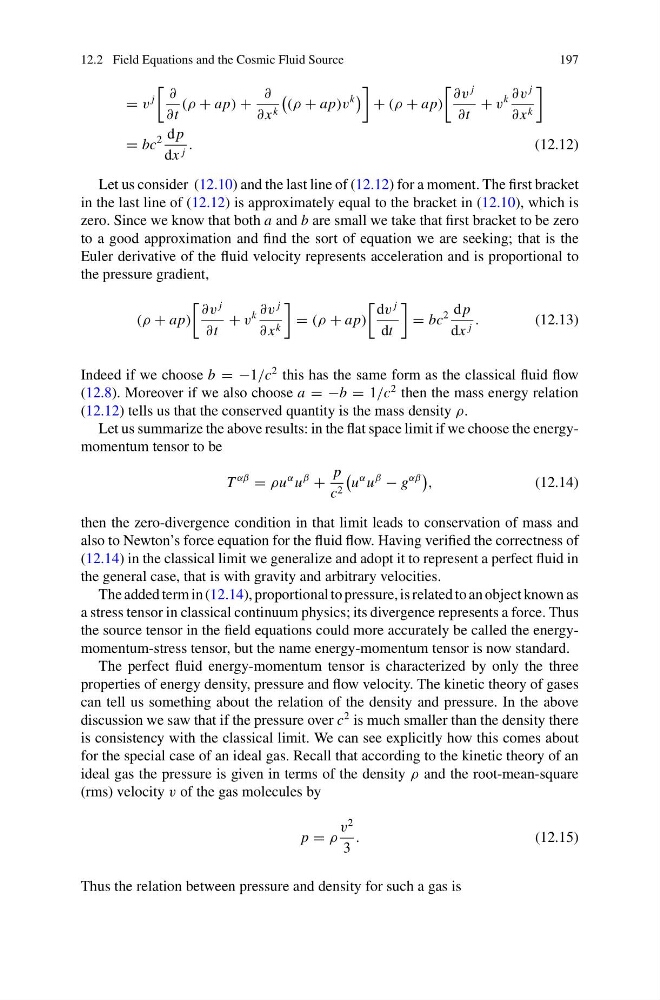
Let us consider (12.10) and the last line of (12.12) for a moment. The first bracket
in the last line of (12.12) is approximately equal to the bracket in (12.10), which is
zero. Since we know that both a and b are small we take that first bracket to be zero
to a good approximation and find the sort of equation we are seeking; that is the
Euler derivative of the fluid velocity represents acceleration and is proportional to
the pressure gradient,
(ρ + ap)
∂v
j
∂t
+ v
k ∂v
j
∂ x k
= (ρ + ap)
dv
j
dt
= bc
2 d p
dx j .
(12.13)
Indeed if we choose b = −1/c
2 this has the same form as the classical fluid flow
(12.8). Moreover if we also choose a = −b = 1/c
2 then the mass energy relation
(12.12) tells us that the conserved quantity is the mass density ρ.
Let us summarize the above results: in the flat space limit if we choose the energymomentum tensor to be
T
αβ
= ρu
α u
β
+
p
c 2
u
α u
β
− g
αβ
,
(12.14)
then the zero-divergence condition in that limit leads to conservation of mass and
also to Newton’s force equation for the fluid flow. Having verified the correctness of
(12.14) in the classical limit we generalize and adopt it to represent a perfect fluid in
the general case, that is with gravity and arbitrary velocities.
The added term in (12.14), proportional to pressure, is related to an object known as
a stress tensor in classical continuum physics; its divergence represents a force. Thus
the source tensor in the field equations could more accurately be called the energymomentum-stress tensor, but the name energy-momentum tensor is now standard.
The perfect fluid energy-momentum tensor is characterized by only the three
properties of energy density, pressure and flow velocity. The kinetic theory of gases
can tell us something about the relation of the density and pressure. In the above
discussion we saw that if the pressure over c
2 is much smaller than the density there
is consistency with the classical limit. We can see explicitly how this comes about
for the special case of an ideal gas. Recall that according to the kinetic theory of an
ideal gas the pressure is given in terms of the density ρ and the root-mean-square
(rms) velocity v of the gas molecules by
p = ρ
v
2
3
.
(12.15)
Thus the relation between pressure and density for such a gas is
197
= v
j
∂
∂t
(ρ + ap) +
∂
∂ x k
(ρ + ap)v
k
+ (ρ + ap)
∂v
j
∂t
+ v
k ∂v
j
∂ x k
= bc
2 d p
dx j .
(12.12)
Let us consider (12.10) and the last line of (12.12) for a moment. The first bracket
in the last line of (12.12) is approximately equal to the bracket in (12.10), which is
zero. Since we know that both a and b are small we take that first bracket to be zero
to a good approximation and find the sort of equation we are seeking; that is the
Euler derivative of the fluid velocity represents acceleration and is proportional to
the pressure gradient,
(ρ + ap)
∂v
j
∂t
+ v
k ∂v
j
∂ x k
= (ρ + ap)
dv
j
dt
= bc
2 d p
dx j .
(12.13)
Indeed if we choose b = −1/c
2 this has the same form as the classical fluid flow
(12.8). Moreover if we also choose a = −b = 1/c
2 then the mass energy relation
(12.12) tells us that the conserved quantity is the mass density ρ.
Let us summarize the above results: in the flat space limit if we choose the energymomentum tensor to be
T
αβ
= ρu
α u
β
+
p
c 2
u
α u
β
− g
αβ
,
(12.14)
then the zero-divergence condition in that limit leads to conservation of mass and
also to Newton’s force equation for the fluid flow. Having verified the correctness of
(12.14) in the classical limit we generalize and adopt it to represent a perfect fluid in
the general case, that is with gravity and arbitrary velocities.
The added term in (12.14), proportional to pressure, is related to an object known as
a stress tensor in classical continuum physics; its divergence represents a force. Thus
the source tensor in the field equations could more accurately be called the energymomentum-stress tensor, but the name energy-momentum tensor is now standard.
The perfect fluid energy-momentum tensor is characterized by only the three
properties of energy density, pressure and flow velocity. The kinetic theory of gases
can tell us something about the relation of the density and pressure. In the above
discussion we saw that if the pressure over c
2 is much smaller than the density there
is consistency with the classical limit. We can see explicitly how this comes about
for the special case of an ideal gas. Recall that according to the kinetic theory of an
ideal gas the pressure is given in terms of the density ρ and the root-mean-square
(rms) velocity v of the gas molecules by
p = ρ
v
2
3
.
(12.15)
Thus the relation between pressure and density for such a gas is