

1.2 The Simplest Lorentz Transformation
7
A(v) = a 11
1 −v/c
−v/c 1
.
(1.14)
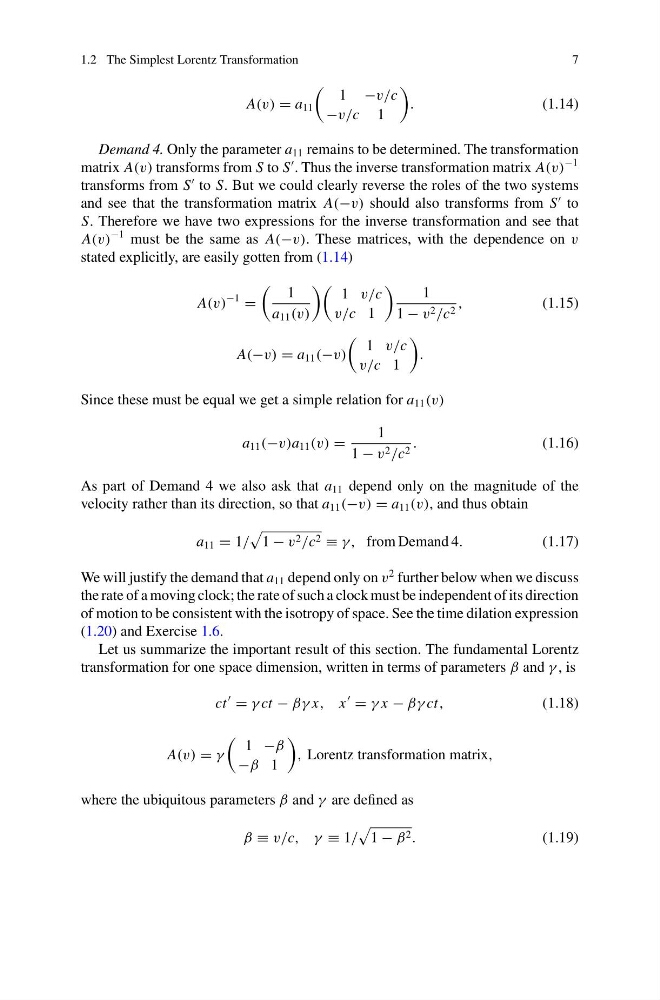
Demand 4. Only the parameter a 11 remains to be determined. The transformation
matrix A(v) transforms from S to S
. Thus the inverse transformation matrix A(v)
−1
transforms from S
to S. But we could clearly reverse the roles of the two systems
and see that the transformation matrix A(−v) should also transforms from S
to
S. Therefore we have two expressions for the inverse transformation and see that
A(v)
−1 must be the same as A(−v). These matrices, with the dependence on v
stated explicitly, are easily gotten from (1.14)
A(v)
−1
=
1
a 11 (v)
1 v/c
v/c 1
1
1 − v 2 /c 2 ,
(1.15)
A(−v) = a 11 (−v)
1 v/c
v/c 1
.
Since these must be equal we get a simple relation for a 11 (v)
a 11 (−v)a 11 (v) =
1
1 − v 2 /c 2 .
(1.16)
As part of Demand 4 we also ask that a 11 depend only on the magnitude of the
velocity rather than its direction, so that a 11 (−v) = a 11 (v), and thus obtain
a 11 = 1/
1 − v 2 /c 2 ≡ γ, from Demand 4.
(1.17)
We will justify the demand that a 11 depend only on v
2 further below when we discuss
the rate of a moving clock; the rate of such a clock must be independent of its direction
of motion to be consistent with the isotropy of space. See the time dilation expression
(1.20) and Exercise 1.6.
Let us summarize the important result of this section. The fundamental Lorentz
transformation for one space dimension, written in terms of parameters β and γ , is
ct
= γ ct − βγ x, x
= γ x − βγ ct,
(1.18)
A(v) = γ
1 −β
−β 1
, Lorentz transformation matrix,
where the ubiquitous parameters β and γ are defined as
β ≡ v/c, γ ≡ 1/
1 − β 2 .
(1.19)
7
A(v) = a 11
1 −v/c
−v/c 1
.
(1.14)
Demand 4. Only the parameter a 11 remains to be determined. The transformation
matrix A(v) transforms from S to S
. Thus the inverse transformation matrix A(v)
−1
transforms from S
to S. But we could clearly reverse the roles of the two systems
and see that the transformation matrix A(−v) should also transforms from S
to
S. Therefore we have two expressions for the inverse transformation and see that
A(v)
−1 must be the same as A(−v). These matrices, with the dependence on v
stated explicitly, are easily gotten from (1.14)
A(v)
−1
=
1
a 11 (v)
1 v/c
v/c 1
1
1 − v 2 /c 2 ,
(1.15)
A(−v) = a 11 (−v)
1 v/c
v/c 1
.
Since these must be equal we get a simple relation for a 11 (v)
a 11 (−v)a 11 (v) =
1
1 − v 2 /c 2 .
(1.16)
As part of Demand 4 we also ask that a 11 depend only on the magnitude of the
velocity rather than its direction, so that a 11 (−v) = a 11 (v), and thus obtain
a 11 = 1/
1 − v 2 /c 2 ≡ γ, from Demand 4.
(1.17)
We will justify the demand that a 11 depend only on v
2 further below when we discuss
the rate of a moving clock; the rate of such a clock must be independent of its direction
of motion to be consistent with the isotropy of space. See the time dilation expression
(1.20) and Exercise 1.6.
Let us summarize the important result of this section. The fundamental Lorentz
transformation for one space dimension, written in terms of parameters β and γ , is
ct
= γ ct − βγ x, x
= γ x − βγ ct,
(1.18)
A(v) = γ
1 −β
−β 1
, Lorentz transformation matrix,
where the ubiquitous parameters β and γ are defined as
β ≡ v/c, γ ≡ 1/
1 − β 2 .
(1.19)