

6
1 A Brief Stroll in Special Relativity
x
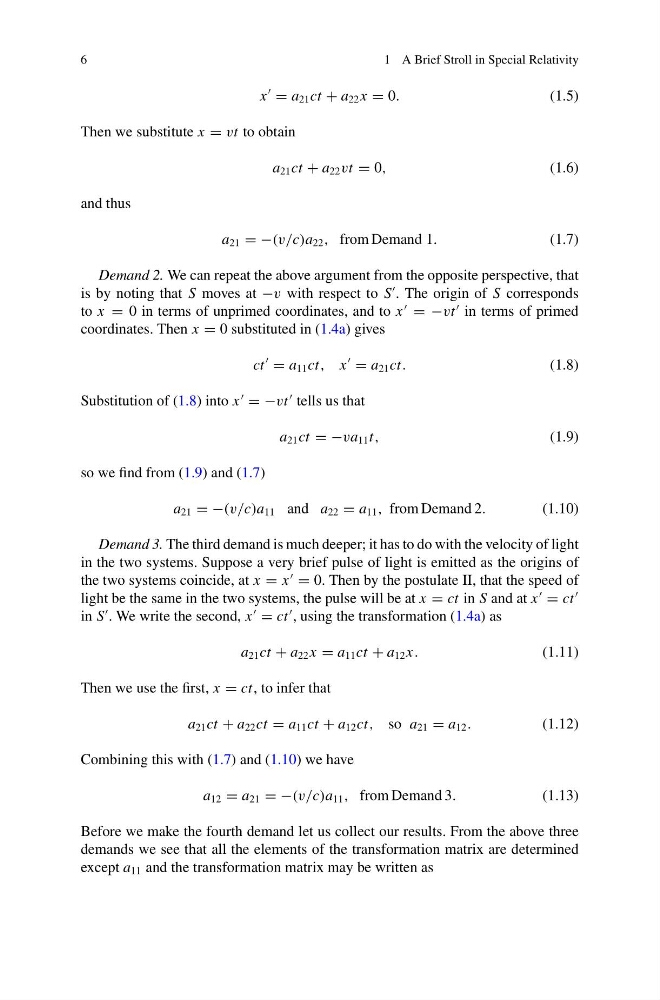
= a 21 ct + a 22 x = 0.
(1.5)
Then we substitute x = vt to obtain
a 21 ct + a 22 vt = 0,
(1.6)
and thus
a 21 = −(v/c)a 22 , from Demand 1.
(1.7)
Demand 2. We can repeat the above argument from the opposite perspective, that
is by noting that S moves at −v with respect to S
. The origin of S corresponds
to x = 0 in terms of unprimed coordinates, and to x
= −vt
in terms of primed
coordinates. Then x = 0 substituted in (1.4a) gives
ct
= a 11 ct, x
= a 21 ct.
(1.8)
Substitution of (1.8) into x
= −vt
tells us that
a 21 ct = −va 11 t,
(1.9)
so we find from (1.9) and (1.7)
a 21 = −(v/c)a 11 and a 22 = a 11 , from Demand 2.
(1.10)
Demand 3. The third demand is much deeper; it has to do with the velocity of light
in the two systems. Suppose a very brief pulse of light is emitted as the origins of
the two systems coincide, at x = x
= 0. Then by the postulate II, that the speed of
light be the same in the two systems, the pulse will be at x = ct in S and at x
= ct
in S
. We write the second, x
= ct
, using the transformation (1.4a) as
a 21 ct + a 22 x = a 11 ct + a 12 x.
(1.11)
Then we use the first, x = ct, to infer that
a 21 ct + a 22 ct = a 11 ct + a 12 ct, so a 21 = a 12 .
(1.12)
Combining this with (1.7) and (1.10) we have
a 12 = a 21 = −(v/c)a 11 , from Demand 3.
(1.13)
Before we make the fourth demand let us collect our results. From the above three
demands we see that all the elements of the transformation matrix are determined
except a 11 and the transformation matrix may be written as
1 A Brief Stroll in Special Relativity
x
= a 21 ct + a 22 x = 0.
(1.5)
Then we substitute x = vt to obtain
a 21 ct + a 22 vt = 0,
(1.6)
and thus
a 21 = −(v/c)a 22 , from Demand 1.
(1.7)
Demand 2. We can repeat the above argument from the opposite perspective, that
is by noting that S moves at −v with respect to S
. The origin of S corresponds
to x = 0 in terms of unprimed coordinates, and to x
= −vt
in terms of primed
coordinates. Then x = 0 substituted in (1.4a) gives
ct
= a 11 ct, x
= a 21 ct.
(1.8)
Substitution of (1.8) into x
= −vt
tells us that
a 21 ct = −va 11 t,
(1.9)
so we find from (1.9) and (1.7)
a 21 = −(v/c)a 11 and a 22 = a 11 , from Demand 2.
(1.10)
Demand 3. The third demand is much deeper; it has to do with the velocity of light
in the two systems. Suppose a very brief pulse of light is emitted as the origins of
the two systems coincide, at x = x
= 0. Then by the postulate II, that the speed of
light be the same in the two systems, the pulse will be at x = ct in S and at x
= ct
in S
. We write the second, x
= ct
, using the transformation (1.4a) as
a 21 ct + a 22 x = a 11 ct + a 12 x.
(1.11)
Then we use the first, x = ct, to infer that
a 21 ct + a 22 ct = a 11 ct + a 12 ct, so a 21 = a 12 .
(1.12)
Combining this with (1.7) and (1.10) we have
a 12 = a 21 = −(v/c)a 11 , from Demand 3.
(1.13)
Before we make the fourth demand let us collect our results. From the above three
demands we see that all the elements of the transformation matrix are determined
except a 11 and the transformation matrix may be written as