

11.3 Gravitational Plane Waves
165
The first of these is the wave equation with velocity equal to c and the second is the
Lorentz gauge condition. From (11.24) it is apparent that all of the functions ¯
h μν and
h μν and h and ¯
h obey the wave equation. Moreover it is important that the Riemann
tensor does also, as is clear from (11.6).
To get a solution for a plane wave moving at c in the spacetime direction k μ we
choose a smooth function (U ) of the scalar U = k β x
β . Then its derivatives obey,
(U ) =
k β x
β
,
∂
∂ x μ =
d
dU
∂U
∂ x μ = ,U k μ ,
2
= ,U,U k μ k
μ
.
(11.25)
Here the comma U indicates a derivative with respect to the scalar argument U . Any
such function is thus a solution of the wave equation if k μ is chosen to be a null
vector, k μ k
μ
= 0. We may choose the z direction to lie along the space component
of the null vector k μ so it is a constant multiple of (1, 0, 0, −1) and U is a multiple
of ct − z. We may thus take U = ct − z without loss of generality in what follows.
To set up a plane wave solution we write the metric field in terms of the function
(U ) and a set of coefficients μν ,
¯
h μν (U ) = μν (U ).
(11.26)
The μν is a constant array of what we will call polarization coefficients, in analogy
with electromagnetic radiation. It is only necessary to impose the Lorentz condition
in (11.24) to determine the coefficients. To do this we align the z axis along the
direction of the wave as above, then choose the coefficient matrix to be either of the
following
μν =
⎛
⎜
⎜
⎝
0 0 0 0
0 1 0 0
0 0 −1 0
0 0 0 0
⎞
⎟
⎟
⎠ , or μν =
⎛
⎜
⎜
⎝
0 0 0 0
0 0 1 0
0 1 0 0
0 0 0 0
⎞
⎟
⎟
⎠ so μν k
ν
= 0.
(11.27)
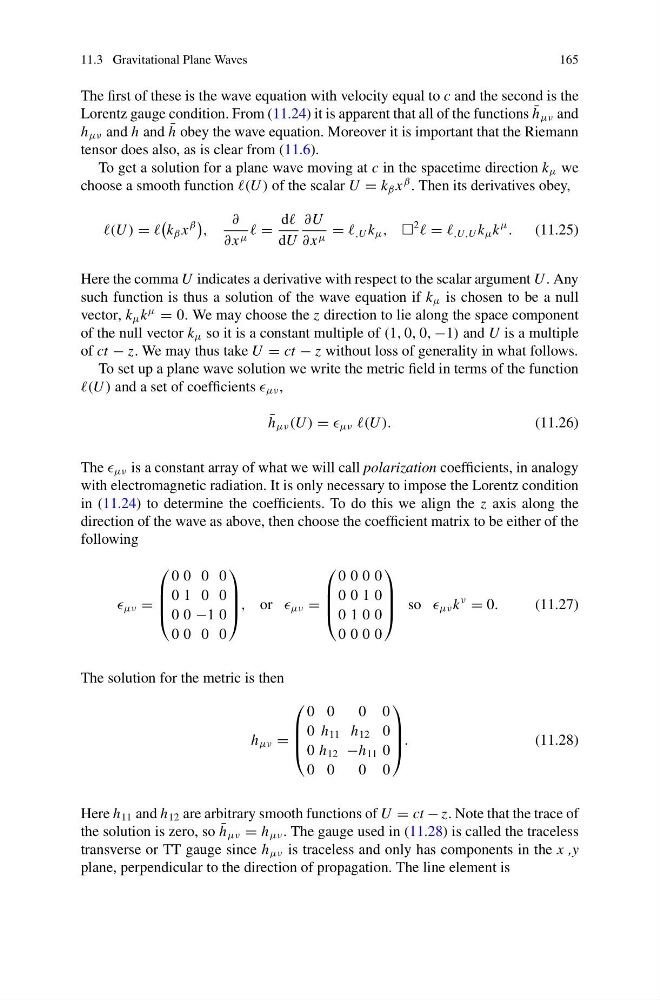
The solution for the metric is then
h μν =
⎛
⎜
⎜
⎝
0 0
0 0
0 h 11 h 12 0
0 h 12 −h 11 0
0 0
0 0
⎞
⎟
⎟
⎠ .
(11.28)
Here h 11 and h 12 are arbitrary smooth functions of U = ct − z. Note that the trace of
the solution is zero, so ¯
h μν = h μν . The gauge used in (11.28) is called the traceless
transverse or TT gauge since h μν is traceless and only has components in the x ,y
plane, perpendicular to the direction of propagation. The line element is
165
The first of these is the wave equation with velocity equal to c and the second is the
Lorentz gauge condition. From (11.24) it is apparent that all of the functions ¯
h μν and
h μν and h and ¯
h obey the wave equation. Moreover it is important that the Riemann
tensor does also, as is clear from (11.6).
To get a solution for a plane wave moving at c in the spacetime direction k μ we
choose a smooth function (U ) of the scalar U = k β x
β . Then its derivatives obey,
(U ) =
k β x
β
,
∂
∂ x μ =
d
dU
∂U
∂ x μ = ,U k μ ,
2
= ,U,U k μ k
μ
.
(11.25)
Here the comma U indicates a derivative with respect to the scalar argument U . Any
such function is thus a solution of the wave equation if k μ is chosen to be a null
vector, k μ k
μ
= 0. We may choose the z direction to lie along the space component
of the null vector k μ so it is a constant multiple of (1, 0, 0, −1) and U is a multiple
of ct − z. We may thus take U = ct − z without loss of generality in what follows.
To set up a plane wave solution we write the metric field in terms of the function
(U ) and a set of coefficients μν ,
¯
h μν (U ) = μν (U ).
(11.26)
The μν is a constant array of what we will call polarization coefficients, in analogy
with electromagnetic radiation. It is only necessary to impose the Lorentz condition
in (11.24) to determine the coefficients. To do this we align the z axis along the
direction of the wave as above, then choose the coefficient matrix to be either of the
following
μν =
⎛
⎜
⎜
⎝
0 0 0 0
0 1 0 0
0 0 −1 0
0 0 0 0
⎞
⎟
⎟
⎠ , or μν =
⎛
⎜
⎜
⎝
0 0 0 0
0 0 1 0
0 1 0 0
0 0 0 0
⎞
⎟
⎟
⎠ so μν k
ν
= 0.
(11.27)
The solution for the metric is then
h μν =
⎛
⎜
⎜
⎝
0 0
0 0
0 h 11 h 12 0
0 h 12 −h 11 0
0 0
0 0
⎞
⎟
⎟
⎠ .
(11.28)
Here h 11 and h 12 are arbitrary smooth functions of U = ct − z. Note that the trace of
the solution is zero, so ¯
h μν = h μν . The gauge used in (11.28) is called the traceless
transverse or TT gauge since h μν is traceless and only has components in the x ,y
plane, perpendicular to the direction of propagation. The line element is