

162
11 Linearized General Relativity and Gravitational Waves
G μν =
1
2
¯
h
,λ
μν ,λ − ¯
h
λ
ν ,λ,μ − ¯
h
λ
μ ,λ,ν
+ η μν
¯
h
αω
,ω,α
= −
8π G
c 2
T μν .
(11.13)
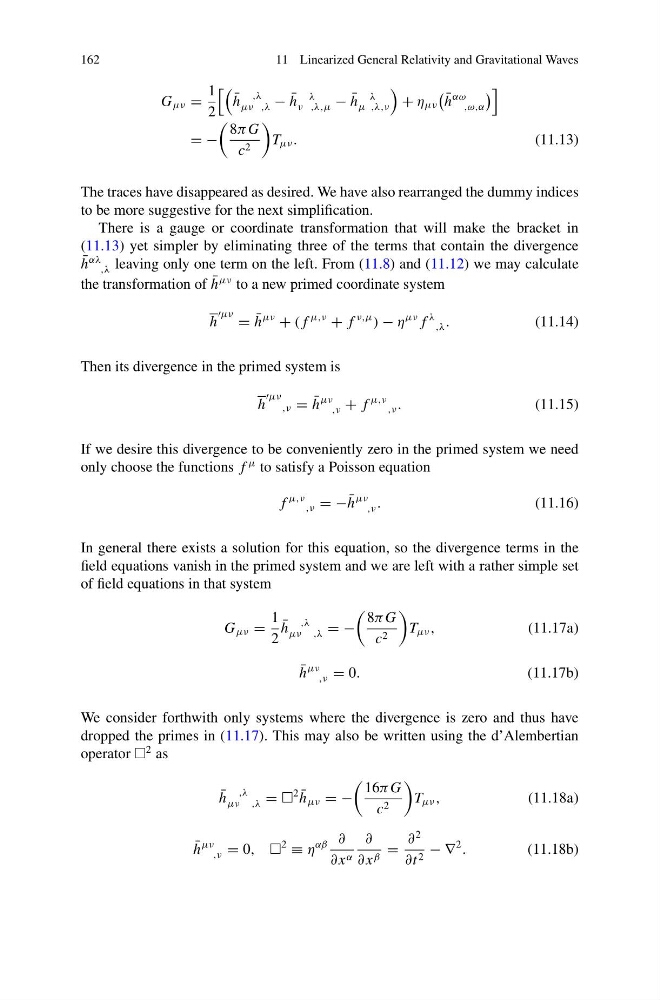
The traces have disappeared as desired. We have also rearranged the dummy indices
to be more suggestive for the next simplification.
There is a gauge or coordinate transformation that will make the bracket in
(11.13) yet simpler by eliminating three of the terms that contain the divergence
¯
h
αλ
,λ leaving only one term on the left. From (11.8) and (11.12) we may calculate
the transformation of ¯
h
μν to a new primed coordinate system
h
μν = ¯
h
μν
+ ( f
μ,ν
+ f
ν,μ
) − η
μν f
λ ,λ .
(11.14)
Then its divergence in the primed system is
h
μν
,ν = ¯
h
μν
,ν + f
μ,ν ,ν .
(11.15)
If we desire this divergence to be conveniently zero in the primed system we need
only choose the functions f
μ to satisfy a Poisson equation
f
μ,ν ,ν = − ¯
h
μν
,ν .
(11.16)
In general there exists a solution for this equation, so the divergence terms in the
field equations vanish in the primed system and we are left with a rather simple set
of field equations in that system
G μν =
1
2
¯
h
,λ
μν ,λ = −
8π G
c 2
T μν ,
(11.17a)
¯
h
μν
,ν = 0.
(11.17b)
We consider forthwith only systems where the divergence is zero and thus have
dropped the primes in (11.17). This may also be written using the d’Alembertian
operator
2 as
¯
h
,λ
μν ,λ =
2 ¯
h μν = −
16π G
c 2
T μν ,
(11.18a)
¯
h
μν
,ν = 0,
2
≡ η
αβ ∂
∂ x α
∂
∂ x β =
∂
2
∂t 2 − ∇
2
.
(11.18b)
11 Linearized General Relativity and Gravitational Waves
G μν =
1
2
¯
h
,λ
μν ,λ − ¯
h
λ
ν ,λ,μ − ¯
h
λ
μ ,λ,ν
+ η μν
¯
h
αω
,ω,α
= −
8π G
c 2
T μν .
(11.13)
The traces have disappeared as desired. We have also rearranged the dummy indices
to be more suggestive for the next simplification.
There is a gauge or coordinate transformation that will make the bracket in
(11.13) yet simpler by eliminating three of the terms that contain the divergence
¯
h
αλ
,λ leaving only one term on the left. From (11.8) and (11.12) we may calculate
the transformation of ¯
h
μν to a new primed coordinate system
h
μν = ¯
h
μν
+ ( f
μ,ν
+ f
ν,μ
) − η
μν f
λ ,λ .
(11.14)
Then its divergence in the primed system is
h
μν
,ν = ¯
h
μν
,ν + f
μ,ν ,ν .
(11.15)
If we desire this divergence to be conveniently zero in the primed system we need
only choose the functions f
μ to satisfy a Poisson equation
f
μ,ν ,ν = − ¯
h
μν
,ν .
(11.16)
In general there exists a solution for this equation, so the divergence terms in the
field equations vanish in the primed system and we are left with a rather simple set
of field equations in that system
G μν =
1
2
¯
h
,λ
μν ,λ = −
8π G
c 2
T μν ,
(11.17a)
¯
h
μν
,ν = 0.
(11.17b)
We consider forthwith only systems where the divergence is zero and thus have
dropped the primes in (11.17). This may also be written using the d’Alembertian
operator
2 as
¯
h
,λ
μν ,λ =
2 ¯
h μν = −
16π G
c 2
T μν ,
(11.18a)
¯
h
μν
,ν = 0,
2
≡ η
αβ ∂
∂ x α
∂
∂ x β =
∂
2
∂t 2 − ∇
2
.
(11.18b)