

10.2 Null Surfaces
147
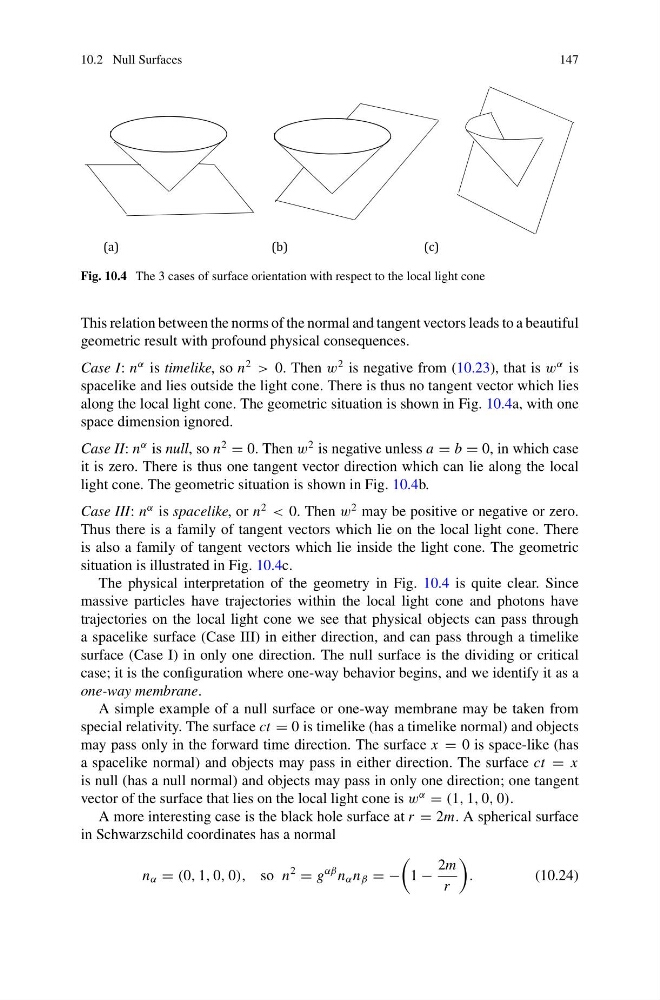
Fig. 10.4 The 3 cases of surface orientation with respect to the local light cone
This relation between the norms of the normal and tangent vectors leads to a beautiful
geometric result with profound physical consequences.
Case I: n
α is timelike, so n
2
> 0. Then w
2 is negative from (10.23), that is w
α is
spacelike and lies outside the light cone. There is thus no tangent vector which lies
along the local light cone. The geometric situation is shown in Fig. 10.4a, with one
space dimension ignored.
Case II: n
α is null, so n
2
= 0. Then w
2 is negative unless a = b = 0, in which case
it is zero. There is thus one tangent vector direction which can lie along the local
light cone. The geometric situation is shown in Fig. 10.4b.
Case III: n
α is spacelike, or n
2
< 0. Then w
2 may be positive or negative or zero.
Thus there is a family of tangent vectors which lie on the local light cone. There
is also a family of tangent vectors which lie inside the light cone. The geometric
situation is illustrated in Fig. 10.4c.
The physical interpretation of the geometry in Fig. 10.4 is quite clear. Since
massive particles have trajectories within the local light cone and photons have
trajectories on the local light cone we see that physical objects can pass through
a spacelike surface (Case III) in either direction, and can pass through a timelike
surface (Case I) in only one direction. The null surface is the dividing or critical
case; it is the configuration where one-way behavior begins, and we identify it as a
one-way membrane.
A simple example of a null surface or one-way membrane may be taken from
special relativity. The surface ct = 0 is timelike (has a timelike normal) and objects
may pass only in the forward time direction. The surface x = 0 is space-like (has
a spacelike normal) and objects may pass in either direction. The surface ct = x
is null (has a null normal) and objects may pass in only one direction; one tangent
vector of the surface that lies on the local light cone is w
α
= (1, 1, 0, 0).
A more interesting case is the black hole surface at r = 2m. A spherical surface
in Schwarzschild coordinates has a normal
n α = (0, 1, 0, 0), so n
2
= g
αβ n α n β = −
1 −
2m
r
.
(10.24)
147
Fig. 10.4 The 3 cases of surface orientation with respect to the local light cone
This relation between the norms of the normal and tangent vectors leads to a beautiful
geometric result with profound physical consequences.
Case I: n
α is timelike, so n
2
> 0. Then w
2 is negative from (10.23), that is w
α is
spacelike and lies outside the light cone. There is thus no tangent vector which lies
along the local light cone. The geometric situation is shown in Fig. 10.4a, with one
space dimension ignored.
Case II: n
α is null, so n
2
= 0. Then w
2 is negative unless a = b = 0, in which case
it is zero. There is thus one tangent vector direction which can lie along the local
light cone. The geometric situation is shown in Fig. 10.4b.
Case III: n
α is spacelike, or n
2
< 0. Then w
2 may be positive or negative or zero.
Thus there is a family of tangent vectors which lie on the local light cone. There
is also a family of tangent vectors which lie inside the light cone. The geometric
situation is illustrated in Fig. 10.4c.
The physical interpretation of the geometry in Fig. 10.4 is quite clear. Since
massive particles have trajectories within the local light cone and photons have
trajectories on the local light cone we see that physical objects can pass through
a spacelike surface (Case III) in either direction, and can pass through a timelike
surface (Case I) in only one direction. The null surface is the dividing or critical
case; it is the configuration where one-way behavior begins, and we identify it as a
one-way membrane.
A simple example of a null surface or one-way membrane may be taken from
special relativity. The surface ct = 0 is timelike (has a timelike normal) and objects
may pass only in the forward time direction. The surface x = 0 is space-like (has
a spacelike normal) and objects may pass in either direction. The surface ct = x
is null (has a null normal) and objects may pass in only one direction; one tangent
vector of the surface that lies on the local light cone is w
α
= (1, 1, 0, 0).
A more interesting case is the black hole surface at r = 2m. A spherical surface
in Schwarzschild coordinates has a normal
n α = (0, 1, 0, 0), so n
2
= g
αβ n α n β = −
1 −
2m
r
.
(10.24)