

146
10 Black Holes and Gravitational Collapse
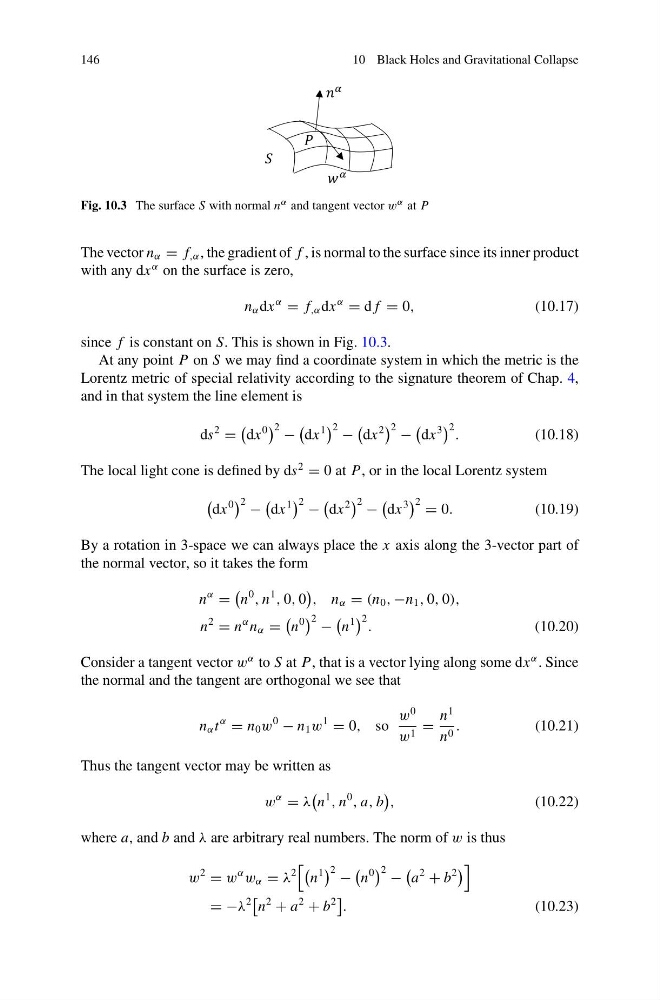
Fig. 10.3 The surface S with normal n α and tangent vector w α at P
The vector n α = f ,α , the gradient of f , is normal to the surface since its inner product
with any dx
α on the surface is zero,
n α dx
α
= f ,α dx
α
= d f = 0,
(10.17)
since f is constant on S. This is shown in Fig. 10.3.
At any point P on S we may find a coordinate system in which the metric is the
Lorentz metric of special relativity according to the signature theorem of Chap. 4,
and in that system the line element is
ds
2
=
dx
0
2 −
dx
1
2 −
dx
2
2 −
dx
3
2 .
(10.18)
The local light cone is defined by ds
2
= 0 at P, or in the local Lorentz system
dx
0
2 −
dx
1
2 −
dx
2
2 −
dx
3
2 = 0.
(10.19)
By a rotation in 3-space we can always place the x axis along the 3-vector part of
the normal vector, so it takes the form
n
α
=
n
0
, n
1
, 0, 0
, n α = (n 0 , −n 1 , 0, 0),
n
2
= n
α n α =
n
0
2 −
n
1
2 .
(10.20)
Consider a tangent vector w
α to S at P, that is a vector lying along some dx
α . Since
the normal and the tangent are orthogonal we see that
n α t
α
= n 0 w
0
− n 1 w
1
= 0, so
w
0
w 1 =
n
1
n 0 .
(10.21)
Thus the tangent vector may be written as
w
α
= λ
n
1
, n
0
, a, b
,
(10.22)
where a, and b and λ are arbitrary real numbers. The norm of w is thus
w
2
= w
α
w α = λ
2
n
1
2 −
n
0
2 −
a
2
+ b
2
= −λ
2
n
2
+ a
2
+ b
2
.
(10.23)
10 Black Holes and Gravitational Collapse
Fig. 10.3 The surface S with normal n α and tangent vector w α at P
The vector n α = f ,α , the gradient of f , is normal to the surface since its inner product
with any dx
α on the surface is zero,
n α dx
α
= f ,α dx
α
= d f = 0,
(10.17)
since f is constant on S. This is shown in Fig. 10.3.
At any point P on S we may find a coordinate system in which the metric is the
Lorentz metric of special relativity according to the signature theorem of Chap. 4,
and in that system the line element is
ds
2
=
dx
0
2 −
dx
1
2 −
dx
2
2 −
dx
3
2 .
(10.18)
The local light cone is defined by ds
2
= 0 at P, or in the local Lorentz system
dx
0
2 −
dx
1
2 −
dx
2
2 −
dx
3
2 = 0.
(10.19)
By a rotation in 3-space we can always place the x axis along the 3-vector part of
the normal vector, so it takes the form
n
α
=
n
0
, n
1
, 0, 0
, n α = (n 0 , −n 1 , 0, 0),
n
2
= n
α n α =
n
0
2 −
n
1
2 .
(10.20)
Consider a tangent vector w
α to S at P, that is a vector lying along some dx
α . Since
the normal and the tangent are orthogonal we see that
n α t
α
= n 0 w
0
− n 1 w
1
= 0, so
w
0
w 1 =
n
1
n 0 .
(10.21)
Thus the tangent vector may be written as
w
α
= λ
n
1
, n
0
, a, b
,
(10.22)
where a, and b and λ are arbitrary real numbers. The norm of w is thus
w
2
= w
α
w α = λ
2
n
1
2 −
n
0
2 −
a
2
+ b
2
= −λ
2
n
2
+ a
2
+ b
2
.
(10.23)