

9.2 Orbit of a Planet
133
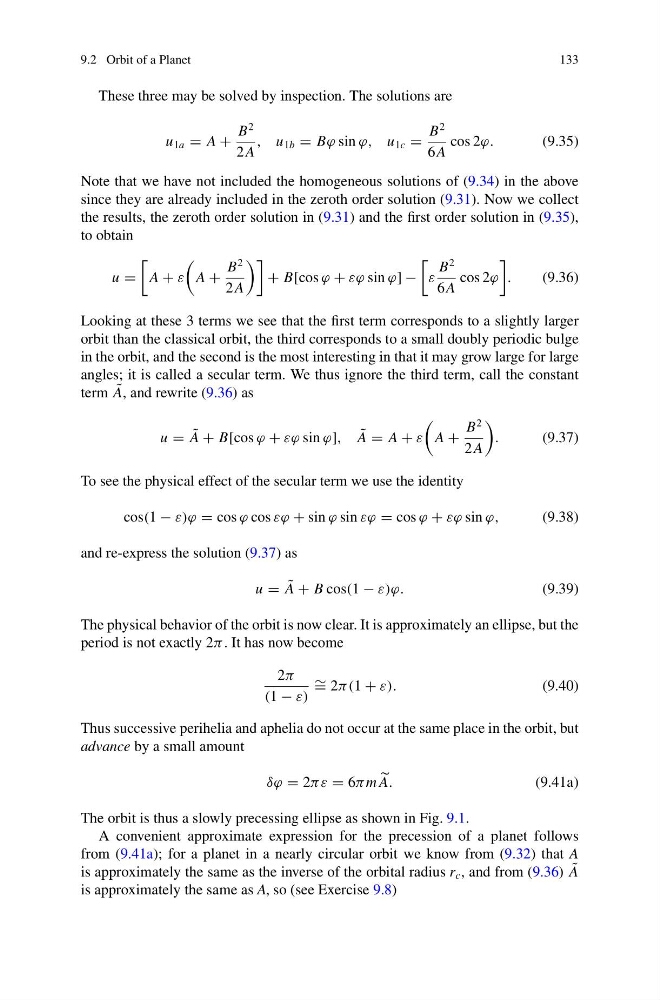
These three may be solved by inspection. The solutions are
u 1a = A +
B
2
2 A
, u 1b = Bϕ sin ϕ, u 1c =
B
2
6A
cos 2ϕ.
(9.35)
Note that we have not included the homogeneous solutions of (9.34) in the above
since they are already included in the zeroth order solution (9.31). Now we collect
the results, the zeroth order solution in (9.31) and the first order solution in (9.35),
to obtain
u =
A + ε
A +
B
2
2 A
+ B[cos ϕ + εϕ sin ϕ] −
ε
B
2
6A
cos 2ϕ
.
(9.36)
Looking at these 3 terms we see that the first term corresponds to a slightly larger
orbit than the classical orbit, the third corresponds to a small doubly periodic bulge
in the orbit, and the second is the most interesting in that it may grow large for large
angles; it is called a secular term. We thus ignore the third term, call the constant
term ˜
A, and rewrite (9.36) as
u = ˜
A + B[cos ϕ + εϕ sin ϕ], ˜
A = A + ε
A +
B
2
2 A
.
(9.37)
To see the physical effect of the secular term we use the identity
cos(1 − ε)ϕ = cos ϕ cos εϕ + sin ϕ sin εϕ = cos ϕ + εϕ sin ϕ,
(9.38)
and re-express the solution (9.37) as
u = ˜
A + B cos(1 − ε)ϕ.
(9.39)
The physical behavior of the orbit is now clear. It is approximately an ellipse, but the
period is not exactly 2π . It has now become
2π
(1 − ε)
∼ = 2π (1 + ε).
(9.40)
Thus successive perihelia and aphelia do not occur at the same place in the orbit, but
advance by a small amount
δϕ = 2πε = 6π m
A.
(9.41a)
The orbit is thus a slowly precessing ellipse as shown in Fig. 9.1.
A convenient approximate expression for the precession of a planet follows
from (9.41a); for a planet in a nearly circular orbit we know from (9.32) that A
is approximately the same as the inverse of the orbital radius r c , and from (9.36) ˜
A
is approximately the same as A, so (see Exercise 9.8)
133
These three may be solved by inspection. The solutions are
u 1a = A +
B
2
2 A
, u 1b = Bϕ sin ϕ, u 1c =
B
2
6A
cos 2ϕ.
(9.35)
Note that we have not included the homogeneous solutions of (9.34) in the above
since they are already included in the zeroth order solution (9.31). Now we collect
the results, the zeroth order solution in (9.31) and the first order solution in (9.35),
to obtain
u =
A + ε
A +
B
2
2 A
+ B[cos ϕ + εϕ sin ϕ] −
ε
B
2
6A
cos 2ϕ
.
(9.36)
Looking at these 3 terms we see that the first term corresponds to a slightly larger
orbit than the classical orbit, the third corresponds to a small doubly periodic bulge
in the orbit, and the second is the most interesting in that it may grow large for large
angles; it is called a secular term. We thus ignore the third term, call the constant
term ˜
A, and rewrite (9.36) as
u = ˜
A + B[cos ϕ + εϕ sin ϕ], ˜
A = A + ε
A +
B
2
2 A
.
(9.37)
To see the physical effect of the secular term we use the identity
cos(1 − ε)ϕ = cos ϕ cos εϕ + sin ϕ sin εϕ = cos ϕ + εϕ sin ϕ,
(9.38)
and re-express the solution (9.37) as
u = ˜
A + B cos(1 − ε)ϕ.
(9.39)
The physical behavior of the orbit is now clear. It is approximately an ellipse, but the
period is not exactly 2π . It has now become
2π
(1 − ε)
∼ = 2π (1 + ε).
(9.40)
Thus successive perihelia and aphelia do not occur at the same place in the orbit, but
advance by a small amount
δϕ = 2πε = 6π m
A.
(9.41a)
The orbit is thus a slowly precessing ellipse as shown in Fig. 9.1.
A convenient approximate expression for the precession of a planet follows
from (9.41a); for a planet in a nearly circular orbit we know from (9.32) that A
is approximately the same as the inverse of the orbital radius r c , and from (9.36) ˜
A
is approximately the same as A, so (see Exercise 9.8)