

132
9 Spherically Symmetric Gravitational Fields
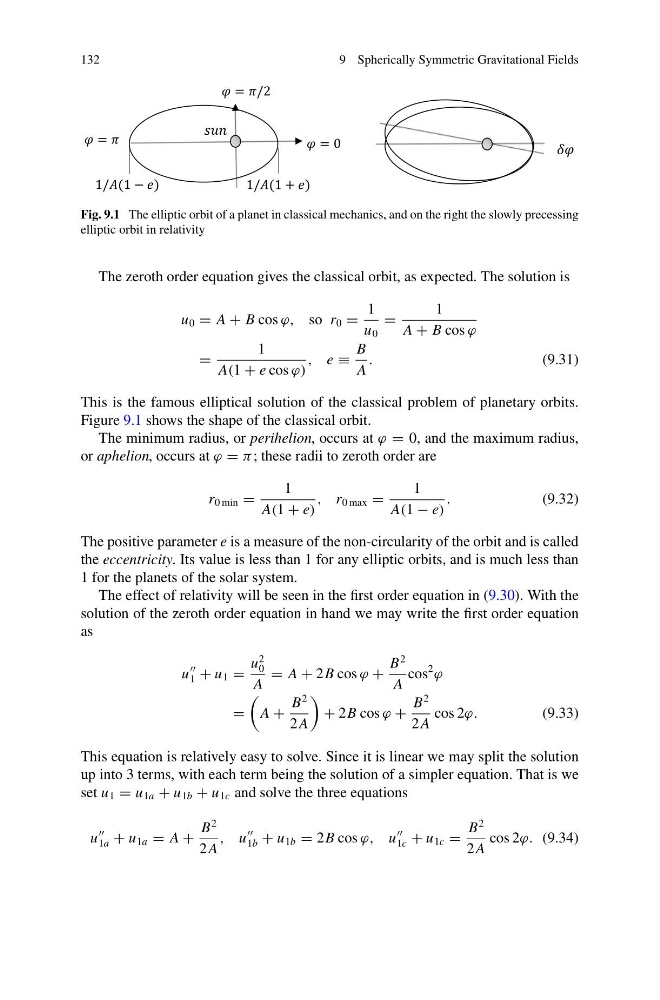
Fig. 9.1 The elliptic orbit of a planet in classical mechanics, and on the right the slowly precessing
elliptic orbit in relativity
The zeroth order equation gives the classical orbit, as expected. The solution is
u 0 = A + B cos ϕ, so r 0 =
1
u 0
=
1
A + B cos ϕ
=
1
A(1 + e cos ϕ)
, e ≡
B
A
.
(9.31)
This is the famous elliptical solution of the classical problem of planetary orbits.
Figure 9.1 shows the shape of the classical orbit.
The minimum radius, or perihelion, occurs at ϕ = 0, and the maximum radius,
or aphelion, occurs at ϕ = π ; these radii to zeroth order are
r 0 min =
1
A(1 + e)
, r 0 max =
1
A(1 − e)
.
(9.32)
The positive parameter e is a measure of the non-circularity of the orbit and is called
the eccentricity. Its value is less than 1 for any elliptic orbits, and is much less than
1 for the planets of the solar system.
The effect of relativity will be seen in the first order equation in (9.30). With the
solution of the zeroth order equation in hand we may write the first order equation
as
u
1 + u 1 =
u
2
0
A
= A + 2B cos ϕ +
B
2
A
cos
2
ϕ
=
A +
B
2
2 A
+ 2B cos ϕ +
B
2
2 A
cos 2ϕ.
(9.33)
This equation is relatively easy to solve. Since it is linear we may split the solution
up into 3 terms, with each term being the solution of a simpler equation. That is we
set u 1 = u 1a + u 1b + u 1c and solve the three equations
u
1a + u 1a = A +
B
2
2 A
, u
1b + u 1b = 2B cos ϕ, u
1c + u 1c =
B
2
2 A
cos 2ϕ. (9.34)
9 Spherically Symmetric Gravitational Fields
Fig. 9.1 The elliptic orbit of a planet in classical mechanics, and on the right the slowly precessing
elliptic orbit in relativity
The zeroth order equation gives the classical orbit, as expected. The solution is
u 0 = A + B cos ϕ, so r 0 =
1
u 0
=
1
A + B cos ϕ
=
1
A(1 + e cos ϕ)
, e ≡
B
A
.
(9.31)
This is the famous elliptical solution of the classical problem of planetary orbits.
Figure 9.1 shows the shape of the classical orbit.
The minimum radius, or perihelion, occurs at ϕ = 0, and the maximum radius,
or aphelion, occurs at ϕ = π ; these radii to zeroth order are
r 0 min =
1
A(1 + e)
, r 0 max =
1
A(1 − e)
.
(9.32)
The positive parameter e is a measure of the non-circularity of the orbit and is called
the eccentricity. Its value is less than 1 for any elliptic orbits, and is much less than
1 for the planets of the solar system.
The effect of relativity will be seen in the first order equation in (9.30). With the
solution of the zeroth order equation in hand we may write the first order equation
as
u
1 + u 1 =
u
2
0
A
= A + 2B cos ϕ +
B
2
A
cos
2
ϕ
=
A +
B
2
2 A
+ 2B cos ϕ +
B
2
2 A
cos 2ϕ.
(9.33)
This equation is relatively easy to solve. Since it is linear we may split the solution
up into 3 terms, with each term being the solution of a simpler equation. That is we
set u 1 = u 1a + u 1b + u 1c and solve the three equations
u
1a + u 1a = A +
B
2
2 A
, u
1b + u 1b = 2B cos ϕ, u
1c + u 1c =
B
2
2 A
cos 2ϕ. (9.34)