

8.4 The Non-vacuum Field Equations
119
T
αβ
= ρu
α u
β
, u
β
=
dx
α
ds
velocity along flow lines in dust fluid.
(8.39)
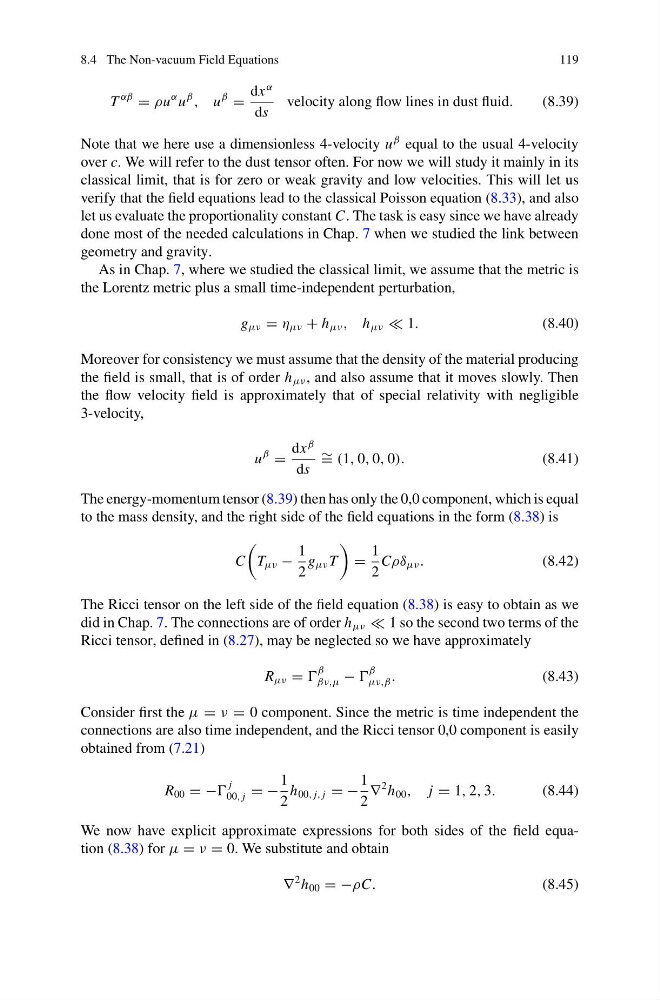
Note that we here use a dimensionless 4-velocity u
β equal to the usual 4-velocity
over c. We will refer to the dust tensor often. For now we will study it mainly in its
classical limit, that is for zero or weak gravity and low velocities. This will let us
verify that the field equations lead to the classical Poisson equation (8.33), and also
let us evaluate the proportionality constant C. The task is easy since we have already
done most of the needed calculations in Chap. 7 when we studied the link between
geometry and gravity.
As in Chap. 7, where we studied the classical limit, we assume that the metric is
the Lorentz metric plus a small time-independent perturbation,
g μν = η μν + h μν , h μν 1.
(8.40)
Moreover for consistency we must assume that the density of the material producing
the field is small, that is of order h μν , and also assume that it moves slowly. Then
the flow velocity field is approximately that of special relativity with negligible
3-velocity,
u
β
=
dx
β
ds
∼ = (1, 0, 0, 0).
(8.41)
The energy-momentum tensor (8.39) then has only the 0,0 component, which is equal
to the mass density, and the right side of the field equations in the form (8.38) is
C
T μν −
1
2
g μν T
=
1
2
Cρδ μν .
(8.42)
The Ricci tensor on the left side of the field equation (8.38) is easy to obtain as we
did in Chap. 7. The connections are of order h μν 1 so the second two terms of the
Ricci tensor, defined in (8.27), may be neglected so we have approximately
R μν =
β
βν,μ −
β
μν,β .
(8.43)
Consider first the μ = ν = 0 component. Since the metric is time independent the
connections are also time independent, and the Ricci tensor 0,0 component is easily
obtained from (7.21)
R 00 = −
j
00, j = −
1
2
h 00, j, j = −
1
2
∇
2 h 00 , j = 1, 2, 3.
(8.44)
We now have explicit approximate expressions for both sides of the field equation (8.38) for μ = ν = 0. We substitute and obtain
∇
2 h 00 = −ρC.
(8.45)
119
T
αβ
= ρu
α u
β
, u
β
=
dx
α
ds
velocity along flow lines in dust fluid.
(8.39)
Note that we here use a dimensionless 4-velocity u
β equal to the usual 4-velocity
over c. We will refer to the dust tensor often. For now we will study it mainly in its
classical limit, that is for zero or weak gravity and low velocities. This will let us
verify that the field equations lead to the classical Poisson equation (8.33), and also
let us evaluate the proportionality constant C. The task is easy since we have already
done most of the needed calculations in Chap. 7 when we studied the link between
geometry and gravity.
As in Chap. 7, where we studied the classical limit, we assume that the metric is
the Lorentz metric plus a small time-independent perturbation,
g μν = η μν + h μν , h μν 1.
(8.40)
Moreover for consistency we must assume that the density of the material producing
the field is small, that is of order h μν , and also assume that it moves slowly. Then
the flow velocity field is approximately that of special relativity with negligible
3-velocity,
u
β
=
dx
β
ds
∼ = (1, 0, 0, 0).
(8.41)
The energy-momentum tensor (8.39) then has only the 0,0 component, which is equal
to the mass density, and the right side of the field equations in the form (8.38) is
C
T μν −
1
2
g μν T
=
1
2
Cρδ μν .
(8.42)
The Ricci tensor on the left side of the field equation (8.38) is easy to obtain as we
did in Chap. 7. The connections are of order h μν 1 so the second two terms of the
Ricci tensor, defined in (8.27), may be neglected so we have approximately
R μν =
β
βν,μ −
β
μν,β .
(8.43)
Consider first the μ = ν = 0 component. Since the metric is time independent the
connections are also time independent, and the Ricci tensor 0,0 component is easily
obtained from (7.21)
R 00 = −
j
00, j = −
1
2
h 00, j, j = −
1
2
∇
2 h 00 , j = 1, 2, 3.
(8.44)
We now have explicit approximate expressions for both sides of the field equation (8.38) for μ = ν = 0. We substitute and obtain
∇
2 h 00 = −ρC.
(8.45)