

118
8 Curved Space and Gravity
T
μν ;ν = 0.
(8.35)
Of course the theory has been set up so that this must be true, and later in this section
and in Part IV we will study the energy-momentum tensor of a fluid to see what the
divergence condition means physically.
Before we further consider the physical meaning of the energy-momentum tensor
let us do a bit of tensor algebra and write the field equations (8.34) in yet another
equivalent way that will prove useful in finding the classical limit. We write the
Einstein tensor according to its definition (8.31) in terms of the Ricci tensor and
substitute it into the field equations (8.34) to get the field equations explicitly in
terms of the Ricci tensor,
G
μν
= R
μν
−
1
2
g
μν R = CT
μν
.
(8.36)
Next we contract this to find a relation between the Riemann scalar and the contracted
energy-momentum tensor T = T
ν ν
R
ν ν −
1
2
g
ν ν R = R − 2R = −R = CT.
(8.37)
From this we may write the field equation (8.36) in terms of the Ricci tensor rather
than the Einstein tensor,
R μν = C
T μν −
1
2
g μν T
.
(8.38)
We may use either the Einstein tensor or the Ricci tensor in writing the field equations,
depending on convenience. The above form (8.38) will be useful in the next section.
In practice there are a number of ways to obtain the energy-momentum tensor of
a given type of material. In this section we will consider only the simplest, that for
an idealized material that is often called “dust.” In Part IV we will discuss a more
general fluid describing the contents of the universe on a large scale.
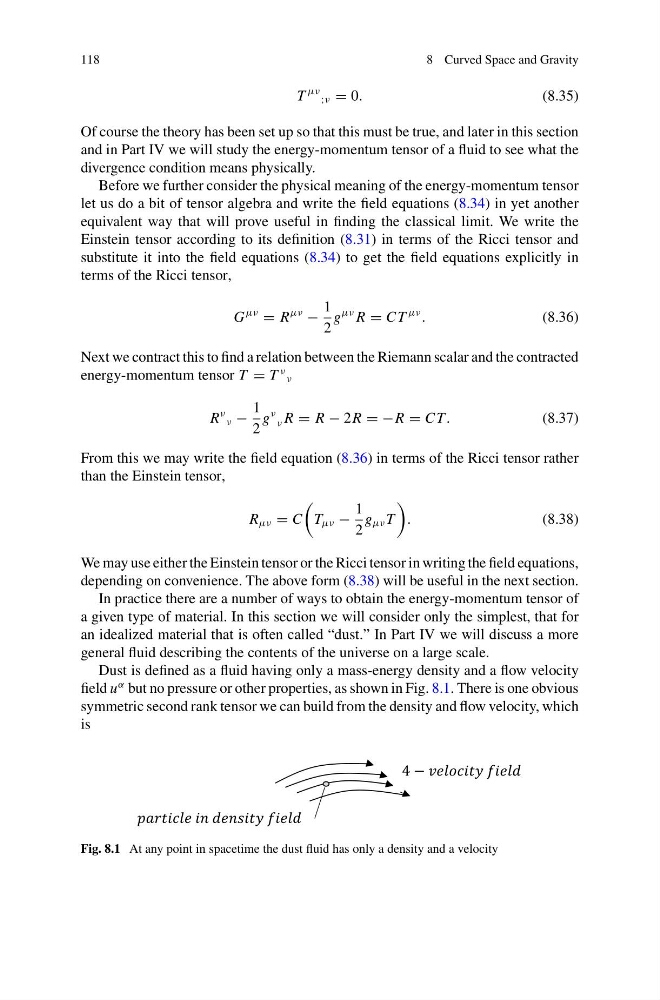
Dust is defined as a fluid having only a mass-energy density and a flow velocity
field u
α but no pressure or other properties, as shown in Fig. 8.1. There is one obvious
symmetric second rank tensor we can build from the density and flow velocity, which
is
Fig. 8.1 At any point in spacetime the dust fluid has only a density and a velocity
8 Curved Space and Gravity
T
μν ;ν = 0.
(8.35)
Of course the theory has been set up so that this must be true, and later in this section
and in Part IV we will study the energy-momentum tensor of a fluid to see what the
divergence condition means physically.
Before we further consider the physical meaning of the energy-momentum tensor
let us do a bit of tensor algebra and write the field equations (8.34) in yet another
equivalent way that will prove useful in finding the classical limit. We write the
Einstein tensor according to its definition (8.31) in terms of the Ricci tensor and
substitute it into the field equations (8.34) to get the field equations explicitly in
terms of the Ricci tensor,
G
μν
= R
μν
−
1
2
g
μν R = CT
μν
.
(8.36)
Next we contract this to find a relation between the Riemann scalar and the contracted
energy-momentum tensor T = T
ν ν
R
ν ν −
1
2
g
ν ν R = R − 2R = −R = CT.
(8.37)
From this we may write the field equation (8.36) in terms of the Ricci tensor rather
than the Einstein tensor,
R μν = C
T μν −
1
2
g μν T
.
(8.38)
We may use either the Einstein tensor or the Ricci tensor in writing the field equations,
depending on convenience. The above form (8.38) will be useful in the next section.
In practice there are a number of ways to obtain the energy-momentum tensor of
a given type of material. In this section we will consider only the simplest, that for
an idealized material that is often called “dust.” In Part IV we will discuss a more
general fluid describing the contents of the universe on a large scale.
Dust is defined as a fluid having only a mass-energy density and a flow velocity
field u
α but no pressure or other properties, as shown in Fig. 8.1. There is one obvious
symmetric second rank tensor we can build from the density and flow velocity, which
is
Fig. 8.1 At any point in spacetime the dust fluid has only a density and a velocity