

104
7 Classical Gravity and Geometry
This is a more accurate and justified version of (7.13). It is worth pondering for a
moment. It says that within the approximation framework that we have set up the
gravitational force is represented by connections, analogous to the fictitious forces
of classical mechanics. To make this correspondence it was necessary to use the
4-dimensions of spacetime in special relativity. Equation (7.20) clearly shows how
the ideas of geometry and classical forces and accelerations are related, and that the
motion is independent of the mass of the body.
To finish our task and relate the geometric view to the classical potential we need
only evaluate the connections in (7.20). We find from their definition
i
00 =
1
2
η
ik
(h 0k,0 + h k0,0 − h 00,k ) =
1
2
h 00,i ,
i
0 j =
1
2
η
ik
(h 0k, j + h k j,0 − h 0 j,k ) = 0,
(7.21)
where we have used the time independence and the diagonal nature of the metric (see
Exercises 7.8 and 7.9). We finally bring everything together and substitute (7.21) into
(7.20) to obtain
d
2 x
i
dt 2 = −
1
2
c
2 h 00,i .
(7.22)
This is a wonderful result. It is identical to the classical equation (7.10) if we identify
φ ,i =
1
2
c
2 h 00,i , so that g 00 = 1 + h 00 = 1 +
2φ
c 2 .
(7.23)
Therefore, in summary, we get classical gravitational theory as the weak field and low
velocity limit of a geometric theory provided that the g 00 component of the metric
is related to the classical potential by (7.23). We emphasize that it is the time part
of the metric that is important and the other components of the metric play a lesser
role in this correspondence. See Exercises 7.8 and 7.9 for further comments on an
analysis to higher order.
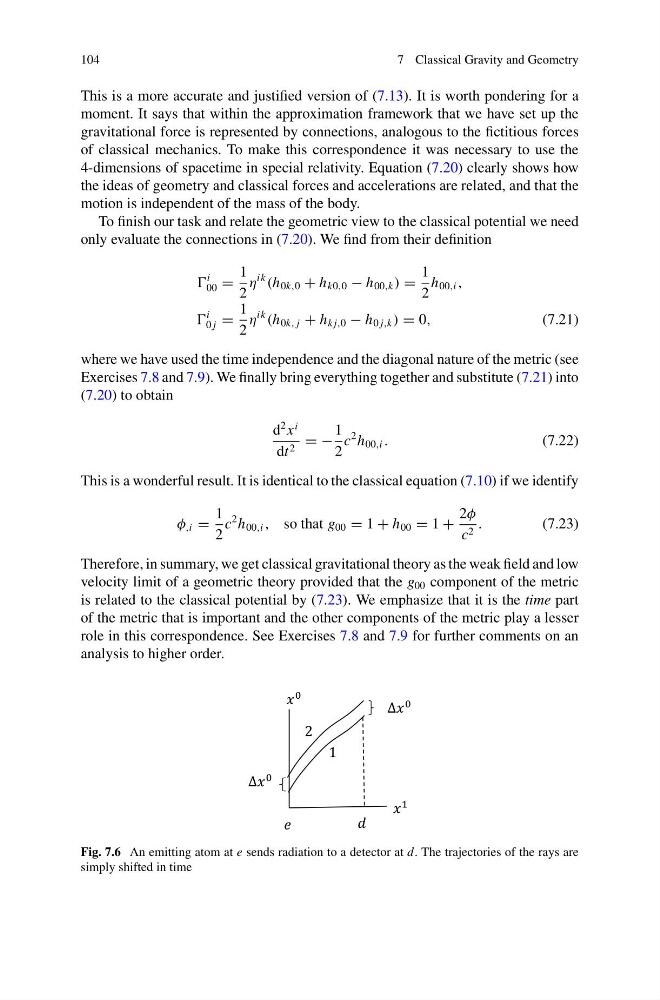
Fig. 7.6 An emitting atom at e sends radiation to a detector at d. The trajectories of the rays are
simply shifted in time
7 Classical Gravity and Geometry
This is a more accurate and justified version of (7.13). It is worth pondering for a
moment. It says that within the approximation framework that we have set up the
gravitational force is represented by connections, analogous to the fictitious forces
of classical mechanics. To make this correspondence it was necessary to use the
4-dimensions of spacetime in special relativity. Equation (7.20) clearly shows how
the ideas of geometry and classical forces and accelerations are related, and that the
motion is independent of the mass of the body.
To finish our task and relate the geometric view to the classical potential we need
only evaluate the connections in (7.20). We find from their definition
i
00 =
1
2
η
ik
(h 0k,0 + h k0,0 − h 00,k ) =
1
2
h 00,i ,
i
0 j =
1
2
η
ik
(h 0k, j + h k j,0 − h 0 j,k ) = 0,
(7.21)
where we have used the time independence and the diagonal nature of the metric (see
Exercises 7.8 and 7.9). We finally bring everything together and substitute (7.21) into
(7.20) to obtain
d
2 x
i
dt 2 = −
1
2
c
2 h 00,i .
(7.22)
This is a wonderful result. It is identical to the classical equation (7.10) if we identify
φ ,i =
1
2
c
2 h 00,i , so that g 00 = 1 + h 00 = 1 +
2φ
c 2 .
(7.23)
Therefore, in summary, we get classical gravitational theory as the weak field and low
velocity limit of a geometric theory provided that the g 00 component of the metric
is related to the classical potential by (7.23). We emphasize that it is the time part
of the metric that is important and the other components of the metric play a lesser
role in this correspondence. See Exercises 7.8 and 7.9 for further comments on an
analysis to higher order.
Fig. 7.6 An emitting atom at e sends radiation to a detector at d. The trajectories of the rays are
simply shifted in time