

7.3 Gravity as a Geometric Phenomenon
103
The h μν represents a weak gravitational field.
(2) We take h μν to be time independent or very slowly varying, and also diagonal
as we will justify in a later section (see also Exercise 7.9).
(3) The 3-velocity of all bodies considered is small, that is β 1.
(4) We assume the equation of motion for a body is the geodesic equation because
a geodesic is the only privileged curve in a metric space.
In the geodesic equation
¨
x
μ
+
μ
αβ ˙
x
α
˙
x
β
= 0
(7.15)
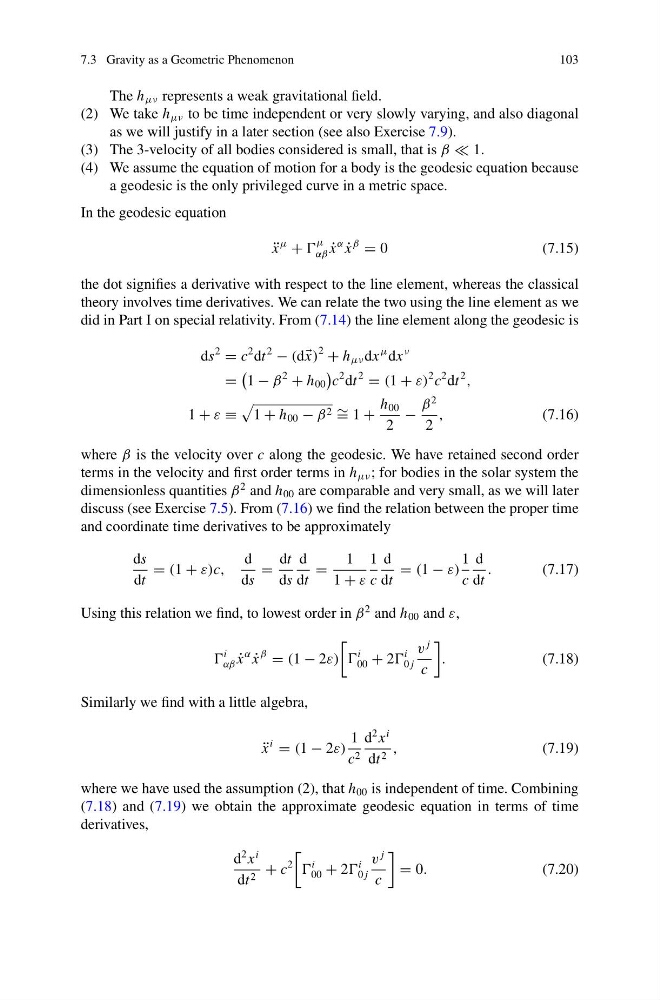
the dot signifies a derivative with respect to the line element, whereas the classical
theory involves time derivatives. We can relate the two using the line element as we
did in Part I on special relativity. From (7.14) the line element along the geodesic is
ds
2
= c
2 dt
2
− (d x)
2 + h μν dx
μ dx
ν
=
1 − β
2
+ h 00
c
2 dt
2
= (1 + ε)
2 c
2 dt
2
,
1 + ε ≡
1 + h 00 − β 2 ∼ = 1 +
h 00
2
−
β
2
2
,
(7.16)
where β is the velocity over c along the geodesic. We have retained second order
terms in the velocity and first order terms in h μν ; for bodies in the solar system the
dimensionless quantities β
2 and h 00 are comparable and very small, as we will later
discuss (see Exercise 7.5). From (7.16) we find the relation between the proper time
and coordinate time derivatives to be approximately
ds
dt
= (1 + ε)c,
d
ds
=
dt
ds
d
dt
=
1
1 + ε
1
c
d
dt
= (1 − ε)
1
c
d
dt
.
(7.17)
Using this relation we find, to lowest order in β
2 and h 00 and ε,
i
αβ ˙
x
α
˙
x
β
= (1 − 2ε)
i
00 + 2
i
0 j
v
j
c
.
(7.18)
Similarly we find with a little algebra,
¨
x
i
= (1 − 2ε)
1
c 2
d
2 x
i
dt 2 ,
(7.19)
where we have used the assumption (2), that h 00 is independent of time. Combining
(7.18) and (7.19) we obtain the approximate geodesic equation in terms of time
derivatives,
d
2 x
i
dt 2 + c
2
i
00 + 2
i
0 j
v
j
c
= 0.
(7.20)
103
The h μν represents a weak gravitational field.
(2) We take h μν to be time independent or very slowly varying, and also diagonal
as we will justify in a later section (see also Exercise 7.9).
(3) The 3-velocity of all bodies considered is small, that is β 1.
(4) We assume the equation of motion for a body is the geodesic equation because
a geodesic is the only privileged curve in a metric space.
In the geodesic equation
¨
x
μ
+
μ
αβ ˙
x
α
˙
x
β
= 0
(7.15)
the dot signifies a derivative with respect to the line element, whereas the classical
theory involves time derivatives. We can relate the two using the line element as we
did in Part I on special relativity. From (7.14) the line element along the geodesic is
ds
2
= c
2 dt
2
− (d x)
2 + h μν dx
μ dx
ν
=
1 − β
2
+ h 00
c
2 dt
2
= (1 + ε)
2 c
2 dt
2
,
1 + ε ≡
1 + h 00 − β 2 ∼ = 1 +
h 00
2
−
β
2
2
,
(7.16)
where β is the velocity over c along the geodesic. We have retained second order
terms in the velocity and first order terms in h μν ; for bodies in the solar system the
dimensionless quantities β
2 and h 00 are comparable and very small, as we will later
discuss (see Exercise 7.5). From (7.16) we find the relation between the proper time
and coordinate time derivatives to be approximately
ds
dt
= (1 + ε)c,
d
ds
=
dt
ds
d
dt
=
1
1 + ε
1
c
d
dt
= (1 − ε)
1
c
d
dt
.
(7.17)
Using this relation we find, to lowest order in β
2 and h 00 and ε,
i
αβ ˙
x
α
˙
x
β
= (1 − 2ε)
i
00 + 2
i
0 j
v
j
c
.
(7.18)
Similarly we find with a little algebra,
¨
x
i
= (1 − 2ε)
1
c 2
d
2 x
i
dt 2 ,
(7.19)
where we have used the assumption (2), that h 00 is independent of time. Combining
(7.18) and (7.19) we obtain the approximate geodesic equation in terms of time
derivatives,
d
2 x
i
dt 2 + c
2
i
00 + 2
i
0 j
v
j
c
= 0.
(7.20)