

170
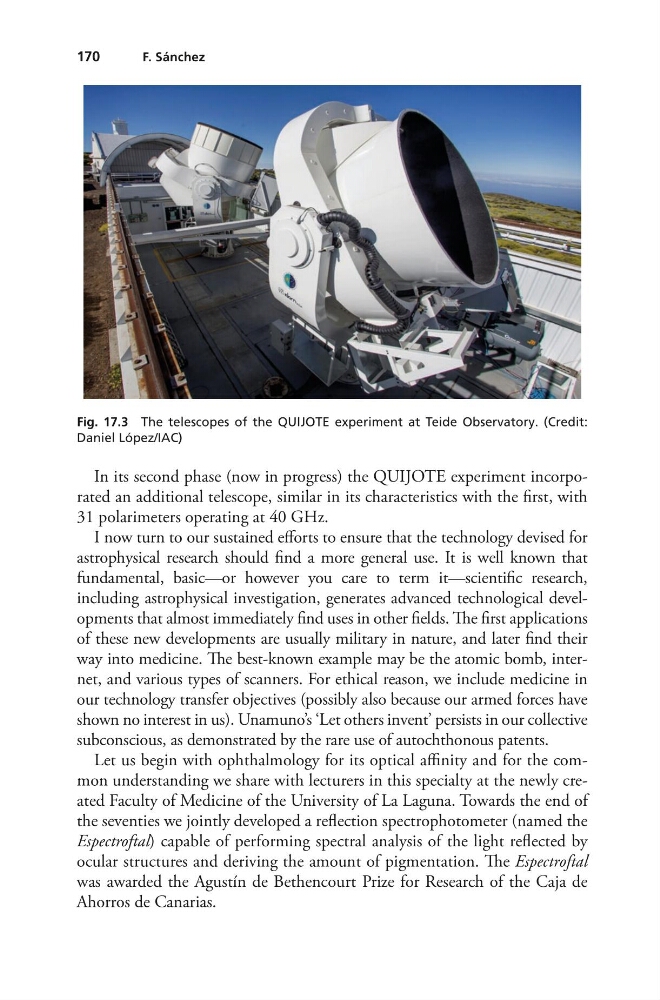
In its second phase (now in progress) the QUIJOTE experiment incorporated an additional telescope, similar in its characteristics with the first, with
31 polarimeters operating at 40 GHz.
I now turn to our sustained efforts to ensure that the technology devised for
astrophysical research should find a more general use. It is well known that
fundamental, basic—or however you care to term it—scientific research,
including astrophysical investigation, generates advanced technological developments that almost immediately find uses in other fields. The first applications
of these new developments are usually military in nature, and later find their
way into medicine. The best-known example may be the atomic bomb, internet, and various types of scanners. For ethical reason, we include medicine in
our technology transfer objectives (possibly also because our armed forces have
shown no interest in us). Unamuno’s ‘Let others invent’ persists in our collective
subconscious, as demonstrated by the rare use of autochthonous patents.
Let us begin with ophthalmology for its optical affinity and for the common understanding we share with lecturers in this specialty at the newly created Faculty of Medicine of the University of La Laguna. Towards the end of
the seventies we jointly developed a reflection spectrophotometer (named the
Espectroftal) capable of performing spectral analysis of the light reflected by
ocular structures and deriving the amount of pigmentation. The Espectroftal
was awarded the Agustín de Bethencourt Prize for Research of the Caja de
Ahorros de Canarias.
Fig. 17.3 The telescopes of the QUIJOTE experiment at Teide Observatory. (Credit:
Daniel López/IAC)
F. Sánchez
In its second phase (now in progress) the QUIJOTE experiment incorporated an additional telescope, similar in its characteristics with the first, with
31 polarimeters operating at 40 GHz.
I now turn to our sustained efforts to ensure that the technology devised for
astrophysical research should find a more general use. It is well known that
fundamental, basic—or however you care to term it—scientific research,
including astrophysical investigation, generates advanced technological developments that almost immediately find uses in other fields. The first applications
of these new developments are usually military in nature, and later find their
way into medicine. The best-known example may be the atomic bomb, internet, and various types of scanners. For ethical reason, we include medicine in
our technology transfer objectives (possibly also because our armed forces have
shown no interest in us). Unamuno’s ‘Let others invent’ persists in our collective
subconscious, as demonstrated by the rare use of autochthonous patents.
Let us begin with ophthalmology for its optical affinity and for the common understanding we share with lecturers in this specialty at the newly created Faculty of Medicine of the University of La Laguna. Towards the end of
the seventies we jointly developed a reflection spectrophotometer (named the
Espectroftal) capable of performing spectral analysis of the light reflected by
ocular structures and deriving the amount of pigmentation. The Espectroftal
was awarded the Agustín de Bethencourt Prize for Research of the Caja de
Ahorros de Canarias.
Fig. 17.3 The telescopes of the QUIJOTE experiment at Teide Observatory. (Credit:
Daniel López/IAC)
F. Sánchez