

3 The Measurements of the Oxygen Reduction Reaction
79
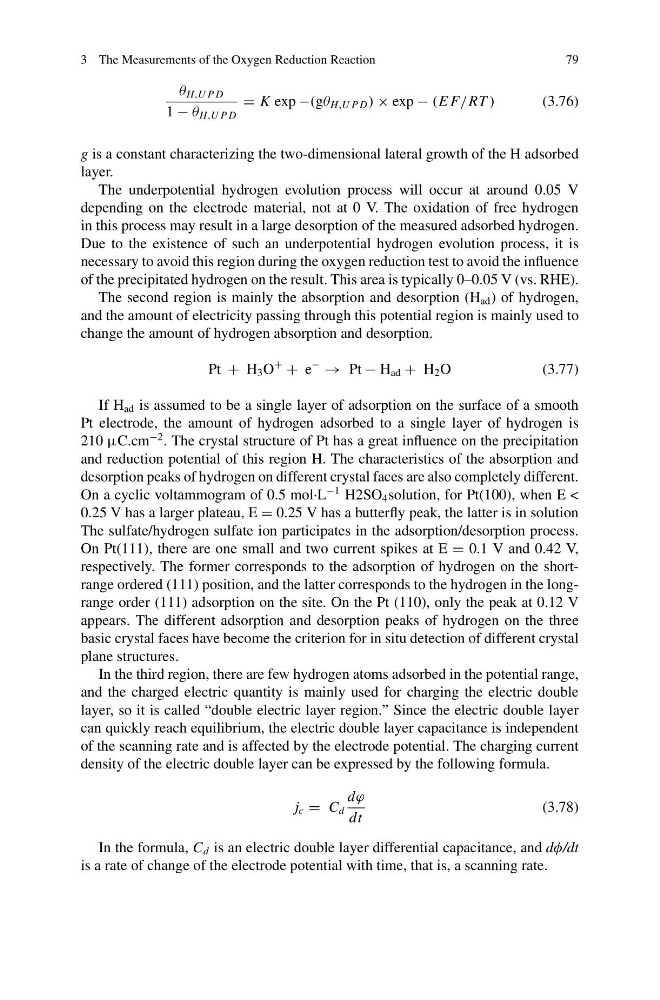
θ H,U P D
1 − θ H,U P D
= K exp −(gθ H,U P D ) × exp − (E F/RT )
(3.76)
g is a constant characterizing the two-dimensional lateral growth of the H adsorbed
layer.
The underpotential hydrogen evolution process will occur at around 0.05 V
depending on the electrode material, not at 0 V. The oxidation of free hydrogen
in this process may result in a large desorption of the measured adsorbed hydrogen.
Due to the existence of such an underpotential hydrogen evolution process, it is
necessary to avoid this region during the oxygen reduction test to avoid the influence
of the precipitated hydrogen on the result. This area is typically 0–0.05 V (vs. RHE).
The second region is mainly the absorption and desorption (H ad ) of hydrogen,
and the amount of electricity passing through this potential region is mainly used to
change the amount of hydrogen absorption and desorption.
Pt + H 3 O
+
+ e
−
→ Pt − H ad + H 2 O
(3.77)
If H ad is assumed to be a single layer of adsorption on the surface of a smooth
Pt electrode, the amount of hydrogen adsorbed to a single layer of hydrogen is
210 μC.cm
−2 . The crystal structure of Pt has a great influence on the precipitation
and reduction potential of this region H. The characteristics of the absorption and
desorption peaks of hydrogen on different crystal faces are also completely different.
On a cyclic voltammogram of 0.5 mol·L
−1 H2SO 4 solution, for Pt(100), when E <
0.25 V has a larger plateau, E = 0.25 V has a butterfly peak, the latter is in solution
The sulfate/hydrogen sulfate ion participates in the adsorption/desorption process.
On Pt(111), there are one small and two current spikes at E = 0.1 V and 0.42 V,
respectively. The former corresponds to the adsorption of hydrogen on the shortrange ordered (111) position, and the latter corresponds to the hydrogen in the longrange order (111) adsorption on the site. On the Pt (110), only the peak at 0.12 V
appears. The different adsorption and desorption peaks of hydrogen on the three
basic crystal faces have become the criterion for in situ detection of different crystal
plane structures.
In the third region, there are few hydrogen atoms adsorbed in the potential range,
and the charged electric quantity is mainly used for charging the electric double
layer, so it is called “double electric layer region.” Since the electric double layer
can quickly reach equilibrium, the electric double layer capacitance is independent
of the scanning rate and is affected by the electrode potential. The charging current
density of the electric double layer can be expressed by the following formula.
j c = C d
dϕ
dt
(3.78)
In the formula, C d is an electric double layer differential capacitance, and dφ/dt
is a rate of change of the electrode potential with time, that is, a scanning rate.
79
θ H,U P D
1 − θ H,U P D
= K exp −(gθ H,U P D ) × exp − (E F/RT )
(3.76)
g is a constant characterizing the two-dimensional lateral growth of the H adsorbed
layer.
The underpotential hydrogen evolution process will occur at around 0.05 V
depending on the electrode material, not at 0 V. The oxidation of free hydrogen
in this process may result in a large desorption of the measured adsorbed hydrogen.
Due to the existence of such an underpotential hydrogen evolution process, it is
necessary to avoid this region during the oxygen reduction test to avoid the influence
of the precipitated hydrogen on the result. This area is typically 0–0.05 V (vs. RHE).
The second region is mainly the absorption and desorption (H ad ) of hydrogen,
and the amount of electricity passing through this potential region is mainly used to
change the amount of hydrogen absorption and desorption.
Pt + H 3 O
+
+ e
−
→ Pt − H ad + H 2 O
(3.77)
If H ad is assumed to be a single layer of adsorption on the surface of a smooth
Pt electrode, the amount of hydrogen adsorbed to a single layer of hydrogen is
210 μC.cm
−2 . The crystal structure of Pt has a great influence on the precipitation
and reduction potential of this region H. The characteristics of the absorption and
desorption peaks of hydrogen on different crystal faces are also completely different.
On a cyclic voltammogram of 0.5 mol·L
−1 H2SO 4 solution, for Pt(100), when E <
0.25 V has a larger plateau, E = 0.25 V has a butterfly peak, the latter is in solution
The sulfate/hydrogen sulfate ion participates in the adsorption/desorption process.
On Pt(111), there are one small and two current spikes at E = 0.1 V and 0.42 V,
respectively. The former corresponds to the adsorption of hydrogen on the shortrange ordered (111) position, and the latter corresponds to the hydrogen in the longrange order (111) adsorption on the site. On the Pt (110), only the peak at 0.12 V
appears. The different adsorption and desorption peaks of hydrogen on the three
basic crystal faces have become the criterion for in situ detection of different crystal
plane structures.
In the third region, there are few hydrogen atoms adsorbed in the potential range,
and the charged electric quantity is mainly used for charging the electric double
layer, so it is called “double electric layer region.” Since the electric double layer
can quickly reach equilibrium, the electric double layer capacitance is independent
of the scanning rate and is affected by the electrode potential. The charging current
density of the electric double layer can be expressed by the following formula.
j c = C d
dϕ
dt
(3.78)
In the formula, C d is an electric double layer differential capacitance, and dφ/dt
is a rate of change of the electrode potential with time, that is, a scanning rate.