

3 The Measurements of the Oxygen Reduction Reaction
61
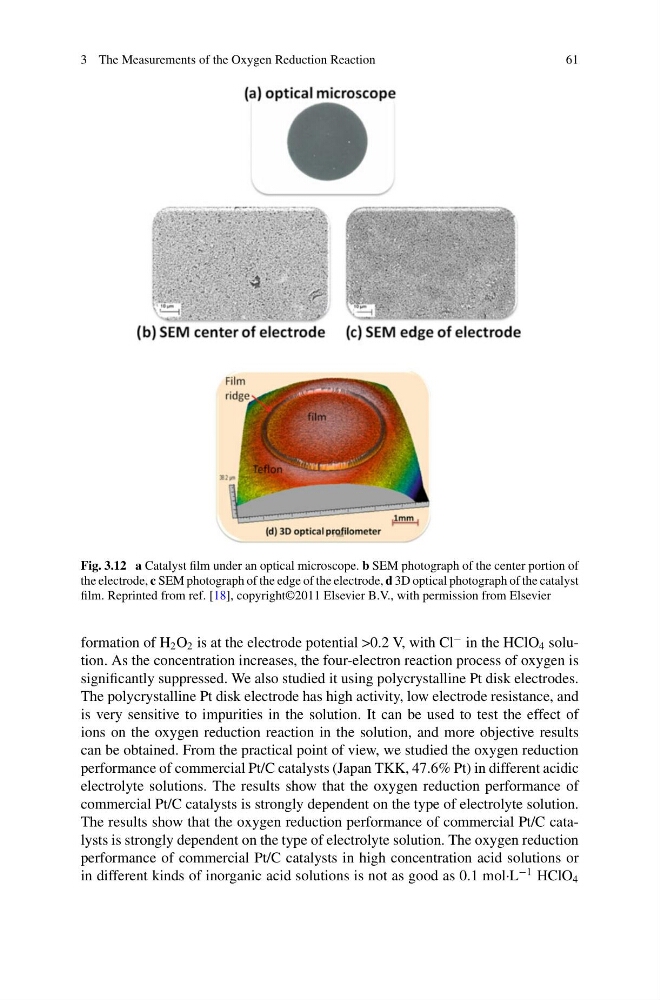
Fig. 3.12 a Catalyst film under an optical microscope. b SEM photograph of the center portion of
the electrode, c SEM photograph of the edge of the electrode, d 3D optical photograph of the catalyst
film. Reprinted from ref. [18], copyright©2011 Elsevier B.V., with permission from Elsevier
formation of H 2 O 2 is at the electrode potential >0.2 V, with Cl
− in the HClO 4 solution. As the concentration increases, the four-electron reaction process of oxygen is
significantly suppressed. We also studied it using polycrystalline Pt disk electrodes.
The polycrystalline Pt disk electrode has high activity, low electrode resistance, and
is very sensitive to impurities in the solution. It can be used to test the effect of
ions on the oxygen reduction reaction in the solution, and more objective results
can be obtained. From the practical point of view, we studied the oxygen reduction
performance of commercial Pt/C catalysts (Japan TKK, 47.6% Pt) in different acidic
electrolyte solutions. The results show that the oxygen reduction performance of
commercial Pt/C catalysts is strongly dependent on the type of electrolyte solution.
The results show that the oxygen reduction performance of commercial Pt/C catalysts is strongly dependent on the type of electrolyte solution. The oxygen reduction
performance of commercial Pt/C catalysts in high concentration acid solutions or
in different kinds of inorganic acid solutions is not as good as 0.1 mol·L
−1 HClO 4
61
Fig. 3.12 a Catalyst film under an optical microscope. b SEM photograph of the center portion of
the electrode, c SEM photograph of the edge of the electrode, d 3D optical photograph of the catalyst
film. Reprinted from ref. [18], copyright©2011 Elsevier B.V., with permission from Elsevier
formation of H 2 O 2 is at the electrode potential >0.2 V, with Cl
− in the HClO 4 solution. As the concentration increases, the four-electron reaction process of oxygen is
significantly suppressed. We also studied it using polycrystalline Pt disk electrodes.
The polycrystalline Pt disk electrode has high activity, low electrode resistance, and
is very sensitive to impurities in the solution. It can be used to test the effect of
ions on the oxygen reduction reaction in the solution, and more objective results
can be obtained. From the practical point of view, we studied the oxygen reduction
performance of commercial Pt/C catalysts (Japan TKK, 47.6% Pt) in different acidic
electrolyte solutions. The results show that the oxygen reduction performance of
commercial Pt/C catalysts is strongly dependent on the type of electrolyte solution.
The results show that the oxygen reduction performance of commercial Pt/C catalysts is strongly dependent on the type of electrolyte solution. The oxygen reduction
performance of commercial Pt/C catalysts in high concentration acid solutions or
in different kinds of inorganic acid solutions is not as good as 0.1 mol·L
−1 HClO 4