

54
C. Juhong et al.
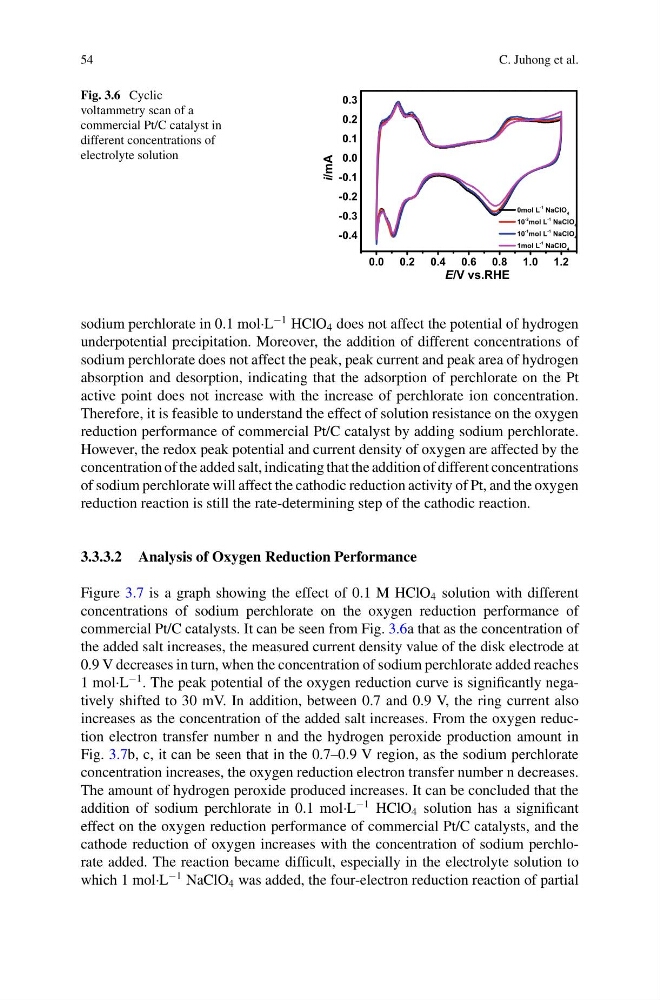
Fig. 3.6 Cyclic
voltammetry scan of a
commercial Pt/C catalyst in
different concentrations of
electrolyte solution
0.0 0.2 0.4 0.6 0.8 1.0 1.2
-0.4
-0.3
-0.2
-0.1
0.0
0.1
0.2
0.3
i/mA
E/V vs.RHE
0mol L -1 NaClO 4
10 -2 mol L -1 NaClO 4
10 -1 mol L -1 NaClO 4
1mol L -1 NaClO 4
sodium perchlorate in 0.1 mol·L
−1 HClO 4 does not affect the potential of hydrogen
underpotential precipitation. Moreover, the addition of different concentrations of
sodium perchlorate does not affect the peak, peak current and peak area of hydrogen
absorption and desorption, indicating that the adsorption of perchlorate on the Pt
active point does not increase with the increase of perchlorate ion concentration.
Therefore, it is feasible to understand the effect of solution resistance on the oxygen
reduction performance of commercial Pt/C catalyst by adding sodium perchlorate.
However, the redox peak potential and current density of oxygen are affected by the
concentration of the added salt, indicating that the addition of different concentrations
of sodium perchlorate will affect the cathodic reduction activity of Pt, and the oxygen
reduction reaction is still the rate-determining step of the cathodic reaction.
3.3.3.2 Analysis of Oxygen Reduction Performance
Figure 3.7 is a graph showing the effect of 0.1 M HClO 4 solution with different
concentrations of sodium perchlorate on the oxygen reduction performance of
commercial Pt/C catalysts. It can be seen from Fig. 3.6a that as the concentration of
the added salt increases, the measured current density value of the disk electrode at
0.9 V decreases in turn, when the concentration of sodium perchlorate added reaches
1 mol·L
−1 . The peak potential of the oxygen reduction curve is significantly negatively shifted to 30 mV. In addition, between 0.7 and 0.9 V, the ring current also
increases as the concentration of the added salt increases. From the oxygen reduction electron transfer number n and the hydrogen peroxide production amount in
Fig. 3.7b, c, it can be seen that in the 0.7–0.9 V region, as the sodium perchlorate
concentration increases, the oxygen reduction electron transfer number n decreases.
The amount of hydrogen peroxide produced increases. It can be concluded that the
addition of sodium perchlorate in 0.1 mol·L
−1 HClO 4 solution has a significant
effect on the oxygen reduction performance of commercial Pt/C catalysts, and the
cathode reduction of oxygen increases with the concentration of sodium perchlorate added. The reaction became difficult, especially in the electrolyte solution to
which 1 mol·L
−1 NaClO 4 was added, the four-electron reduction reaction of partial
C. Juhong et al.
Fig. 3.6 Cyclic
voltammetry scan of a
commercial Pt/C catalyst in
different concentrations of
electrolyte solution
0.0 0.2 0.4 0.6 0.8 1.0 1.2
-0.4
-0.3
-0.2
-0.1
0.0
0.1
0.2
0.3
i/mA
E/V vs.RHE
0mol L -1 NaClO 4
10 -2 mol L -1 NaClO 4
10 -1 mol L -1 NaClO 4
1mol L -1 NaClO 4
sodium perchlorate in 0.1 mol·L
−1 HClO 4 does not affect the potential of hydrogen
underpotential precipitation. Moreover, the addition of different concentrations of
sodium perchlorate does not affect the peak, peak current and peak area of hydrogen
absorption and desorption, indicating that the adsorption of perchlorate on the Pt
active point does not increase with the increase of perchlorate ion concentration.
Therefore, it is feasible to understand the effect of solution resistance on the oxygen
reduction performance of commercial Pt/C catalyst by adding sodium perchlorate.
However, the redox peak potential and current density of oxygen are affected by the
concentration of the added salt, indicating that the addition of different concentrations
of sodium perchlorate will affect the cathodic reduction activity of Pt, and the oxygen
reduction reaction is still the rate-determining step of the cathodic reaction.
3.3.3.2 Analysis of Oxygen Reduction Performance
Figure 3.7 is a graph showing the effect of 0.1 M HClO 4 solution with different
concentrations of sodium perchlorate on the oxygen reduction performance of
commercial Pt/C catalysts. It can be seen from Fig. 3.6a that as the concentration of
the added salt increases, the measured current density value of the disk electrode at
0.9 V decreases in turn, when the concentration of sodium perchlorate added reaches
1 mol·L
−1 . The peak potential of the oxygen reduction curve is significantly negatively shifted to 30 mV. In addition, between 0.7 and 0.9 V, the ring current also
increases as the concentration of the added salt increases. From the oxygen reduction electron transfer number n and the hydrogen peroxide production amount in
Fig. 3.7b, c, it can be seen that in the 0.7–0.9 V region, as the sodium perchlorate
concentration increases, the oxygen reduction electron transfer number n decreases.
The amount of hydrogen peroxide produced increases. It can be concluded that the
addition of sodium perchlorate in 0.1 mol·L
−1 HClO 4 solution has a significant
effect on the oxygen reduction performance of commercial Pt/C catalysts, and the
cathode reduction of oxygen increases with the concentration of sodium perchlorate added. The reaction became difficult, especially in the electrolyte solution to
which 1 mol·L
−1 NaClO 4 was added, the four-electron reduction reaction of partial