

250
J. Zhu et al.
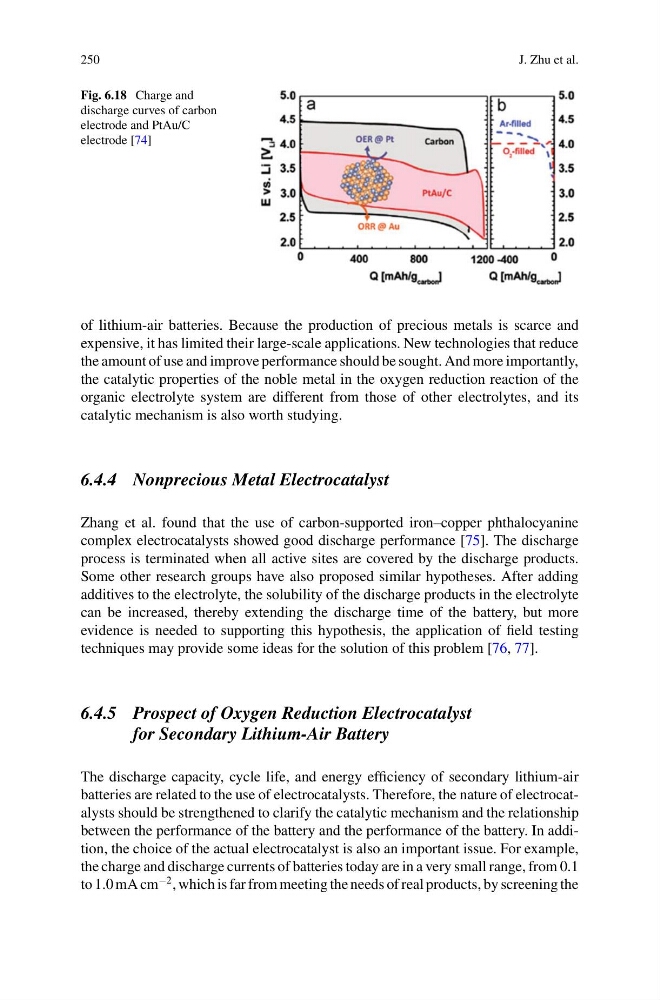
Fig. 6.18 Charge and
discharge curves of carbon
electrode and PtAu/C
electrode [74]
of lithium-air batteries. Because the production of precious metals is scarce and
expensive, it has limited their large-scale applications. New technologies that reduce
the amount of use and improve performance should be sought. And more importantly,
the catalytic properties of the noble metal in the oxygen reduction reaction of the
organic electrolyte system are different from those of other electrolytes, and its
catalytic mechanism is also worth studying.
6.4.4 Nonprecious Metal Electrocatalyst
Zhang et al. found that the use of carbon-supported iron–copper phthalocyanine
complex electrocatalysts showed good discharge performance [75]. The discharge
process is terminated when all active sites are covered by the discharge products.
Some other research groups have also proposed similar hypotheses. After adding
additives to the electrolyte, the solubility of the discharge products in the electrolyte
can be increased, thereby extending the discharge time of the battery, but more
evidence is needed to supporting this hypothesis, the application of field testing
techniques may provide some ideas for the solution of this problem [76, 77].
6.4.5 Prospect of Oxygen Reduction Electrocatalyst
for Secondary Lithium-Air Battery
The discharge capacity, cycle life, and energy efficiency of secondary lithium-air
batteries are related to the use of electrocatalysts. Therefore, the nature of electrocatalysts should be strengthened to clarify the catalytic mechanism and the relationship
between the performance of the battery and the performance of the battery. In addition, the choice of the actual electrocatalyst is also an important issue. For example,
the charge and discharge currents of batteries today are in a very small range, from 0.1
to 1.0 mA cm
−2 , which is far from meeting the needs of real products, by screening the
J. Zhu et al.
Fig. 6.18 Charge and
discharge curves of carbon
electrode and PtAu/C
electrode [74]
of lithium-air batteries. Because the production of precious metals is scarce and
expensive, it has limited their large-scale applications. New technologies that reduce
the amount of use and improve performance should be sought. And more importantly,
the catalytic properties of the noble metal in the oxygen reduction reaction of the
organic electrolyte system are different from those of other electrolytes, and its
catalytic mechanism is also worth studying.
6.4.4 Nonprecious Metal Electrocatalyst
Zhang et al. found that the use of carbon-supported iron–copper phthalocyanine
complex electrocatalysts showed good discharge performance [75]. The discharge
process is terminated when all active sites are covered by the discharge products.
Some other research groups have also proposed similar hypotheses. After adding
additives to the electrolyte, the solubility of the discharge products in the electrolyte
can be increased, thereby extending the discharge time of the battery, but more
evidence is needed to supporting this hypothesis, the application of field testing
techniques may provide some ideas for the solution of this problem [76, 77].
6.4.5 Prospect of Oxygen Reduction Electrocatalyst
for Secondary Lithium-Air Battery
The discharge capacity, cycle life, and energy efficiency of secondary lithium-air
batteries are related to the use of electrocatalysts. Therefore, the nature of electrocatalysts should be strengthened to clarify the catalytic mechanism and the relationship
between the performance of the battery and the performance of the battery. In addition, the choice of the actual electrocatalyst is also an important issue. For example,
the charge and discharge currents of batteries today are in a very small range, from 0.1
to 1.0 mA cm
−2 , which is far from meeting the needs of real products, by screening the