

16
Z. Zhao and P. K. Shen
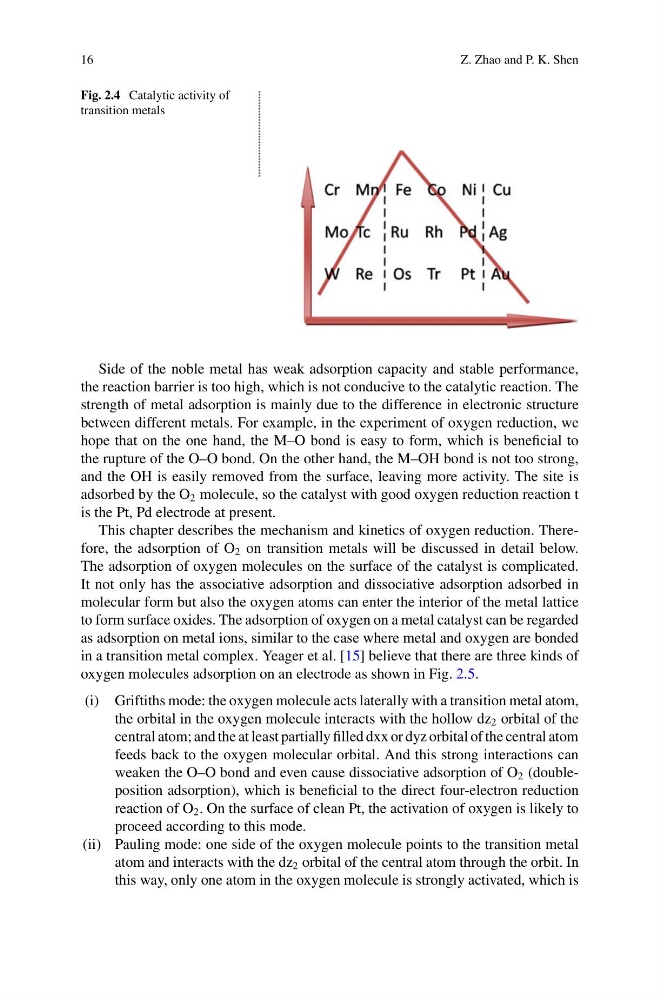
Fig. 2.4 Catalytic activity of
transition metals
Side of the noble metal has weak adsorption capacity and stable performance,
the reaction barrier is too high, which is not conducive to the catalytic reaction. The
strength of metal adsorption is mainly due to the difference in electronic structure
between different metals. For example, in the experiment of oxygen reduction, we
hope that on the one hand, the M–O bond is easy to form, which is beneficial to
the rupture of the O–O bond. On the other hand, the M–OH bond is not too strong,
and the OH is easily removed from the surface, leaving more activity. The site is
adsorbed by the O 2 molecule, so the catalyst with good oxygen reduction reaction t
is the Pt, Pd electrode at present.
This chapter describes the mechanism and kinetics of oxygen reduction. Therefore, the adsorption of O 2 on transition metals will be discussed in detail below.
The adsorption of oxygen molecules on the surface of the catalyst is complicated.
It not only has the associative adsorption and dissociative adsorption adsorbed in
molecular form but also the oxygen atoms can enter the interior of the metal lattice
to form surface oxides. The adsorption of oxygen on a metal catalyst can be regarded
as adsorption on metal ions, similar to the case where metal and oxygen are bonded
in a transition metal complex. Yeager et al. [15] believe that there are three kinds of
oxygen molecules adsorption on an electrode as shown in Fig. 2.5.
(i) Griftiths mode: the oxygen molecule acts laterally with a transition metal atom,
the orbital in the oxygen molecule interacts with the hollow dz 2 orbital of the
central atom; and the at least partially filled dxx or dyz orbital of the central atom
feeds back to the oxygen molecular orbital. And this strong interactions can
weaken the O–O bond and even cause dissociative adsorption of O 2 (doubleposition adsorption), which is beneficial to the direct four-electron reduction
reaction of O 2 . On the surface of clean Pt, the activation of oxygen is likely to
proceed according to this mode.
(ii) Pauling mode: one side of the oxygen molecule points to the transition metal
atom and interacts with the dz 2 orbital of the central atom through the orbit. In
this way, only one atom in the oxygen molecule is strongly activated, which is
Z. Zhao and P. K. Shen
Fig. 2.4 Catalytic activity of
transition metals
Side of the noble metal has weak adsorption capacity and stable performance,
the reaction barrier is too high, which is not conducive to the catalytic reaction. The
strength of metal adsorption is mainly due to the difference in electronic structure
between different metals. For example, in the experiment of oxygen reduction, we
hope that on the one hand, the M–O bond is easy to form, which is beneficial to
the rupture of the O–O bond. On the other hand, the M–OH bond is not too strong,
and the OH is easily removed from the surface, leaving more activity. The site is
adsorbed by the O 2 molecule, so the catalyst with good oxygen reduction reaction t
is the Pt, Pd electrode at present.
This chapter describes the mechanism and kinetics of oxygen reduction. Therefore, the adsorption of O 2 on transition metals will be discussed in detail below.
The adsorption of oxygen molecules on the surface of the catalyst is complicated.
It not only has the associative adsorption and dissociative adsorption adsorbed in
molecular form but also the oxygen atoms can enter the interior of the metal lattice
to form surface oxides. The adsorption of oxygen on a metal catalyst can be regarded
as adsorption on metal ions, similar to the case where metal and oxygen are bonded
in a transition metal complex. Yeager et al. [15] believe that there are three kinds of
oxygen molecules adsorption on an electrode as shown in Fig. 2.5.
(i) Griftiths mode: the oxygen molecule acts laterally with a transition metal atom,
the orbital in the oxygen molecule interacts with the hollow dz 2 orbital of the
central atom; and the at least partially filled dxx or dyz orbital of the central atom
feeds back to the oxygen molecular orbital. And this strong interactions can
weaken the O–O bond and even cause dissociative adsorption of O 2 (doubleposition adsorption), which is beneficial to the direct four-electron reduction
reaction of O 2 . On the surface of clean Pt, the activation of oxygen is likely to
proceed according to this mode.
(ii) Pauling mode: one side of the oxygen molecule points to the transition metal
atom and interacts with the dz 2 orbital of the central atom through the orbit. In
this way, only one atom in the oxygen molecule is strongly activated, which is