

5 Preparation of the Catalysts
201
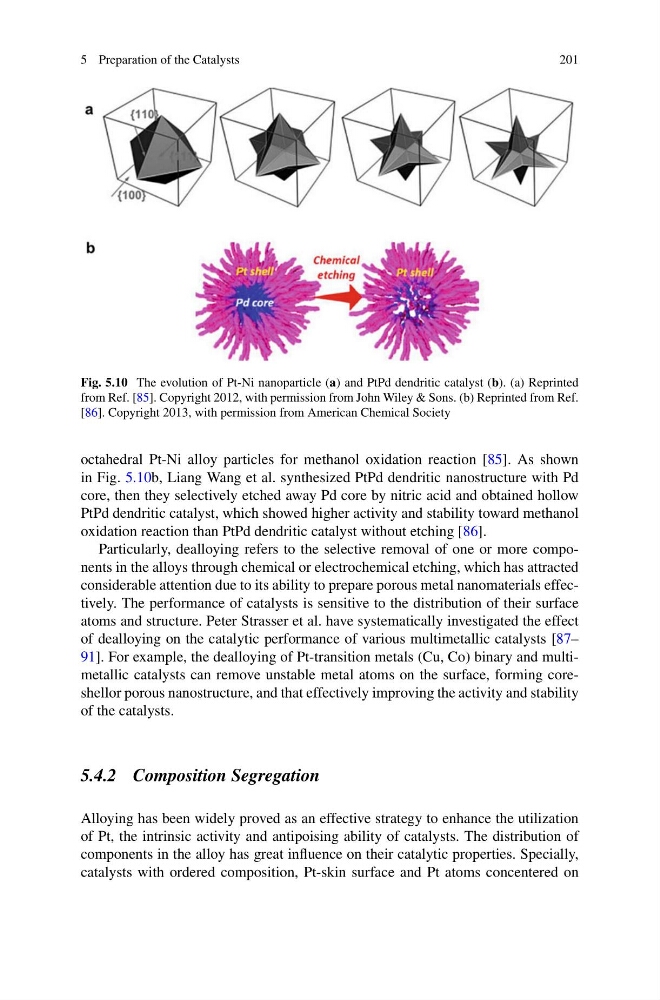
Fig. 5.10 The evolution of Pt-Ni nanoparticle (a) and PtPd dendritic catalyst (b). (a) Reprinted
from Ref. [85]. Copyright 2012, with permission from John Wiley & Sons. (b) Reprinted from Ref.
[86]. Copyright 2013, with permission from American Chemical Society
octahedral Pt-Ni alloy particles for methanol oxidation reaction [85]. As shown
in Fig. 5.10b, Liang Wang et al. synthesized PtPd dendritic nanostructure with Pd
core, then they selectively etched away Pd core by nitric acid and obtained hollow
PtPd dendritic catalyst, which showed higher activity and stability toward methanol
oxidation reaction than PtPd dendritic catalyst without etching [86].
Particularly, dealloying refers to the selective removal of one or more components in the alloys through chemical or electrochemical etching, which has attracted
considerable attention due to its ability to prepare porous metal nanomaterials effectively. The performance of catalysts is sensitive to the distribution of their surface
atoms and structure. Peter Strasser et al. have systematically investigated the effect
of dealloying on the catalytic performance of various multimetallic catalysts [87–
91]. For example, the dealloying of Pt-transition metals (Cu, Co) binary and multimetallic catalysts can remove unstable metal atoms on the surface, forming coreshellor porous nanostructure, and that effectively improving the activity and stability
of the catalysts.
5.4.2 Composition Segregation
Alloying has been widely proved as an effective strategy to enhance the utilization
of Pt, the intrinsic activity and antipoising ability of catalysts. The distribution of
components in the alloy has great influence on their catalytic properties. Specially,
catalysts with ordered composition, Pt-skin surface and Pt atoms concentered on
201
Fig. 5.10 The evolution of Pt-Ni nanoparticle (a) and PtPd dendritic catalyst (b). (a) Reprinted
from Ref. [85]. Copyright 2012, with permission from John Wiley & Sons. (b) Reprinted from Ref.
[86]. Copyright 2013, with permission from American Chemical Society
octahedral Pt-Ni alloy particles for methanol oxidation reaction [85]. As shown
in Fig. 5.10b, Liang Wang et al. synthesized PtPd dendritic nanostructure with Pd
core, then they selectively etched away Pd core by nitric acid and obtained hollow
PtPd dendritic catalyst, which showed higher activity and stability toward methanol
oxidation reaction than PtPd dendritic catalyst without etching [86].
Particularly, dealloying refers to the selective removal of one or more components in the alloys through chemical or electrochemical etching, which has attracted
considerable attention due to its ability to prepare porous metal nanomaterials effectively. The performance of catalysts is sensitive to the distribution of their surface
atoms and structure. Peter Strasser et al. have systematically investigated the effect
of dealloying on the catalytic performance of various multimetallic catalysts [87–
91]. For example, the dealloying of Pt-transition metals (Cu, Co) binary and multimetallic catalysts can remove unstable metal atoms on the surface, forming coreshellor porous nanostructure, and that effectively improving the activity and stability
of the catalysts.
5.4.2 Composition Segregation
Alloying has been widely proved as an effective strategy to enhance the utilization
of Pt, the intrinsic activity and antipoising ability of catalysts. The distribution of
components in the alloy has great influence on their catalytic properties. Specially,
catalysts with ordered composition, Pt-skin surface and Pt atoms concentered on