

200
S. Luo et al.
is a cathodic reduction reaction, which include oxygen reduction, hydrogen production, reduction of oxidant, deposition of noble metals, etc. As etching proceeds, in
most cases, the cathodic or anodic process will be blocked by the corrosion products
due to the solution ions, resulting in the diffusion being blocked and the corrosion
rate being slowed down. This phenomenon is called polarization, and the corrosion
of the metal will be decreased with the effect of polarization.
By rational utilization and control of etching, catalysts with unique nanostructure can be synthesized. Younan Xia et al. controlled the etching of Pd nanoparticles by Cl
− /O 2 , realized the selective elimination of twin formed at the early stage,
and thus synthesized uniform and single-crystal Pd nanoparticles. This research not
only proved the role of oxidative etching by Cl
− /O 2 on Pd nanoparticles but also
demonstrated that the selective etching could optimize the shape of nanoparticles
[78–80].
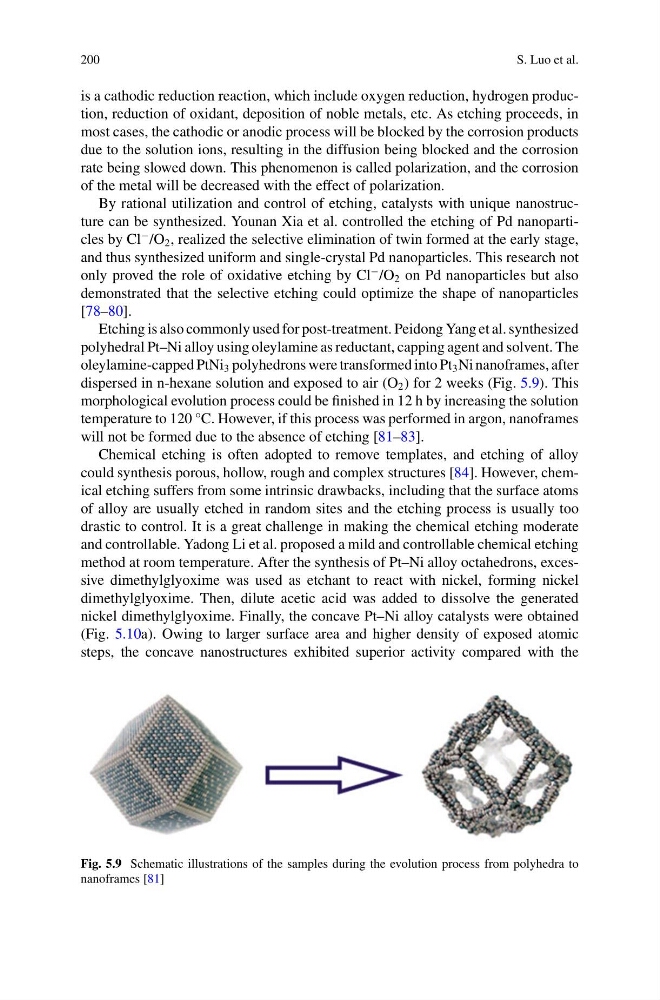
Etching is also commonly used for post-treatment. Peidong Yang et al. synthesized
polyhedral Pt–Ni alloy using oleylamine as reductant, capping agent and solvent. The
oleylamine-capped PtNi 3 polyhedrons were transformed into Pt 3 Ni nanoframes, after
dispersed in n-hexane solution and exposed to air (O 2 ) for 2 weeks (Fig. 5.9). This
morphological evolution process could be finished in 12 h by increasing the solution
temperature to 120 °C. However, if this process was performed in argon, nanoframes
will not be formed due to the absence of etching [81–83].
Chemical etching is often adopted to remove templates, and etching of alloy
could synthesis porous, hollow, rough and complex structures [84]. However, chemical etching suffers from some intrinsic drawbacks, including that the surface atoms
of alloy are usually etched in random sites and the etching process is usually too
drastic to control. It is a great challenge in making the chemical etching moderate
and controllable. Yadong Li et al. proposed a mild and controllable chemical etching
method at room temperature. After the synthesis of Pt–Ni alloy octahedrons, excessive dimethylglyoxime was used as etchant to react with nickel, forming nickel
dimethylglyoxime. Then, dilute acetic acid was added to dissolve the generated
nickel dimethylglyoxime. Finally, the concave Pt–Ni alloy catalysts were obtained
(Fig. 5.10a). Owing to larger surface area and higher density of exposed atomic
steps, the concave nanostructures exhibited superior activity compared with the
Fig. 5.9 Schematic illustrations of the samples during the evolution process from polyhedra to
nanoframes [81]
S. Luo et al.
is a cathodic reduction reaction, which include oxygen reduction, hydrogen production, reduction of oxidant, deposition of noble metals, etc. As etching proceeds, in
most cases, the cathodic or anodic process will be blocked by the corrosion products
due to the solution ions, resulting in the diffusion being blocked and the corrosion
rate being slowed down. This phenomenon is called polarization, and the corrosion
of the metal will be decreased with the effect of polarization.
By rational utilization and control of etching, catalysts with unique nanostructure can be synthesized. Younan Xia et al. controlled the etching of Pd nanoparticles by Cl
− /O 2 , realized the selective elimination of twin formed at the early stage,
and thus synthesized uniform and single-crystal Pd nanoparticles. This research not
only proved the role of oxidative etching by Cl
− /O 2 on Pd nanoparticles but also
demonstrated that the selective etching could optimize the shape of nanoparticles
[78–80].
Etching is also commonly used for post-treatment. Peidong Yang et al. synthesized
polyhedral Pt–Ni alloy using oleylamine as reductant, capping agent and solvent. The
oleylamine-capped PtNi 3 polyhedrons were transformed into Pt 3 Ni nanoframes, after
dispersed in n-hexane solution and exposed to air (O 2 ) for 2 weeks (Fig. 5.9). This
morphological evolution process could be finished in 12 h by increasing the solution
temperature to 120 °C. However, if this process was performed in argon, nanoframes
will not be formed due to the absence of etching [81–83].
Chemical etching is often adopted to remove templates, and etching of alloy
could synthesis porous, hollow, rough and complex structures [84]. However, chemical etching suffers from some intrinsic drawbacks, including that the surface atoms
of alloy are usually etched in random sites and the etching process is usually too
drastic to control. It is a great challenge in making the chemical etching moderate
and controllable. Yadong Li et al. proposed a mild and controllable chemical etching
method at room temperature. After the synthesis of Pt–Ni alloy octahedrons, excessive dimethylglyoxime was used as etchant to react with nickel, forming nickel
dimethylglyoxime. Then, dilute acetic acid was added to dissolve the generated
nickel dimethylglyoxime. Finally, the concave Pt–Ni alloy catalysts were obtained
(Fig. 5.10a). Owing to larger surface area and higher density of exposed atomic
steps, the concave nanostructures exhibited superior activity compared with the
Fig. 5.9 Schematic illustrations of the samples during the evolution process from polyhedra to
nanoframes [81]