

2 Mechanism of Oxygen Reduction Reaction
13
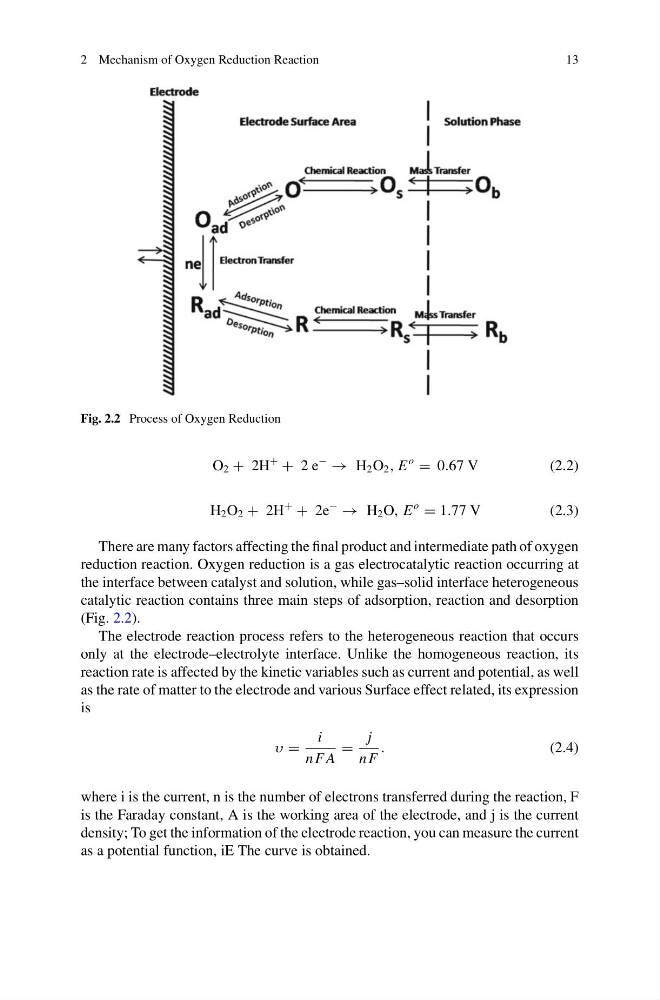
Fig. 2.2 Process of Oxygen Reduction
O 2 + 2H
+
+ 2 e
−
→ H 2 O 2 , E
o
= 0.67 V
(2.2)
H 2 O 2 + 2H
+
+ 2e
−
→ H 2 O, E
o
= 1.77 V
(2.3)
There are many factors affecting the final product and intermediate path of oxygen
reduction reaction. Oxygen reduction is a gas electrocatalytic reaction occurring at
the interface between catalyst and solution, while gas–solid interface heterogeneous
catalytic reaction contains three main steps of adsorption, reaction and desorption
(Fig. 2.2).
The electrode reaction process refers to the heterogeneous reaction that occurs
only at the electrode–electrolyte interface. Unlike the homogeneous reaction, its
reaction rate is affected by the kinetic variables such as current and potential, as well
as the rate of matter to the electrode and various Surface effect related, its expression
is
υ =
i
n F A
=
j
n F
.
(2.4)
where i is the current, n is the number of electrons transferred during the reaction, F
is the Faraday constant, A is the working area of the electrode, and j is the current
density; To get the information of the electrode reaction, you can measure the current
as a potential function, iE The curve is obtained.
13
Fig. 2.2 Process of Oxygen Reduction
O 2 + 2H
+
+ 2 e
−
→ H 2 O 2 , E
o
= 0.67 V
(2.2)
H 2 O 2 + 2H
+
+ 2e
−
→ H 2 O, E
o
= 1.77 V
(2.3)
There are many factors affecting the final product and intermediate path of oxygen
reduction reaction. Oxygen reduction is a gas electrocatalytic reaction occurring at
the interface between catalyst and solution, while gas–solid interface heterogeneous
catalytic reaction contains three main steps of adsorption, reaction and desorption
(Fig. 2.2).
The electrode reaction process refers to the heterogeneous reaction that occurs
only at the electrode–electrolyte interface. Unlike the homogeneous reaction, its
reaction rate is affected by the kinetic variables such as current and potential, as well
as the rate of matter to the electrode and various Surface effect related, its expression
is
υ =
i
n F A
=
j
n F
.
(2.4)
where i is the current, n is the number of electrons transferred during the reaction, F
is the Faraday constant, A is the working area of the electrode, and j is the current
density; To get the information of the electrode reaction, you can measure the current
as a potential function, iE The curve is obtained.