

12
Z. Zhao and P. K. Shen
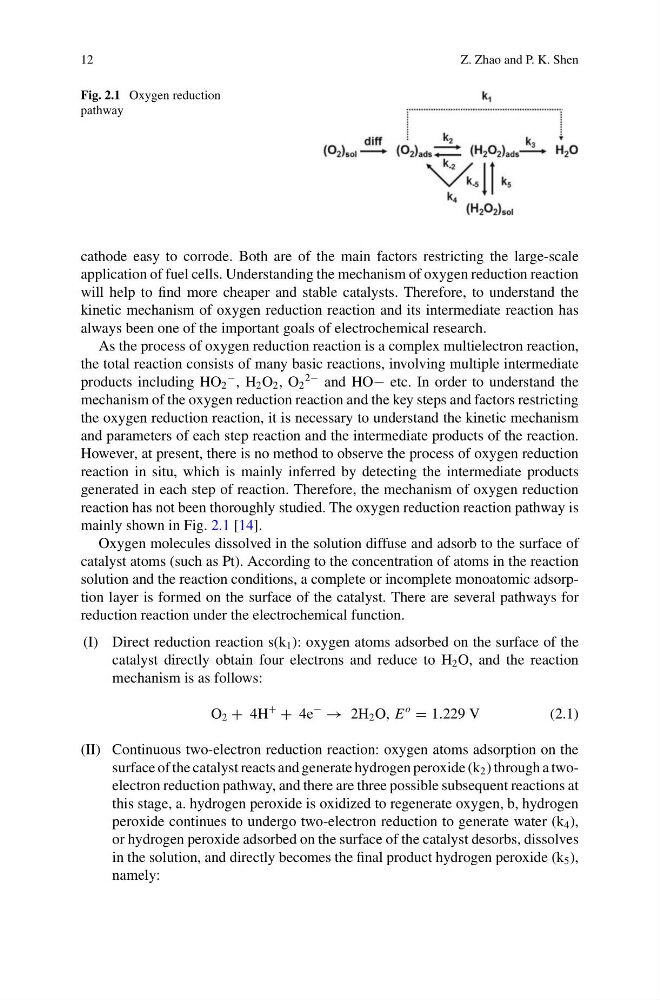
Fig. 2.1 Oxygen reduction
pathway
cathode easy to corrode. Both are of the main factors restricting the large-scale
application of fuel cells. Understanding the mechanism of oxygen reduction reaction
will help to find more cheaper and stable catalysts. Therefore, to understand the
kinetic mechanism of oxygen reduction reaction and its intermediate reaction has
always been one of the important goals of electrochemical research.
As the process of oxygen reduction reaction is a complex multielectron reaction,
the total reaction consists of many basic reactions, involving multiple intermediate
products including HO 2
− , H 2 O 2 , O 2
2− and HO− etc. In order to understand the
mechanism of the oxygen reduction reaction and the key steps and factors restricting
the oxygen reduction reaction, it is necessary to understand the kinetic mechanism
and parameters of each step reaction and the intermediate products of the reaction.
However, at present, there is no method to observe the process of oxygen reduction
reaction in situ, which is mainly inferred by detecting the intermediate products
generated in each step of reaction. Therefore, the mechanism of oxygen reduction
reaction has not been thoroughly studied. The oxygen reduction reaction pathway is
mainly shown in Fig. 2.1 [14].
Oxygen molecules dissolved in the solution diffuse and adsorb to the surface of
catalyst atoms (such as Pt). According to the concentration of atoms in the reaction
solution and the reaction conditions, a complete or incomplete monoatomic adsorption layer is formed on the surface of the catalyst. There are several pathways for
reduction reaction under the electrochemical function.
(I) Direct reduction reaction s(k 1 ): oxygen atoms adsorbed on the surface of the
catalyst directly obtain four electrons and reduce to H 2 O, and the reaction
mechanism is as follows:
O 2 + 4H
+
+ 4e
−
→ 2H 2 O, E
o
= 1.229 V
(2.1)
(II) Continuous two-electron reduction reaction: oxygen atoms adsorption on the
surface of the catalyst reacts and generate hydrogen peroxide (k 2 ) through a twoelectron reduction pathway, and there are three possible subsequent reactions at
this stage, a. hydrogen peroxide is oxidized to regenerate oxygen, b, hydrogen
peroxide continues to undergo two-electron reduction to generate water (k 4 ),
or hydrogen peroxide adsorbed on the surface of the catalyst desorbs, dissolves
in the solution, and directly becomes the final product hydrogen peroxide (k 5 ),
namely:
Z. Zhao and P. K. Shen
Fig. 2.1 Oxygen reduction
pathway
cathode easy to corrode. Both are of the main factors restricting the large-scale
application of fuel cells. Understanding the mechanism of oxygen reduction reaction
will help to find more cheaper and stable catalysts. Therefore, to understand the
kinetic mechanism of oxygen reduction reaction and its intermediate reaction has
always been one of the important goals of electrochemical research.
As the process of oxygen reduction reaction is a complex multielectron reaction,
the total reaction consists of many basic reactions, involving multiple intermediate
products including HO 2
− , H 2 O 2 , O 2
2− and HO− etc. In order to understand the
mechanism of the oxygen reduction reaction and the key steps and factors restricting
the oxygen reduction reaction, it is necessary to understand the kinetic mechanism
and parameters of each step reaction and the intermediate products of the reaction.
However, at present, there is no method to observe the process of oxygen reduction
reaction in situ, which is mainly inferred by detecting the intermediate products
generated in each step of reaction. Therefore, the mechanism of oxygen reduction
reaction has not been thoroughly studied. The oxygen reduction reaction pathway is
mainly shown in Fig. 2.1 [14].
Oxygen molecules dissolved in the solution diffuse and adsorb to the surface of
catalyst atoms (such as Pt). According to the concentration of atoms in the reaction
solution and the reaction conditions, a complete or incomplete monoatomic adsorption layer is formed on the surface of the catalyst. There are several pathways for
reduction reaction under the electrochemical function.
(I) Direct reduction reaction s(k 1 ): oxygen atoms adsorbed on the surface of the
catalyst directly obtain four electrons and reduce to H 2 O, and the reaction
mechanism is as follows:
O 2 + 4H
+
+ 4e
−
→ 2H 2 O, E
o
= 1.229 V
(2.1)
(II) Continuous two-electron reduction reaction: oxygen atoms adsorption on the
surface of the catalyst reacts and generate hydrogen peroxide (k 2 ) through a twoelectron reduction pathway, and there are three possible subsequent reactions at
this stage, a. hydrogen peroxide is oxidized to regenerate oxygen, b, hydrogen
peroxide continues to undergo two-electron reduction to generate water (k 4 ),
or hydrogen peroxide adsorbed on the surface of the catalyst desorbs, dissolves
in the solution, and directly becomes the final product hydrogen peroxide (k 5 ),
namely: