

126
Y. Li et al.
O 2 saturated 0.5 M H 2 SO 4 solution, the kinetic current density of cubic Pd-NPs
increased three times at 0.85 V (vs. RHE). In addition, in 0.1 M KOH, the dynamic
current density of cubic Pd-NPs at 0.95 V (vs. RHE) is also three times higher than
that of spherical Pd-NPs [187]. Shao et al. [188] synthesized octahedral and cubic Pd
nanocrystals using Cl
− and Br
− as capping agents. The cubic Pd nanocrystals have
the best ORR performance, which is equivalent to Pt.
For Pt, its catalytic activity has a large determinant relationship with its atomic
structure arrangement [189]. The ORR activity of each crystal plane of Pt has been
studied in detail. In a 0.1 M HClO 4 solution without strong ion adsorption, the ORR
activity of each low-index crystal plane of Pt is as follows: Pt (100) < Pt (111) < Pt
(110) [147]. Kondo et al. [148] studied the ORR activity of Pd’s low-index crystal
planes using a rotating ring-disc electrode (RRDE). The different crystal planes of
Pd are obtained by using the reflected beam orientation of the He–Ne laser. After
polishing and grinding, anneal it to remove the surface distortion to obtain Pd with
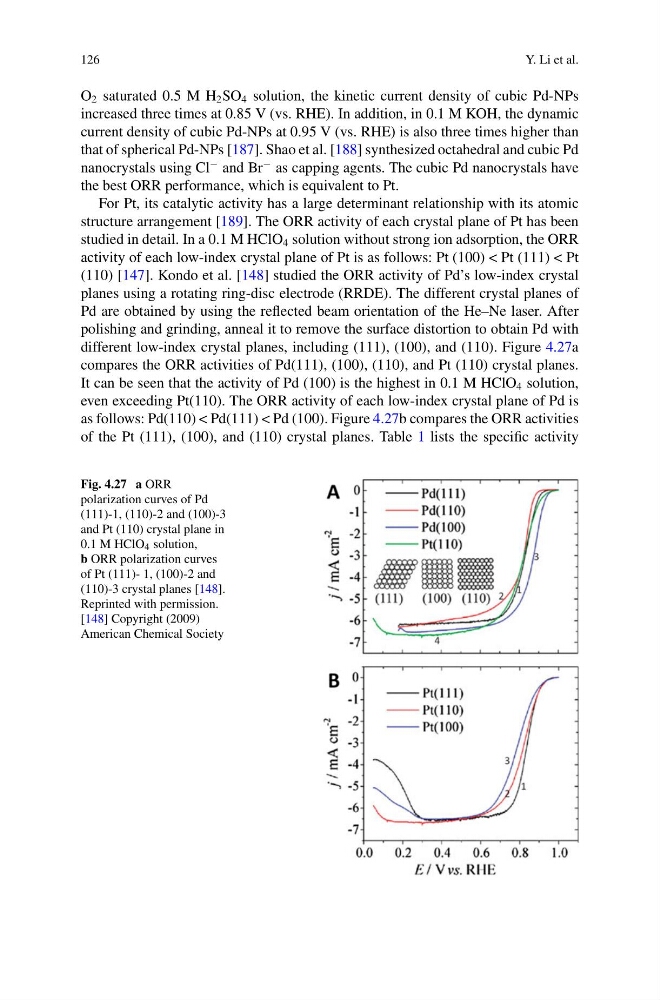
different low-index crystal planes, including (111), (100), and (110). Figure 4.27a
compares the ORR activities of Pd(111), (100), (110), and Pt (110) crystal planes.
It can be seen that the activity of Pd (100) is the highest in 0.1 M HClO 4 solution,
even exceeding Pt(110). The ORR activity of each low-index crystal plane of Pd is
as follows: Pd(110) < Pd(111) < Pd (100). Figure 4.27b compares the ORR activities
of the Pt (111), (100), and (110) crystal planes. Table 1 lists the specific activity
Fig. 4.27 a ORR
polarization curves of Pd
(111)-1, (110)-2 and (100)-3
and Pt (110) crystal plane in
0.1 M HClO 4 solution,
b ORR polarization curves
of Pt (111)- 1, (100)-2 and
(110)-3 crystal planes [148].
Reprinted with permission.
[148] Copyright (2009)
American Chemical Society
Y. Li et al.
O 2 saturated 0.5 M H 2 SO 4 solution, the kinetic current density of cubic Pd-NPs
increased three times at 0.85 V (vs. RHE). In addition, in 0.1 M KOH, the dynamic
current density of cubic Pd-NPs at 0.95 V (vs. RHE) is also three times higher than
that of spherical Pd-NPs [187]. Shao et al. [188] synthesized octahedral and cubic Pd
nanocrystals using Cl
− and Br
− as capping agents. The cubic Pd nanocrystals have
the best ORR performance, which is equivalent to Pt.
For Pt, its catalytic activity has a large determinant relationship with its atomic
structure arrangement [189]. The ORR activity of each crystal plane of Pt has been
studied in detail. In a 0.1 M HClO 4 solution without strong ion adsorption, the ORR
activity of each low-index crystal plane of Pt is as follows: Pt (100) < Pt (111) < Pt
(110) [147]. Kondo et al. [148] studied the ORR activity of Pd’s low-index crystal
planes using a rotating ring-disc electrode (RRDE). The different crystal planes of
Pd are obtained by using the reflected beam orientation of the He–Ne laser. After
polishing and grinding, anneal it to remove the surface distortion to obtain Pd with
different low-index crystal planes, including (111), (100), and (110). Figure 4.27a
compares the ORR activities of Pd(111), (100), (110), and Pt (110) crystal planes.
It can be seen that the activity of Pd (100) is the highest in 0.1 M HClO 4 solution,
even exceeding Pt(110). The ORR activity of each low-index crystal plane of Pd is
as follows: Pd(110) < Pd(111) < Pd (100). Figure 4.27b compares the ORR activities
of the Pt (111), (100), and (110) crystal planes. Table 1 lists the specific activity
Fig. 4.27 a ORR
polarization curves of Pd
(111)-1, (110)-2 and (100)-3
and Pt (110) crystal plane in
0.1 M HClO 4 solution,
b ORR polarization curves
of Pt (111)- 1, (100)-2 and
(110)-3 crystal planes [148].
Reprinted with permission.
[148] Copyright (2009)
American Chemical Society