

4 Catalyst Materials for Oxygen Reduction Reaction
125
For nanomaterials, their performance is often determined by structure and
morphology. Xiao et al. [186] proved the decisive relationship between Pd nanostructure and ORR activity. By adjusting the solubility of the precursors, they
prepared Pd nanostructures with different morphologies by electrodeposition: under
the same conditions, they are to electrodeposit in 10
–5 M PdCl 2 solution to obtain
Pd nanoparticles(Pd-NPs) and electrodeposit in 3 × 10
–4 M PdCl 2 solution to obtain
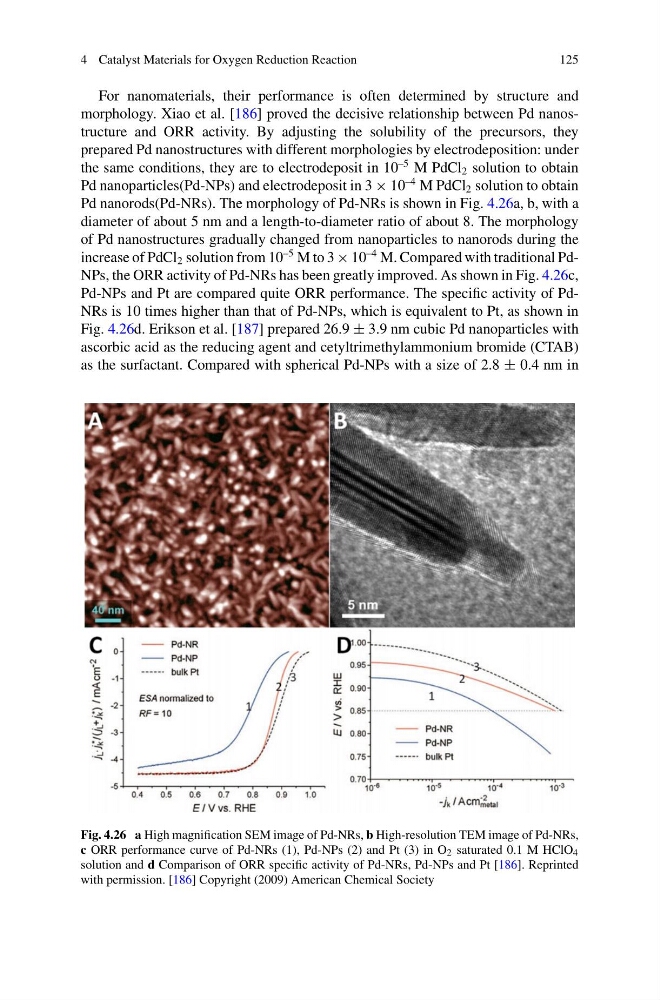
Pd nanorods(Pd-NRs). The morphology of Pd-NRs is shown in Fig. 4.26a, b, with a
diameter of about 5 nm and a length-to-diameter ratio of about 8. The morphology
of Pd nanostructures gradually changed from nanoparticles to nanorods during the
increase of PdCl 2 solution from 10
–5 M to 3 × 10
–4 M. Compared with traditional PdNPs, the ORR activity of Pd-NRs has been greatly improved. As shown in Fig. 4.26c,
Pd-NPs and Pt are compared quite ORR performance. The specific activity of PdNRs is 10 times higher than that of Pd-NPs, which is equivalent to Pt, as shown in
Fig. 4.26d. Erikson et al. [187] prepared 26.9 ± 3.9 nm cubic Pd nanoparticles with
ascorbic acid as the reducing agent and cetyltrimethylammonium bromide (CTAB)
as the surfactant. Compared with spherical Pd-NPs with a size of 2.8 ± 0.4 nm in
Fig. 4.26 a High magnification SEM image of Pd-NRs, b High-resolution TEM image of Pd-NRs,
c ORR performance curve of Pd-NRs (1), Pd-NPs (2) and Pt (3) in O 2 saturated 0.1 M HClO 4
solution and d Comparison of ORR specific activity of Pd-NRs, Pd-NPs and Pt [186]. Reprinted
with permission. [186] Copyright (2009) American Chemical Society
125
For nanomaterials, their performance is often determined by structure and
morphology. Xiao et al. [186] proved the decisive relationship between Pd nanostructure and ORR activity. By adjusting the solubility of the precursors, they
prepared Pd nanostructures with different morphologies by electrodeposition: under
the same conditions, they are to electrodeposit in 10
–5 M PdCl 2 solution to obtain
Pd nanoparticles(Pd-NPs) and electrodeposit in 3 × 10
–4 M PdCl 2 solution to obtain
Pd nanorods(Pd-NRs). The morphology of Pd-NRs is shown in Fig. 4.26a, b, with a
diameter of about 5 nm and a length-to-diameter ratio of about 8. The morphology
of Pd nanostructures gradually changed from nanoparticles to nanorods during the
increase of PdCl 2 solution from 10
–5 M to 3 × 10
–4 M. Compared with traditional PdNPs, the ORR activity of Pd-NRs has been greatly improved. As shown in Fig. 4.26c,
Pd-NPs and Pt are compared quite ORR performance. The specific activity of PdNRs is 10 times higher than that of Pd-NPs, which is equivalent to Pt, as shown in
Fig. 4.26d. Erikson et al. [187] prepared 26.9 ± 3.9 nm cubic Pd nanoparticles with
ascorbic acid as the reducing agent and cetyltrimethylammonium bromide (CTAB)
as the surfactant. Compared with spherical Pd-NPs with a size of 2.8 ± 0.4 nm in
Fig. 4.26 a High magnification SEM image of Pd-NRs, b High-resolution TEM image of Pd-NRs,
c ORR performance curve of Pd-NRs (1), Pd-NPs (2) and Pt (3) in O 2 saturated 0.1 M HClO 4
solution and d Comparison of ORR specific activity of Pd-NRs, Pd-NPs and Pt [186]. Reprinted
with permission. [186] Copyright (2009) American Chemical Society