

122
Y. Li et al.
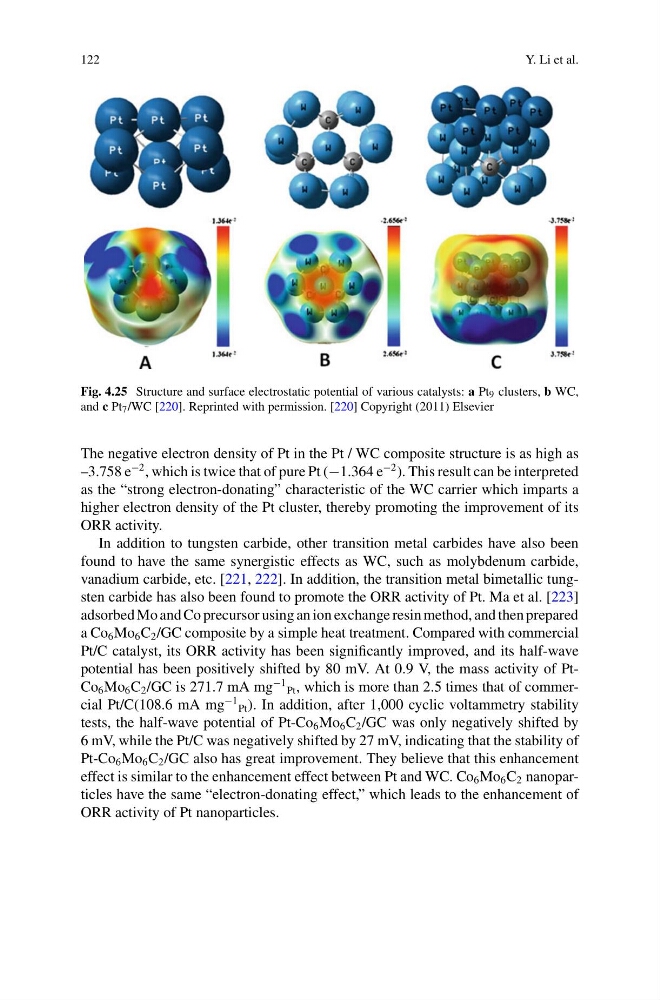
Fig. 4.25 Structure and surface electrostatic potential of various catalysts: a Pt 9 clusters, b WC,
and c Pt 7 /WC [220]. Reprinted with permission. [220] Copyright (2011) Elsevier
The negative electron density of Pt in the Pt / WC composite structure is as high as
–3.758 e
−2 , which is twice that of pure Pt (−1.364 e
−2 ). This result can be interpreted
as the “strong electron-donating” characteristic of the WC carrier which imparts a
higher electron density of the Pt cluster, thereby promoting the improvement of its
ORR activity.
In addition to tungsten carbide, other transition metal carbides have also been
found to have the same synergistic effects as WC, such as molybdenum carbide,
vanadium carbide, etc. [221, 222]. In addition, the transition metal bimetallic tungsten carbide has also been found to promote the ORR activity of Pt. Ma et al. [223]
adsorbed Mo and Co precursor using an ion exchange resin method, and then prepared
a Co 6 Mo 6 C 2 /GC composite by a simple heat treatment. Compared with commercial
Pt/C catalyst, its ORR activity has been significantly improved, and its half-wave
potential has been positively shifted by 80 mV. At 0.9 V, the mass activity of PtCo 6 Mo 6 C 2 /GC is 271.7 mA mg
−1
Pt , which is more than 2.5 times that of commercial Pt/C(108.6 mA mg
−1
Pt ). In addition, after 1,000 cyclic voltammetry stability
tests, the half-wave potential of Pt-Co 6 Mo 6 C 2 /GC was only negatively shifted by
6 mV, while the Pt/C was negatively shifted by 27 mV, indicating that the stability of
Pt-Co 6 Mo 6 C 2 /GC also has great improvement. They believe that this enhancement
effect is similar to the enhancement effect between Pt and WC. Co 6 Mo 6 C 2 nanoparticles have the same “electron-donating effect,” which leads to the enhancement of
ORR activity of Pt nanoparticles.
Y. Li et al.
Fig. 4.25 Structure and surface electrostatic potential of various catalysts: a Pt 9 clusters, b WC,
and c Pt 7 /WC [220]. Reprinted with permission. [220] Copyright (2011) Elsevier
The negative electron density of Pt in the Pt / WC composite structure is as high as
–3.758 e
−2 , which is twice that of pure Pt (−1.364 e
−2 ). This result can be interpreted
as the “strong electron-donating” characteristic of the WC carrier which imparts a
higher electron density of the Pt cluster, thereby promoting the improvement of its
ORR activity.
In addition to tungsten carbide, other transition metal carbides have also been
found to have the same synergistic effects as WC, such as molybdenum carbide,
vanadium carbide, etc. [221, 222]. In addition, the transition metal bimetallic tungsten carbide has also been found to promote the ORR activity of Pt. Ma et al. [223]
adsorbed Mo and Co precursor using an ion exchange resin method, and then prepared
a Co 6 Mo 6 C 2 /GC composite by a simple heat treatment. Compared with commercial
Pt/C catalyst, its ORR activity has been significantly improved, and its half-wave
potential has been positively shifted by 80 mV. At 0.9 V, the mass activity of PtCo 6 Mo 6 C 2 /GC is 271.7 mA mg
−1
Pt , which is more than 2.5 times that of commercial Pt/C(108.6 mA mg
−1
Pt ). In addition, after 1,000 cyclic voltammetry stability
tests, the half-wave potential of Pt-Co 6 Mo 6 C 2 /GC was only negatively shifted by
6 mV, while the Pt/C was negatively shifted by 27 mV, indicating that the stability of
Pt-Co 6 Mo 6 C 2 /GC also has great improvement. They believe that this enhancement
effect is similar to the enhancement effect between Pt and WC. Co 6 Mo 6 C 2 nanoparticles have the same “electron-donating effect,” which leads to the enhancement of
ORR activity of Pt nanoparticles.