

104
Y. Li et al.
shows the relationship between the ORR activity and oxygen adsorption energy of
bimetallic Pt-based ORR catalysts reported in the literature, similar to the volcano
diagram [132].
Lim et al. [153] first prepared truncated octahedral Pd nanoparticles with a size of
9 nm by using ascorbic acid, and then prepared nano-dendritic Pd–Pt bimetallic alloys
(Pd–Pt dendrites) with a size of 23 nm by using truncated octahedral Pd nanoparticles
as seeds. At room temperature, the mass activity of Pd–Pt dendrites in 0.1 M HClO 4
medium at 0.9 V (vs. RHE) is 204 mA mg
−1
Pd + Pt , which is 2.1 times, and 4.3 times
of commercial Pt/C (95 mA mg
−1
Pt ) and carrier-free Pt black (48 mA mg
−1
Pt ). If
only the mass specific activity of Pt is counted, the mass activity of such dendritic
Pd–Pt dendrites can reach 241 mA mg
−1
Pt , which is 2.5 times that of commercial
Pt/C. At a temperature of 60 °C, the mass specific activity of Pd–Pt dendrites can
reach 433 mA mg
−1
Pt , which is still better than commercial Pt/C (204 mA mg
−1
Pt )
and carrier-free Pt black (78 mA mg
−1
Pt ), which is very close to the goal set by the
US Department of Energy (at 80 °C, the specific mass activity at 0.9 V (vs. RHE)
reaches 440 mA mg
−1
Pt ).
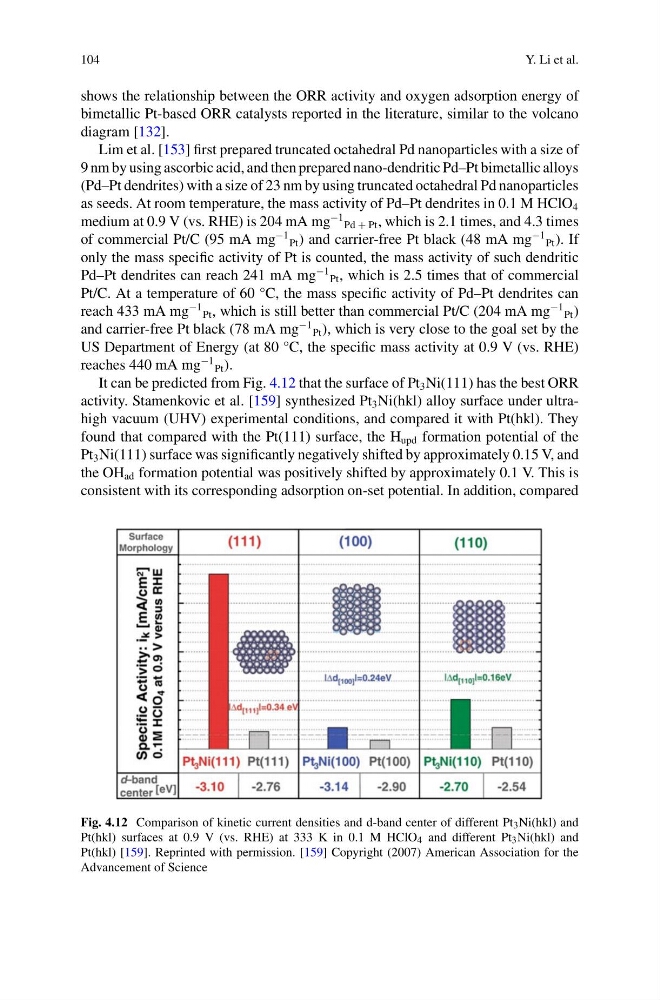
It can be predicted from Fig. 4.12 that the surface of Pt 3 Ni(111) has the best ORR
activity. Stamenkovic et al. [159] synthesized Pt 3 Ni(hkl) alloy surface under ultrahigh vacuum (UHV) experimental conditions, and compared it with Pt(hkl). They
found that compared with the Pt(111) surface, the H upd formation potential of the
Pt 3 Ni(111) surface was significantly negatively shifted by approximately 0.15 V, and
the OH ad formation potential was positively shifted by approximately 0.1 V. This is
consistent with its corresponding adsorption on-set potential. In addition, compared
Fig. 4.12 Comparison of kinetic current densities and d-band center of different Pt 3 Ni(hkl) and
Pt(hkl) surfaces at 0.9 V (vs. RHE) at 333 K in 0.1 M HClO 4 and different Pt 3 Ni(hkl) and
Pt(hkl) [159]. Reprinted with permission. [159] Copyright (2007) American Association for the
Advancement of Science
Y. Li et al.
shows the relationship between the ORR activity and oxygen adsorption energy of
bimetallic Pt-based ORR catalysts reported in the literature, similar to the volcano
diagram [132].
Lim et al. [153] first prepared truncated octahedral Pd nanoparticles with a size of
9 nm by using ascorbic acid, and then prepared nano-dendritic Pd–Pt bimetallic alloys
(Pd–Pt dendrites) with a size of 23 nm by using truncated octahedral Pd nanoparticles
as seeds. At room temperature, the mass activity of Pd–Pt dendrites in 0.1 M HClO 4
medium at 0.9 V (vs. RHE) is 204 mA mg
−1
Pd + Pt , which is 2.1 times, and 4.3 times
of commercial Pt/C (95 mA mg
−1
Pt ) and carrier-free Pt black (48 mA mg
−1
Pt ). If
only the mass specific activity of Pt is counted, the mass activity of such dendritic
Pd–Pt dendrites can reach 241 mA mg
−1
Pt , which is 2.5 times that of commercial
Pt/C. At a temperature of 60 °C, the mass specific activity of Pd–Pt dendrites can
reach 433 mA mg
−1
Pt , which is still better than commercial Pt/C (204 mA mg
−1
Pt )
and carrier-free Pt black (78 mA mg
−1
Pt ), which is very close to the goal set by the
US Department of Energy (at 80 °C, the specific mass activity at 0.9 V (vs. RHE)
reaches 440 mA mg
−1
Pt ).
It can be predicted from Fig. 4.12 that the surface of Pt 3 Ni(111) has the best ORR
activity. Stamenkovic et al. [159] synthesized Pt 3 Ni(hkl) alloy surface under ultrahigh vacuum (UHV) experimental conditions, and compared it with Pt(hkl). They
found that compared with the Pt(111) surface, the H upd formation potential of the
Pt 3 Ni(111) surface was significantly negatively shifted by approximately 0.15 V, and
the OH ad formation potential was positively shifted by approximately 0.1 V. This is
consistent with its corresponding adsorption on-set potential. In addition, compared
Fig. 4.12 Comparison of kinetic current densities and d-band center of different Pt 3 Ni(hkl) and
Pt(hkl) surfaces at 0.9 V (vs. RHE) at 333 K in 0.1 M HClO 4 and different Pt 3 Ni(hkl) and
Pt(hkl) [159]. Reprinted with permission. [159] Copyright (2007) American Association for the
Advancement of Science