

4 Catalyst Materials for Oxygen Reduction Reaction
103
4.2.2 Pt-Based Alloy ORR Catalysts
By reducing the Pt particle size to achieve an improvement in the ORR performance
of Pt, which subjects to the “negative size effect,” it does not meet the PEMFC’s
requirement for a significant reduction in the amount of Pt. Furthermore, the smaller
the Pt particles (less than 2 nm), the more difficult it is to prepare by a simple
method. Another way to effectively increase the ORR activity of Pt is to change the
structure and electronic properties of Pt by alloying, thereby achieving the purpose
of enhancing ORR activity.
At a voltage of 0.8–0.9 V, which is also the voltage during normal operation
of PEMFC, oxygen is adsorbed on the surface layer of the catalyst, followed by
the cleavage of the O–O bond and the generation of hydroxyl groups adsorbed on
the surface. The hydroxyl groups adsorbed on the surface then react with a proton to
produce water. This is the basic reaction process of ORR on the surface of Pt, and also
the basis for the design of Pt-based alloy on ORR [151]. Based on this, researchers
have studied a series of bimetallic Pt-based alloy catalysts for different metals (such
as Ni, Co, Fe, Ti, Y, Au, Pd, Rh, Ir, Ru, etc.) [132, 152–156]. The research results
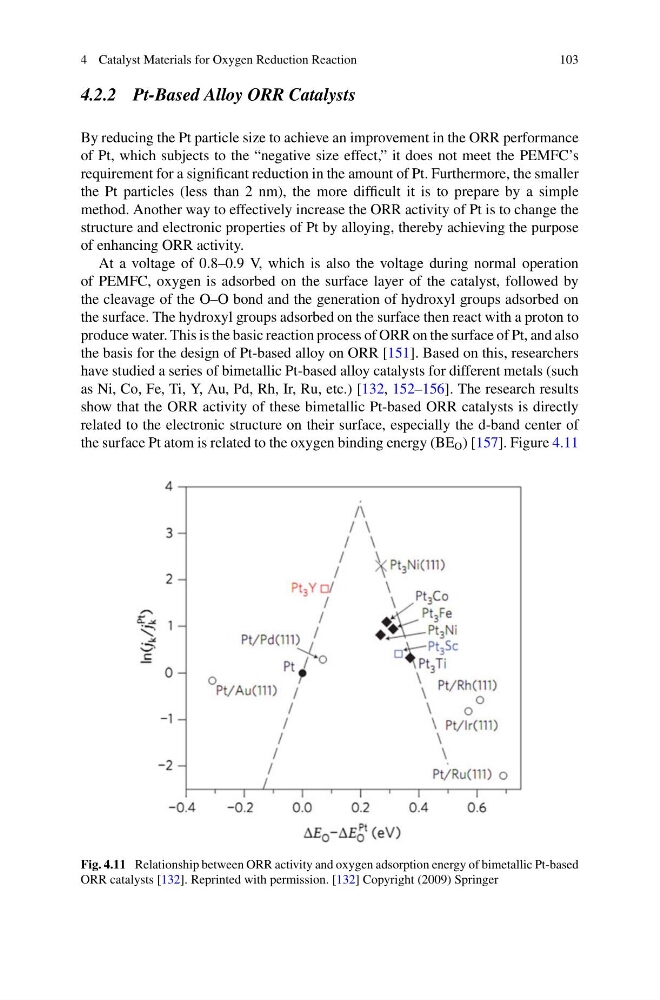
show that the ORR activity of these bimetallic Pt-based ORR catalysts is directly
related to the electronic structure on their surface, especially the d-band center of
the surface Pt atom is related to the oxygen binding energy (BE O ) [157]. Figure 4.11
Fig. 4.11 Relationship between ORR activity and oxygen adsorption energy of bimetallic Pt-based
ORR catalysts [132]. Reprinted with permission. [132] Copyright (2009) Springer
103
4.2.2 Pt-Based Alloy ORR Catalysts
By reducing the Pt particle size to achieve an improvement in the ORR performance
of Pt, which subjects to the “negative size effect,” it does not meet the PEMFC’s
requirement for a significant reduction in the amount of Pt. Furthermore, the smaller
the Pt particles (less than 2 nm), the more difficult it is to prepare by a simple
method. Another way to effectively increase the ORR activity of Pt is to change the
structure and electronic properties of Pt by alloying, thereby achieving the purpose
of enhancing ORR activity.
At a voltage of 0.8–0.9 V, which is also the voltage during normal operation
of PEMFC, oxygen is adsorbed on the surface layer of the catalyst, followed by
the cleavage of the O–O bond and the generation of hydroxyl groups adsorbed on
the surface. The hydroxyl groups adsorbed on the surface then react with a proton to
produce water. This is the basic reaction process of ORR on the surface of Pt, and also
the basis for the design of Pt-based alloy on ORR [151]. Based on this, researchers
have studied a series of bimetallic Pt-based alloy catalysts for different metals (such
as Ni, Co, Fe, Ti, Y, Au, Pd, Rh, Ir, Ru, etc.) [132, 152–156]. The research results
show that the ORR activity of these bimetallic Pt-based ORR catalysts is directly
related to the electronic structure on their surface, especially the d-band center of
the surface Pt atom is related to the oxygen binding energy (BE O ) [157]. Figure 4.11
Fig. 4.11 Relationship between ORR activity and oxygen adsorption energy of bimetallic Pt-based
ORR catalysts [132]. Reprinted with permission. [132] Copyright (2009) Springer