

96
Y. Li et al.
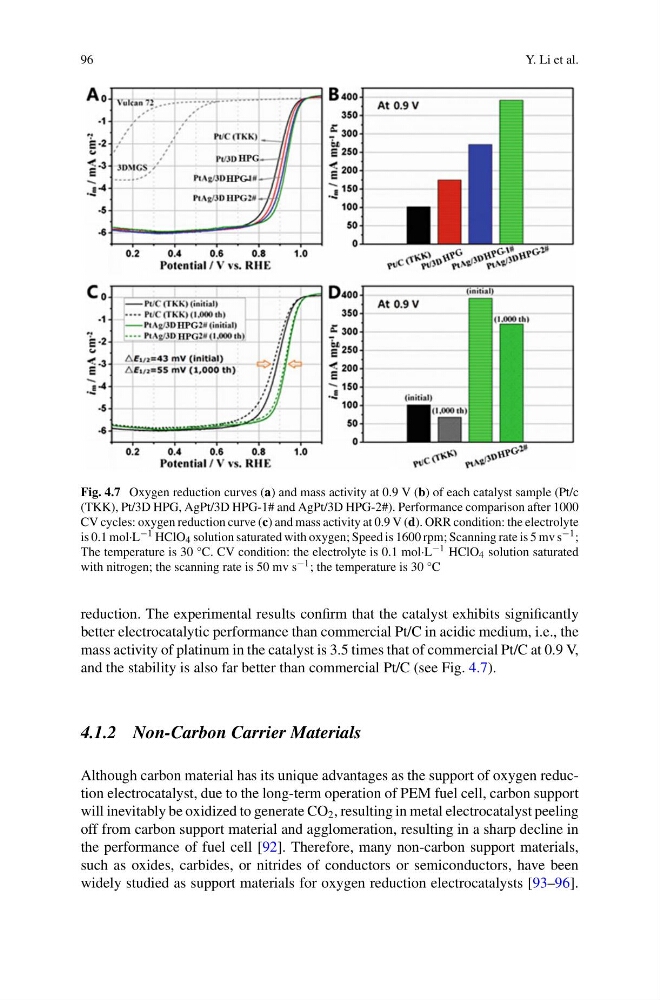
Fig. 4.7 Oxygen reduction curves (a) and mass activity at 0.9 V (b) of each catalyst sample (Pt/c
(TKK), Pt/3D HPG, AgPt/3D HPG-1# and AgPt/3D HPG-2#). Performance comparison after 1000
CV cycles: oxygen reduction curve (c) and mass activity at 0.9 V (d). ORR condition: the electrolyte
is 0.1 mol·L −1 HClO 4 solution saturated with oxygen; Speed is 1600 rpm; Scanning rate is 5 mv s −1 ;
The temperature is 30 °C. CV condition: the electrolyte is 0.1 mol·L −1 HClO 4 solution saturated
with nitrogen; the scanning rate is 50 mv s −1 ; the temperature is 30 °C
reduction. The experimental results confirm that the catalyst exhibits significantly
better electrocatalytic performance than commercial Pt/C in acidic medium, i.e., the
mass activity of platinum in the catalyst is 3.5 times that of commercial Pt/C at 0.9 V,
and the stability is also far better than commercial Pt/C (see Fig. 4.7).
4.1.2 Non-Carbon Carrier Materials
Although carbon material has its unique advantages as the support of oxygen reduction electrocatalyst, due to the long-term operation of PEM fuel cell, carbon support
will inevitably be oxidized to generate CO 2 , resulting in metal electrocatalyst peeling
off from carbon support material and agglomeration, resulting in a sharp decline in
the performance of fuel cell [92]. Therefore, many non-carbon support materials,
such as oxides, carbides, or nitrides of conductors or semiconductors, have been
widely studied as support materials for oxygen reduction electrocatalysts [93–96].
Y. Li et al.
Fig. 4.7 Oxygen reduction curves (a) and mass activity at 0.9 V (b) of each catalyst sample (Pt/c
(TKK), Pt/3D HPG, AgPt/3D HPG-1# and AgPt/3D HPG-2#). Performance comparison after 1000
CV cycles: oxygen reduction curve (c) and mass activity at 0.9 V (d). ORR condition: the electrolyte
is 0.1 mol·L −1 HClO 4 solution saturated with oxygen; Speed is 1600 rpm; Scanning rate is 5 mv s −1 ;
The temperature is 30 °C. CV condition: the electrolyte is 0.1 mol·L −1 HClO 4 solution saturated
with nitrogen; the scanning rate is 50 mv s −1 ; the temperature is 30 °C
reduction. The experimental results confirm that the catalyst exhibits significantly
better electrocatalytic performance than commercial Pt/C in acidic medium, i.e., the
mass activity of platinum in the catalyst is 3.5 times that of commercial Pt/C at 0.9 V,
and the stability is also far better than commercial Pt/C (see Fig. 4.7).
4.1.2 Non-Carbon Carrier Materials
Although carbon material has its unique advantages as the support of oxygen reduction electrocatalyst, due to the long-term operation of PEM fuel cell, carbon support
will inevitably be oxidized to generate CO 2 , resulting in metal electrocatalyst peeling
off from carbon support material and agglomeration, resulting in a sharp decline in
the performance of fuel cell [92]. Therefore, many non-carbon support materials,
such as oxides, carbides, or nitrides of conductors or semiconductors, have been
widely studied as support materials for oxygen reduction electrocatalysts [93–96].