

1 Historical Developments and Future Perspectives …
41
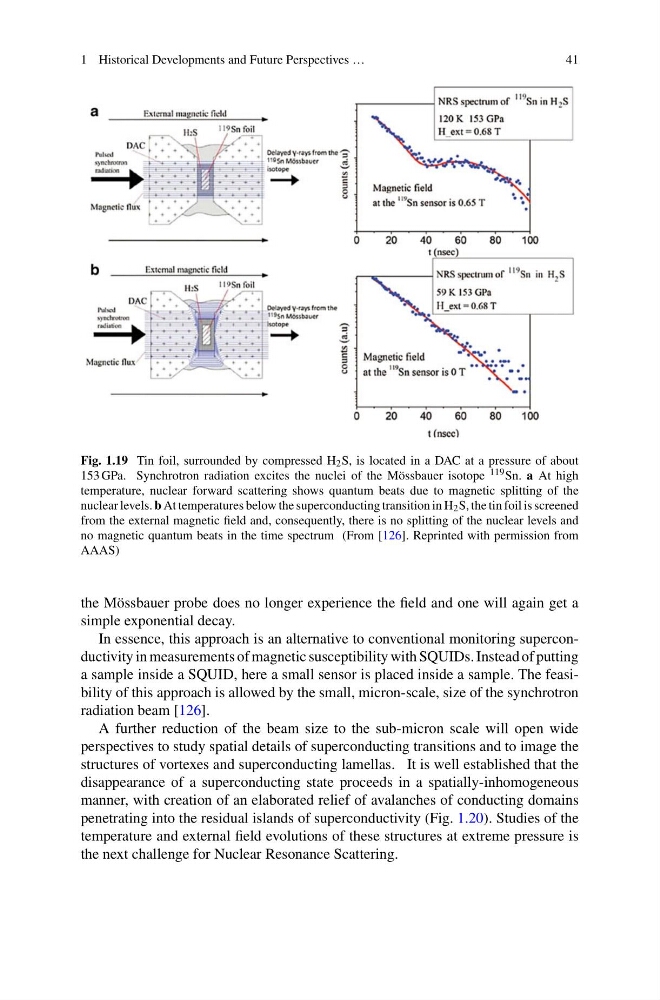
Fig. 1.19 Tin foil, surrounded by compressed H 2 S, is located in a DAC at a pressure of about
153 GPa. Synchrotron radiation excites the nuclei of the Mössbauer isotope 119 Sn. a At high
temperature, nuclear forward scattering shows quantum beats due to magnetic splitting of the
nuclear levels. b At temperatures below the superconducting transition in H 2 S, the tin foil is screened
from the external magnetic field and, consequently, there is no splitting of the nuclear levels and
no magnetic quantum beats in the time spectrum (From [126]. Reprinted with permission from
AAAS)
the Mössbauer probe does no longer experience the field and one will again get a
simple exponential decay.
In essence, this approach is an alternative to conventional monitoring superconductivity in measurements of magnetic susceptibility with SQUIDs. Instead of putting
a sample inside a SQUID, here a small sensor is placed inside a sample. The feasibility of this approach is allowed by the small, micron-scale, size of the synchrotron
radiation beam [126].
A further reduction of the beam size to the sub-micron scale will open wide
perspectives to study spatial details of superconducting transitions and to image the
structures of vortexes and superconducting lamellas. It is well established that the
disappearance of a superconducting state proceeds in a spatially-inhomogeneous
manner, with creation of an elaborated relief of avalanches of conducting domains
penetrating into the residual islands of superconductivity (Fig. 1.20). Studies of the
temperature and external field evolutions of these structures at extreme pressure is
the next challenge for Nuclear Resonance Scattering.
41
Fig. 1.19 Tin foil, surrounded by compressed H 2 S, is located in a DAC at a pressure of about
153 GPa. Synchrotron radiation excites the nuclei of the Mössbauer isotope 119 Sn. a At high
temperature, nuclear forward scattering shows quantum beats due to magnetic splitting of the
nuclear levels. b At temperatures below the superconducting transition in H 2 S, the tin foil is screened
from the external magnetic field and, consequently, there is no splitting of the nuclear levels and
no magnetic quantum beats in the time spectrum (From [126]. Reprinted with permission from
AAAS)
the Mössbauer probe does no longer experience the field and one will again get a
simple exponential decay.
In essence, this approach is an alternative to conventional monitoring superconductivity in measurements of magnetic susceptibility with SQUIDs. Instead of putting
a sample inside a SQUID, here a small sensor is placed inside a sample. The feasibility of this approach is allowed by the small, micron-scale, size of the synchrotron
radiation beam [126].
A further reduction of the beam size to the sub-micron scale will open wide
perspectives to study spatial details of superconducting transitions and to image the
structures of vortexes and superconducting lamellas. It is well established that the
disappearance of a superconducting state proceeds in a spatially-inhomogeneous
manner, with creation of an elaborated relief of avalanches of conducting domains
penetrating into the residual islands of superconductivity (Fig. 1.20). Studies of the
temperature and external field evolutions of these structures at extreme pressure is
the next challenge for Nuclear Resonance Scattering.