

1 Historical Developments and Future Perspectives …
35
such as cryo-magnet or UHV systems a rather large focal distance (∼1 m) is an asset.
The best trade-off is achieved with graded multilayer optics in Kirkpatrick-Baez
geometry [108]. At the Nuclear Resonance beamline at the ESRF a spot size of
about 5 × 10 μm
2 (v × h) at 1 m focal distance and with high flux is available.
1.6.2 Detectors
For nuclear resonance scattering experiments detectors with (sub-) ns time resolution,
high dynamical range, and fast recovery time are mandatory. Beam intensities of
10
9 photons/s in the prompt pulse (i.e. 200 photons per bunch in 16-bunch mode at
the ESRF) are common conditions. The detector must survive this intense prompt
flash and be able to count few nanoseconds later a single photon event of the delayed
nuclear radiation. State-of-the-art detectors are nowadays avalanche photo diode
(APD) detectors [109, 110].
The performance can be summarized as:
• dynamic range and linearity is assured over nine decades of intensity
• efficiency: 40% at 14.4 keV
• background: 0.02 photon/s
• time resolution 100 ps to about 1 ns.
Depending on applications and energy regime stacked (up to 24) and inclined detectors are common practice in order to improve the efficiency.
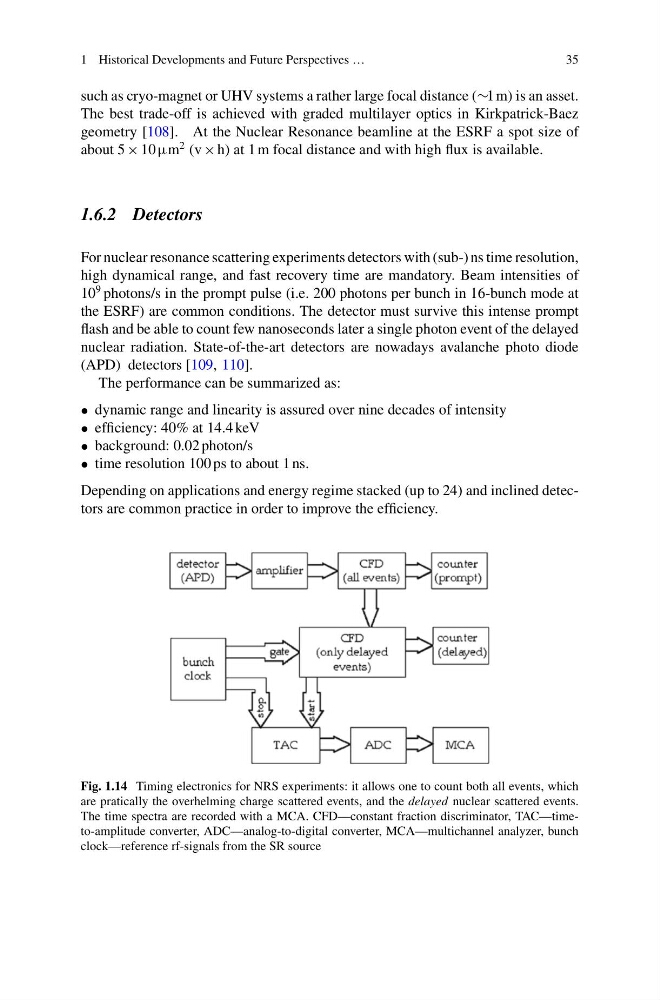
Fig. 1.14 Timing electronics for NRS experiments: it allows one to count both all events, which
are pratically the overhelming charge scattered events, and the delayed nuclear scattered events.
The time spectra are recorded with a MCA. CFD—constant fraction discriminator, TAC—timeto-amplitude converter, ADC—analog-to-digital converter, MCA—multichannel analyzer, bunch
clock—reference rf-signals from the SR source
35
such as cryo-magnet or UHV systems a rather large focal distance (∼1 m) is an asset.
The best trade-off is achieved with graded multilayer optics in Kirkpatrick-Baez
geometry [108]. At the Nuclear Resonance beamline at the ESRF a spot size of
about 5 × 10 μm
2 (v × h) at 1 m focal distance and with high flux is available.
1.6.2 Detectors
For nuclear resonance scattering experiments detectors with (sub-) ns time resolution,
high dynamical range, and fast recovery time are mandatory. Beam intensities of
10
9 photons/s in the prompt pulse (i.e. 200 photons per bunch in 16-bunch mode at
the ESRF) are common conditions. The detector must survive this intense prompt
flash and be able to count few nanoseconds later a single photon event of the delayed
nuclear radiation. State-of-the-art detectors are nowadays avalanche photo diode
(APD) detectors [109, 110].
The performance can be summarized as:
• dynamic range and linearity is assured over nine decades of intensity
• efficiency: 40% at 14.4 keV
• background: 0.02 photon/s
• time resolution 100 ps to about 1 ns.
Depending on applications and energy regime stacked (up to 24) and inclined detectors are common practice in order to improve the efficiency.
Fig. 1.14 Timing electronics for NRS experiments: it allows one to count both all events, which
are pratically the overhelming charge scattered events, and the delayed nuclear scattered events.
The time spectra are recorded with a MCA. CFD—constant fraction discriminator, TAC—timeto-amplitude converter, ADC—analog-to-digital converter, MCA—multichannel analyzer, bunch
clock—reference rf-signals from the SR source