

34
R. Rüffer and A. I. Chumakov
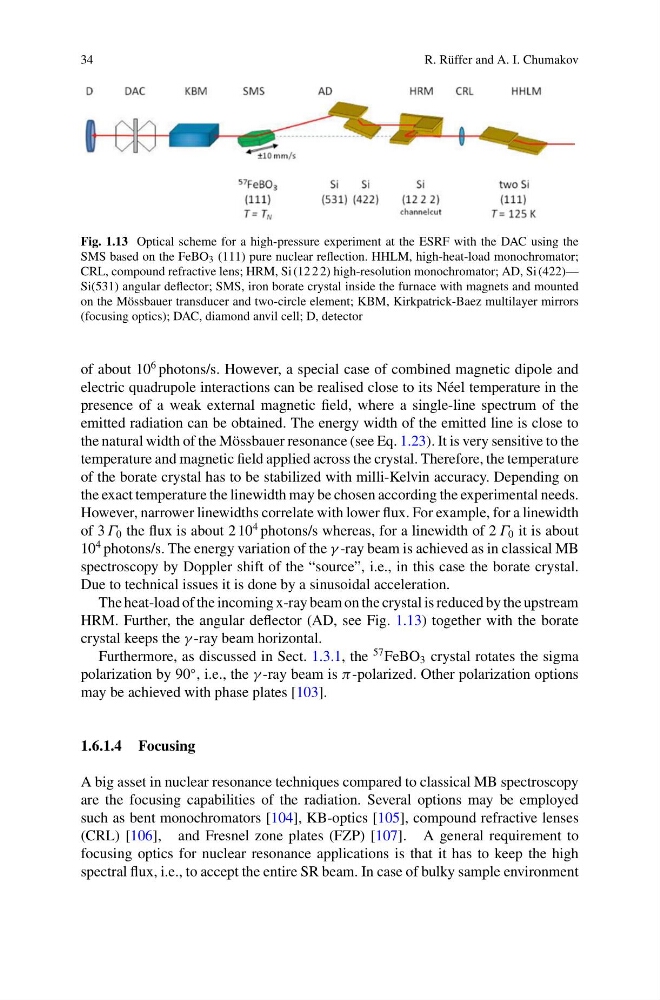
Fig. 1.13 Optical scheme for a high-pressure experiment at the ESRF with the DAC using the
SMS based on the FeBO 3 (111) pure nuclear reflection. HHLM, high-heat-load monochromator;
CRL, compound refractive lens; HRM, Si (12 2 2) high-resolution monochromator; AD, Si (422)—
Si(531) angular deflector; SMS, iron borate crystal inside the furnace with magnets and mounted
on the Mössbauer transducer and two-circle element; KBM, Kirkpatrick-Baez multilayer mirrors
(focusing optics); DAC, diamond anvil cell; D, detector
of about 10
6 photons/s. However, a special case of combined magnetic dipole and
electric quadrupole interactions can be realised close to its Néel temperature in the
presence of a weak external magnetic field, where a single-line spectrum of the
emitted radiation can be obtained. The energy width of the emitted line is close to
the natural width of the Mössbauer resonance (see Eq. 1.23). It is very sensitive to the
temperature and magnetic field applied across the crystal. Therefore, the temperature
of the borate crystal has to be stabilized with milli-Kelvin accuracy. Depending on
the exact temperature the linewidth may be chosen according the experimental needs.
However, narrower linewidths correlate with lower flux. For example, for a linewidth
of 3 Γ 0 the flux is about 2 10
4 photons/s whereas, for a linewidth of 2 Γ 0 it is about
10
4 photons/s. The energy variation of the γ -ray beam is achieved as in classical MB
spectroscopy by Doppler shift of the “source”, i.e., in this case the borate crystal.
Due to technical issues it is done by a sinusoidal acceleration.
The heat-load of the incoming x-ray beam on the crystal is reduced by the upstream
HRM. Further, the angular deflector (AD, see Fig. 1.13) together with the borate
crystal keeps the γ -ray beam horizontal.
Furthermore, as discussed in Sect. 1.3.1, the
57 FeBO 3 crystal rotates the sigma
polarization by 90
◦ , i.e., the γ -ray beam is π -polarized. Other polarization options
may be achieved with phase plates [103].
1.6.1.4 Focusing
A big asset in nuclear resonance techniques compared to classical MB spectroscopy
are the focusing capabilities of the radiation. Several options may be employed
such as bent monochromators [104], KB-optics [105], compound refractive lenses
(CRL) [106], and Fresnel zone plates (FZP) [107]. A general requirement to
focusing optics for nuclear resonance applications is that it has to keep the high
spectral flux, i.e., to accept the entire SR beam. In case of bulky sample environment
R. Rüffer and A. I. Chumakov
Fig. 1.13 Optical scheme for a high-pressure experiment at the ESRF with the DAC using the
SMS based on the FeBO 3 (111) pure nuclear reflection. HHLM, high-heat-load monochromator;
CRL, compound refractive lens; HRM, Si (12 2 2) high-resolution monochromator; AD, Si (422)—
Si(531) angular deflector; SMS, iron borate crystal inside the furnace with magnets and mounted
on the Mössbauer transducer and two-circle element; KBM, Kirkpatrick-Baez multilayer mirrors
(focusing optics); DAC, diamond anvil cell; D, detector
of about 10
6 photons/s. However, a special case of combined magnetic dipole and
electric quadrupole interactions can be realised close to its Néel temperature in the
presence of a weak external magnetic field, where a single-line spectrum of the
emitted radiation can be obtained. The energy width of the emitted line is close to
the natural width of the Mössbauer resonance (see Eq. 1.23). It is very sensitive to the
temperature and magnetic field applied across the crystal. Therefore, the temperature
of the borate crystal has to be stabilized with milli-Kelvin accuracy. Depending on
the exact temperature the linewidth may be chosen according the experimental needs.
However, narrower linewidths correlate with lower flux. For example, for a linewidth
of 3 Γ 0 the flux is about 2 10
4 photons/s whereas, for a linewidth of 2 Γ 0 it is about
10
4 photons/s. The energy variation of the γ -ray beam is achieved as in classical MB
spectroscopy by Doppler shift of the “source”, i.e., in this case the borate crystal.
Due to technical issues it is done by a sinusoidal acceleration.
The heat-load of the incoming x-ray beam on the crystal is reduced by the upstream
HRM. Further, the angular deflector (AD, see Fig. 1.13) together with the borate
crystal keeps the γ -ray beam horizontal.
Furthermore, as discussed in Sect. 1.3.1, the
57 FeBO 3 crystal rotates the sigma
polarization by 90
◦ , i.e., the γ -ray beam is π -polarized. Other polarization options
may be achieved with phase plates [103].
1.6.1.4 Focusing
A big asset in nuclear resonance techniques compared to classical MB spectroscopy
are the focusing capabilities of the radiation. Several options may be employed
such as bent monochromators [104], KB-optics [105], compound refractive lenses
(CRL) [106], and Fresnel zone plates (FZP) [107]. A general requirement to
focusing optics for nuclear resonance applications is that it has to keep the high
spectral flux, i.e., to accept the entire SR beam. In case of bulky sample environment