

482
Y. Yoshida
(a)
(b)
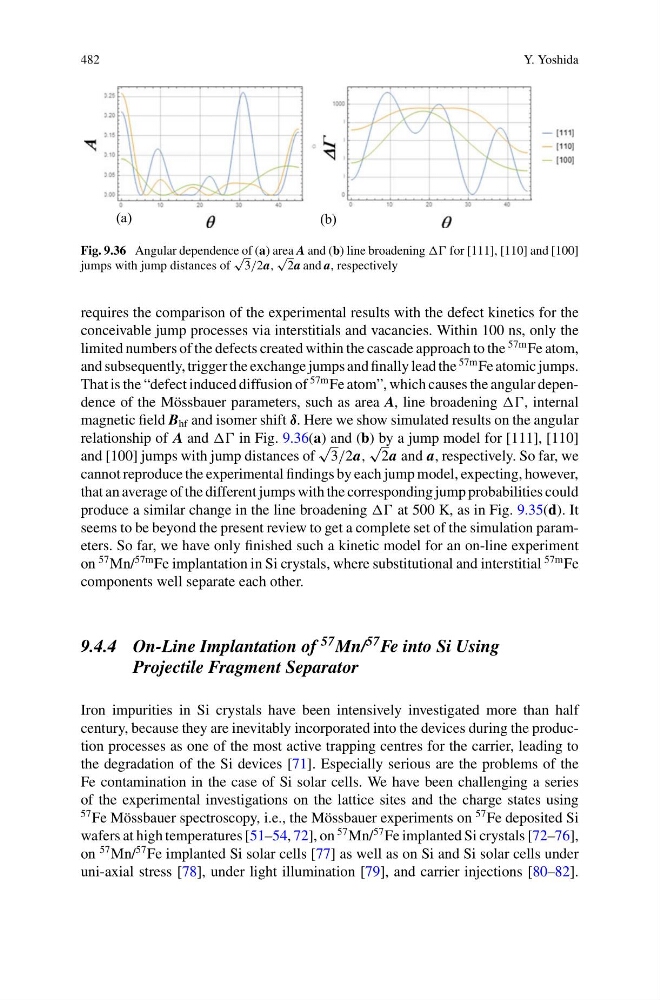
Fig. 9.36 Angular dependence of (a) area A and (b) line broadening for [111], [110] and [100]
jumps with jump distances of
√
3/2a,
√
2a and a, respectively
requires the comparison of the experimental results with the defect kinetics for the
conceivable jump processes via interstitials and vacancies. Within 100 ns, only the
limited numbers of the defects created within the cascade approach to the
57m Fe atom,
and subsequently, trigger the exchange jumps and finally lead the
57m Fe atomic jumps.
That is the “defect induced diffusion of
57m Fe atom”, which causes the angular dependence of the Mössbauer parameters, such as area A, line broadening , internal
magnetic field B hf and isomer shift δ. Here we show simulated results on the angular
relationship of A and in Fig. 9.36(a) and (b) by a jump model for [111], [110]
and [100] jumps with jump distances of
√
3/2a,
√
2a and a, respectively. So far, we
cannot reproduce the experimental findings by each jump model, expecting, however,
that an average of the different jumps with the corresponding jump probabilities could
produce a similar change in the line broadening at 500 K, as in Fig. 9.35(d). It
seems to be beyond the present review to get a complete set of the simulation parameters. So far, we have only finished such a kinetic model for an on-line experiment
on
57 Mn/
57m Fe implantation in Si crystals, where substitutional and interstitial
57m Fe
components well separate each other.
9.4.4 On-Line Implantation of 57 Mn/ 57 Fe into Si Using
Projectile Fragment Separator
Iron impurities in Si crystals have been intensively investigated more than half
century, because they are inevitably incorporated into the devices during the production processes as one of the most active trapping centres for the carrier, leading to
the degradation of the Si devices [71]. Especially serious are the problems of the
Fe contamination in the case of Si solar cells. We have been challenging a series
of the experimental investigations on the lattice sites and the charge states using
57 Fe Mössbauer spectroscopy, i.e., the Mössbauer experiments on
57 Fe deposited Si
wafers at high temperatures [51–54, 72], on
57 Mn/
57 Fe implanted Si crystals [72–76],
on
57 Mn/
57 Fe implanted Si solar cells [77] as well as on Si and Si solar cells under
uni-axial stress [78], under light illumination [79], and carrier injections [80–82].
Y. Yoshida
(a)
(b)
Fig. 9.36 Angular dependence of (a) area A and (b) line broadening for [111], [110] and [100]
jumps with jump distances of
√
3/2a,
√
2a and a, respectively
requires the comparison of the experimental results with the defect kinetics for the
conceivable jump processes via interstitials and vacancies. Within 100 ns, only the
limited numbers of the defects created within the cascade approach to the
57m Fe atom,
and subsequently, trigger the exchange jumps and finally lead the
57m Fe atomic jumps.
That is the “defect induced diffusion of
57m Fe atom”, which causes the angular dependence of the Mössbauer parameters, such as area A, line broadening , internal
magnetic field B hf and isomer shift δ. Here we show simulated results on the angular
relationship of A and in Fig. 9.36(a) and (b) by a jump model for [111], [110]
and [100] jumps with jump distances of
√
3/2a,
√
2a and a, respectively. So far, we
cannot reproduce the experimental findings by each jump model, expecting, however,
that an average of the different jumps with the corresponding jump probabilities could
produce a similar change in the line broadening at 500 K, as in Fig. 9.35(d). It
seems to be beyond the present review to get a complete set of the simulation parameters. So far, we have only finished such a kinetic model for an on-line experiment
on
57 Mn/
57m Fe implantation in Si crystals, where substitutional and interstitial
57m Fe
components well separate each other.
9.4.4 On-Line Implantation of 57 Mn/ 57 Fe into Si Using
Projectile Fragment Separator
Iron impurities in Si crystals have been intensively investigated more than half
century, because they are inevitably incorporated into the devices during the production processes as one of the most active trapping centres for the carrier, leading to
the degradation of the Si devices [71]. Especially serious are the problems of the
Fe contamination in the case of Si solar cells. We have been challenging a series
of the experimental investigations on the lattice sites and the charge states using
57 Fe Mössbauer spectroscopy, i.e., the Mössbauer experiments on
57 Fe deposited Si
wafers at high temperatures [51–54, 72], on
57 Mn/
57 Fe implanted Si crystals [72–76],
on
57 Mn/
57 Fe implanted Si solar cells [77] as well as on Si and Si solar cells under
uni-axial stress [78], under light illumination [79], and carrier injections [80–82].