

9 Mössbauer Spectroscopic Studies on Atomic Diffusion in Materials
481
0
1 0
2 0
3 0
4 0
5 0
0.16
0.18
0.20
0.30
0.32
0.34
0.5
1.0
1.5
(c)
500 K
[110]
[100]
/mms
-1
700 K
(a)
A
700 K
500 K
27.0
27.5
30.5
31.0
0
1 0
2 0
3 0
40
50
0.30
0.35
0.40
0.45
0.50
(b)
700 K
[100]
[110]
500 K
B
hf
/ T
(d)
500 K
700 K
/ mms
-1
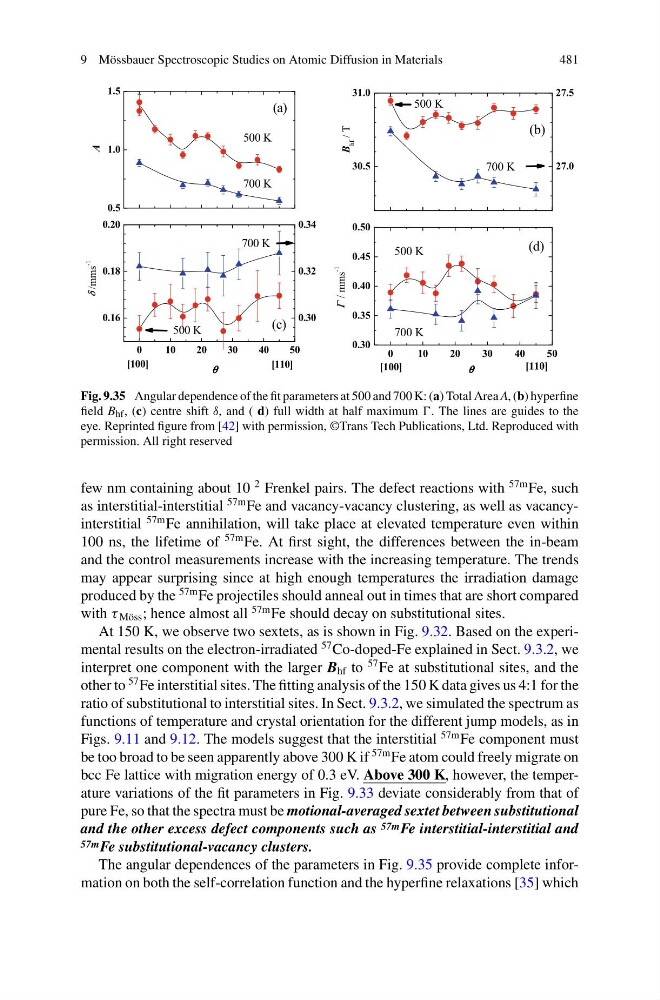
Fig. 9.35 Angular dependence of the fit parameters at 500 and 700 K: (a) Total Area A, (b) hyperfine
field B hf , (c) centre shift δ, and ( d) full width at half maximum . The lines are guides to the
eye. Reprinted figure from [42] with permission, ©Trans Tech Publications, Ltd. Reproduced with
permission. All right reserved
few nm containing about 10
2 Frenkel pairs. The defect reactions with
57m Fe, such
as interstitial-interstitial
57m Fe and vacancy-vacancy clustering, as well as vacancyinterstitial
57m Fe annihilation, will take place at elevated temperature even within
100 ns, the lifetime of
57m Fe. At first sight, the differences between the in-beam
and the control measurements increase with the increasing temperature. The trends
may appear surprising since at high enough temperatures the irradiation damage
produced by the
57m Fe projectiles should anneal out in times that are short compared
with τ Möss ; hence almost all
57m Fe should decay on substitutional sites.
At 150 K, we observe two sextets, as is shown in Fig. 9.32. Based on the experimental results on the electron-irradiated
57 Co-doped-Fe explained in Sect. 9.3.2, we
interpret one component with the larger B hf to
57 Fe at substitutional sites, and the
other to
57 Fe interstitial sites. The fitting analysis of the 150 K data gives us 4:1 for the
ratio of substitutional to interstitial sites. In Sect. 9.3.2, we simulated the spectrum as
functions of temperature and crystal orientation for the different jump models, as in
Figs. 9.11 and 9.12. The models suggest that the interstitial
57m Fe component must
be too broad to be seen apparently above 300 K if
57m Fe atom could freely migrate on
bcc Fe lattice with migration energy of 0.3 eV. Above 300 K, however, the temperature variations of the fit parameters in Fig. 9.33 deviate considerably from that of
pure Fe, so that the spectra must be motional-averaged sextet between substitutional
and the other excess defect components such as 57m Fe interstitial-interstitial and
57m Fe substitutional-vacancy clusters.
The angular dependences of the parameters in Fig. 9.35 provide complete information on both the self-correlation function and the hyperfine relaxations [35] which
481
0
1 0
2 0
3 0
4 0
5 0
0.16
0.18
0.20
0.30
0.32
0.34
0.5
1.0
1.5
(c)
500 K
[110]
[100]
/mms
-1
700 K
(a)
A
700 K
500 K
27.0
27.5
30.5
31.0
0
1 0
2 0
3 0
40
50
0.30
0.35
0.40
0.45
0.50
(b)
700 K
[100]
[110]
500 K
B
hf
/ T
(d)
500 K
700 K
/ mms
-1
Fig. 9.35 Angular dependence of the fit parameters at 500 and 700 K: (a) Total Area A, (b) hyperfine
field B hf , (c) centre shift δ, and ( d) full width at half maximum . The lines are guides to the
eye. Reprinted figure from [42] with permission, ©Trans Tech Publications, Ltd. Reproduced with
permission. All right reserved
few nm containing about 10
2 Frenkel pairs. The defect reactions with
57m Fe, such
as interstitial-interstitial
57m Fe and vacancy-vacancy clustering, as well as vacancyinterstitial
57m Fe annihilation, will take place at elevated temperature even within
100 ns, the lifetime of
57m Fe. At first sight, the differences between the in-beam
and the control measurements increase with the increasing temperature. The trends
may appear surprising since at high enough temperatures the irradiation damage
produced by the
57m Fe projectiles should anneal out in times that are short compared
with τ Möss ; hence almost all
57m Fe should decay on substitutional sites.
At 150 K, we observe two sextets, as is shown in Fig. 9.32. Based on the experimental results on the electron-irradiated
57 Co-doped-Fe explained in Sect. 9.3.2, we
interpret one component with the larger B hf to
57 Fe at substitutional sites, and the
other to
57 Fe interstitial sites. The fitting analysis of the 150 K data gives us 4:1 for the
ratio of substitutional to interstitial sites. In Sect. 9.3.2, we simulated the spectrum as
functions of temperature and crystal orientation for the different jump models, as in
Figs. 9.11 and 9.12. The models suggest that the interstitial
57m Fe component must
be too broad to be seen apparently above 300 K if
57m Fe atom could freely migrate on
bcc Fe lattice with migration energy of 0.3 eV. Above 300 K, however, the temperature variations of the fit parameters in Fig. 9.33 deviate considerably from that of
pure Fe, so that the spectra must be motional-averaged sextet between substitutional
and the other excess defect components such as 57m Fe interstitial-interstitial and
57m Fe substitutional-vacancy clusters.
The angular dependences of the parameters in Fig. 9.35 provide complete information on both the self-correlation function and the hyperfine relaxations [35] which