

476
Y. Yoshida
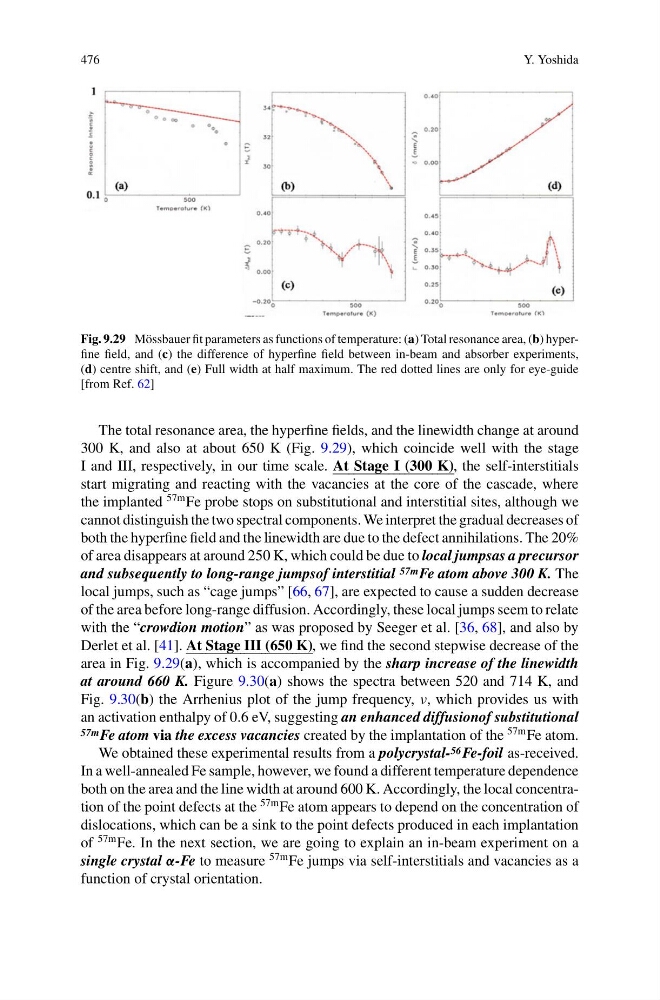
Fig. 9.29 Mössbauer fit parameters as functions of temperature: (a) Total resonance area, (b) hyperfine field, and (c) the difference of hyperfine field between in-beam and absorber experiments,
(d) centre shift, and (e) Full width at half maximum. The red dotted lines are only for eye-guide
[from Ref. 62]
The total resonance area, the hyperfine fields, and the linewidth change at around
300 K, and also at about 650 K (Fig. 9.29), which coincide well with the stage
I and III, respectively, in our time scale. At Stage I (300 K), the self-interstitials
start migrating and reacting with the vacancies at the core of the cascade, where
the implanted
57m Fe probe stops on substitutional and interstitial sites, although we
cannot distinguish the two spectral components. We interpret the gradual decreases of
both the hyperfine field and the linewidth are due to the defect annihilations. The 20%
of area disappears at around 250 K, which could be due to local jumpsas a precursor
and subsequently to long-range jumpsof interstitial 57m Fe atom above 300 K. The
local jumps, such as “cage jumps” [66, 67], are expected to cause a sudden decrease
of the area before long-range diffusion. Accordingly, these local jumps seem to relate
with the “crowdion motion” as was proposed by Seeger et al. [36, 68], and also by
Derlet et al. [41]. At Stage III (650 K), we find the second stepwise decrease of the
area in Fig. 9.29(a), which is accompanied by the sharp increase of the linewidth
at around 660 K. Figure 9.30(a) shows the spectra between 520 and 714 K, and
Fig. 9.30(b) the Arrhenius plot of the jump frequency, ν, which provides us with
an activation enthalpy of 0.6 eV, suggesting an enhanced diffusionof substitutional
57m Fe atom via the excess vacancies created by the implantation of the
57m Fe atom.
We obtained these experimental results from a polycrystal- 56 Fe-foil as-received.
In a well-annealed Fe sample, however, we found a different temperature dependence
both on the area and the line width at around 600 K. Accordingly, the local concentration of the point defects at the
57m Fe atom appears to depend on the concentration of
dislocations, which can be a sink to the point defects produced in each implantation
of
57m Fe. In the next section, we are going to explain an in-beam experiment on a
single crystal α-Fe to measure
57m Fe jumps via self-interstitials and vacancies as a
function of crystal orientation.
Y. Yoshida
Fig. 9.29 Mössbauer fit parameters as functions of temperature: (a) Total resonance area, (b) hyperfine field, and (c) the difference of hyperfine field between in-beam and absorber experiments,
(d) centre shift, and (e) Full width at half maximum. The red dotted lines are only for eye-guide
[from Ref. 62]
The total resonance area, the hyperfine fields, and the linewidth change at around
300 K, and also at about 650 K (Fig. 9.29), which coincide well with the stage
I and III, respectively, in our time scale. At Stage I (300 K), the self-interstitials
start migrating and reacting with the vacancies at the core of the cascade, where
the implanted
57m Fe probe stops on substitutional and interstitial sites, although we
cannot distinguish the two spectral components. We interpret the gradual decreases of
both the hyperfine field and the linewidth are due to the defect annihilations. The 20%
of area disappears at around 250 K, which could be due to local jumpsas a precursor
and subsequently to long-range jumpsof interstitial 57m Fe atom above 300 K. The
local jumps, such as “cage jumps” [66, 67], are expected to cause a sudden decrease
of the area before long-range diffusion. Accordingly, these local jumps seem to relate
with the “crowdion motion” as was proposed by Seeger et al. [36, 68], and also by
Derlet et al. [41]. At Stage III (650 K), we find the second stepwise decrease of the
area in Fig. 9.29(a), which is accompanied by the sharp increase of the linewidth
at around 660 K. Figure 9.30(a) shows the spectra between 520 and 714 K, and
Fig. 9.30(b) the Arrhenius plot of the jump frequency, ν, which provides us with
an activation enthalpy of 0.6 eV, suggesting an enhanced diffusionof substitutional
57m Fe atom via the excess vacancies created by the implantation of the
57m Fe atom.
We obtained these experimental results from a polycrystal- 56 Fe-foil as-received.
In a well-annealed Fe sample, however, we found a different temperature dependence
both on the area and the line width at around 600 K. Accordingly, the local concentration of the point defects at the
57m Fe atom appears to depend on the concentration of
dislocations, which can be a sink to the point defects produced in each implantation
of
57m Fe. In the next section, we are going to explain an in-beam experiment on a
single crystal α-Fe to measure
57m Fe jumps via self-interstitials and vacancies as a
function of crystal orientation.