

464
Y. Yoshida
(b)
(a)
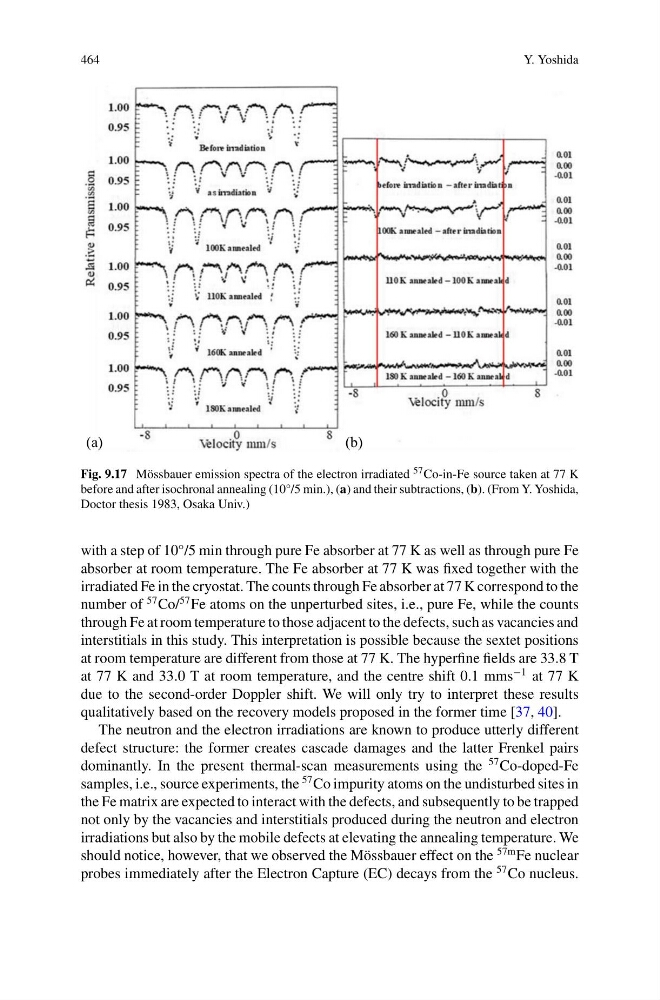
Fig. 9.17 Mössbauer emission spectra of the electron irradiated 57 Co-in-Fe source taken at 77 K
before and after isochronal annealing (10°/5 min.), (a) and their subtractions, (b). (From Y. Yoshida,
Doctor thesis 1983, Osaka Univ.)
with a step of 10°/5 min through pure Fe absorber at 77 K as well as through pure Fe
absorber at room temperature. The Fe absorber at 77 K was fixed together with the
irradiated Fe in the cryostat. The counts through Fe absorber at 77 K correspond to the
number of
57 Co/
57 Fe atoms on the unperturbed sites, i.e., pure Fe, while the counts
through Fe at room temperature to those adjacent to the defects, such as vacancies and
interstitials in this study. This interpretation is possible because the sextet positions
at room temperature are different from those at 77 K. The hyperfine fields are 33.8 T
at 77 K and 33.0 T at room temperature, and the centre shift 0.1 mms
−1 at 77 K
due to the second-order Doppler shift. We will only try to interpret these results
qualitatively based on the recovery models proposed in the former time [37, 40].
The neutron and the electron irradiations are known to produce utterly different
defect structure: the former creates cascade damages and the latter Frenkel pairs
dominantly. In the present thermal-scan measurements using the
57 Co-doped-Fe
samples, i.e., source experiments, the
57 Co impurity atoms on the undisturbed sites in
the Fe matrix are expected to interact with the defects, and subsequently to be trapped
not only by the vacancies and interstitials produced during the neutron and electron
irradiations but also by the mobile defects at elevating the annealing temperature. We
should notice, however, that we observed the Mössbauer effect on the
57m Fe nuclear
probes immediately after the Electron Capture (EC) decays from the
57 Co nucleus.
Y. Yoshida
(b)
(a)
Fig. 9.17 Mössbauer emission spectra of the electron irradiated 57 Co-in-Fe source taken at 77 K
before and after isochronal annealing (10°/5 min.), (a) and their subtractions, (b). (From Y. Yoshida,
Doctor thesis 1983, Osaka Univ.)
with a step of 10°/5 min through pure Fe absorber at 77 K as well as through pure Fe
absorber at room temperature. The Fe absorber at 77 K was fixed together with the
irradiated Fe in the cryostat. The counts through Fe absorber at 77 K correspond to the
number of
57 Co/
57 Fe atoms on the unperturbed sites, i.e., pure Fe, while the counts
through Fe at room temperature to those adjacent to the defects, such as vacancies and
interstitials in this study. This interpretation is possible because the sextet positions
at room temperature are different from those at 77 K. The hyperfine fields are 33.8 T
at 77 K and 33.0 T at room temperature, and the centre shift 0.1 mms
−1 at 77 K
due to the second-order Doppler shift. We will only try to interpret these results
qualitatively based on the recovery models proposed in the former time [37, 40].
The neutron and the electron irradiations are known to produce utterly different
defect structure: the former creates cascade damages and the latter Frenkel pairs
dominantly. In the present thermal-scan measurements using the
57 Co-doped-Fe
samples, i.e., source experiments, the
57 Co impurity atoms on the undisturbed sites in
the Fe matrix are expected to interact with the defects, and subsequently to be trapped
not only by the vacancies and interstitials produced during the neutron and electron
irradiations but also by the mobile defects at elevating the annealing temperature. We
should notice, however, that we observed the Mössbauer effect on the
57m Fe nuclear
probes immediately after the Electron Capture (EC) decays from the
57 Co nucleus.