

434
M. Reissner
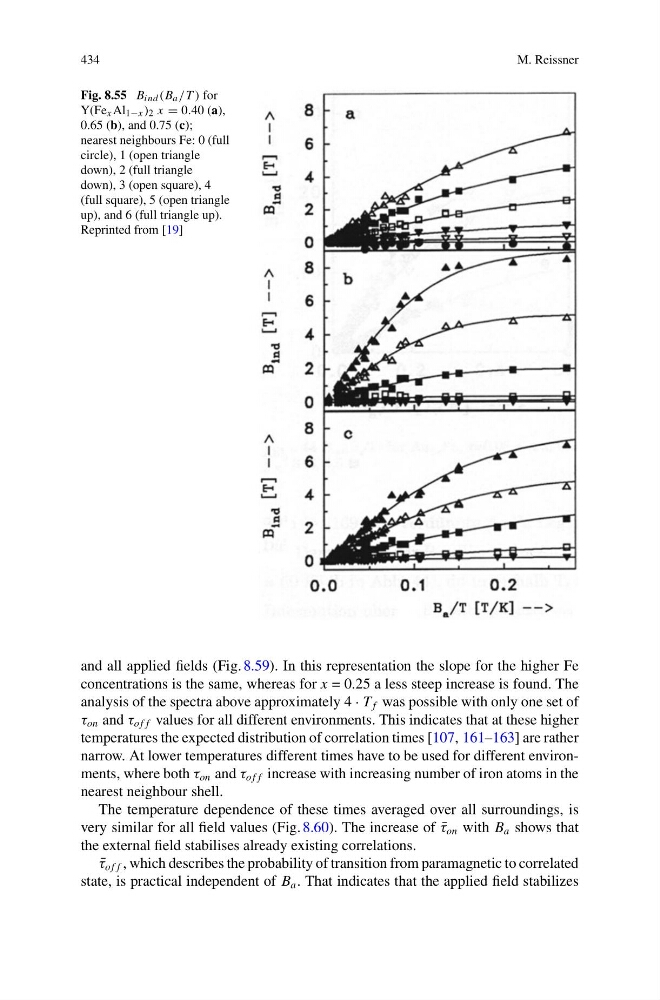
Fig. 8.55 B ind (B a /T ) for
Y(Fe x Al 1−x ) 2 x = 0.40 (a),
0.65 (b), and 0.75 (c);
nearest neighbours Fe: 0 (full
circle), 1 (open triangle
down), 2 (full triangle
down), 3 (open square), 4
(full square), 5 (open triangle
up), and 6 (full triangle up).
Reprinted from [19]
and all applied fields (Fig. 8.59). In this representation the slope for the higher Fe
concentrations is the same, whereas for x = 0.25 a less steep increase is found. The
analysis of the spectra above approximately 4 · T f was possible with only one set of
τ on and τ of f values for all different environments. This indicates that at these higher
temperatures the expected distribution of correlation times [107, 161–163] are rather
narrow. At lower temperatures different times have to be used for different environments, where both τ on and τ of f increase with increasing number of iron atoms in the
nearest neighbour shell.
The temperature dependence of these times averaged over all surroundings, is
very similar for all field values (Fig. 8.60). The increase of ¯
τ on with B a shows that
the external field stabilises already existing correlations.
¯
τ of f , which describes the probability of transition from paramagnetic to correlated
state, is practical independent of B a . That indicates that the applied field stabilizes
M. Reissner
Fig. 8.55 B ind (B a /T ) for
Y(Fe x Al 1−x ) 2 x = 0.40 (a),
0.65 (b), and 0.75 (c);
nearest neighbours Fe: 0 (full
circle), 1 (open triangle
down), 2 (full triangle
down), 3 (open square), 4
(full square), 5 (open triangle
up), and 6 (full triangle up).
Reprinted from [19]
and all applied fields (Fig. 8.59). In this representation the slope for the higher Fe
concentrations is the same, whereas for x = 0.25 a less steep increase is found. The
analysis of the spectra above approximately 4 · T f was possible with only one set of
τ on and τ of f values for all different environments. This indicates that at these higher
temperatures the expected distribution of correlation times [107, 161–163] are rather
narrow. At lower temperatures different times have to be used for different environments, where both τ on and τ of f increase with increasing number of iron atoms in the
nearest neighbour shell.
The temperature dependence of these times averaged over all surroundings, is
very similar for all field values (Fig. 8.60). The increase of ¯
τ on with B a shows that
the external field stabilises already existing correlations.
¯
τ of f , which describes the probability of transition from paramagnetic to correlated
state, is practical independent of B a . That indicates that the applied field stabilizes