

8 Mössbauer Spectroscopy in External Magnetic Fields
429
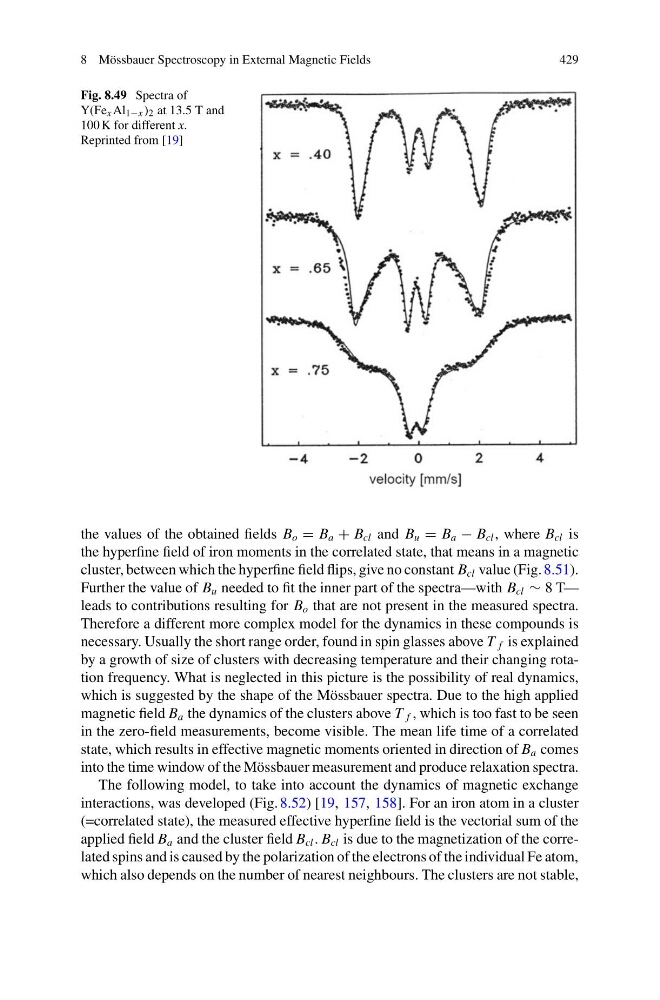
Fig. 8.49 Spectra of
Y(Fe x Al 1−x ) 2 at 13.5 T and
100 K for different x.
Reprinted from [19]
the values of the obtained fields B o = B a + B cl and B u = B a − B cl , where B cl is
the hyperfine field of iron moments in the correlated state, that means in a magnetic
cluster, between which the hyperfine field flips, give no constant B cl value (Fig. 8.51).
Further the value of B u needed to fit the inner part of the spectra—with B cl ∼ 8 T—
leads to contributions resulting for B o that are not present in the measured spectra.
Therefore a different more complex model for the dynamics in these compounds is
necessary. Usually the short range order, found in spin glasses above T f is explained
by a growth of size of clusters with decreasing temperature and their changing rotation frequency. What is neglected in this picture is the possibility of real dynamics,
which is suggested by the shape of the Mössbauer spectra. Due to the high applied
magnetic field B a the dynamics of the clusters above T f , which is too fast to be seen
in the zero-field measurements, become visible. The mean life time of a correlated
state, which results in effective magnetic moments oriented in direction of B a comes
into the time window of the Mössbauer measurement and produce relaxation spectra.
The following model, to take into account the dynamics of magnetic exchange
interactions, was developed (Fig. 8.52) [19, 157, 158]. For an iron atom in a cluster
(=correlated state), the measured effective hyperfine field is the vectorial sum of the
applied field B a and the cluster field B cl . B cl is due to the magnetization of the correlated spins and is caused by the polarization of the electrons of the individual Fe atom,
which also depends on the number of nearest neighbours. The clusters are not stable,
429
Fig. 8.49 Spectra of
Y(Fe x Al 1−x ) 2 at 13.5 T and
100 K for different x.
Reprinted from [19]
the values of the obtained fields B o = B a + B cl and B u = B a − B cl , where B cl is
the hyperfine field of iron moments in the correlated state, that means in a magnetic
cluster, between which the hyperfine field flips, give no constant B cl value (Fig. 8.51).
Further the value of B u needed to fit the inner part of the spectra—with B cl ∼ 8 T—
leads to contributions resulting for B o that are not present in the measured spectra.
Therefore a different more complex model for the dynamics in these compounds is
necessary. Usually the short range order, found in spin glasses above T f is explained
by a growth of size of clusters with decreasing temperature and their changing rotation frequency. What is neglected in this picture is the possibility of real dynamics,
which is suggested by the shape of the Mössbauer spectra. Due to the high applied
magnetic field B a the dynamics of the clusters above T f , which is too fast to be seen
in the zero-field measurements, become visible. The mean life time of a correlated
state, which results in effective magnetic moments oriented in direction of B a comes
into the time window of the Mössbauer measurement and produce relaxation spectra.
The following model, to take into account the dynamics of magnetic exchange
interactions, was developed (Fig. 8.52) [19, 157, 158]. For an iron atom in a cluster
(=correlated state), the measured effective hyperfine field is the vectorial sum of the
applied field B a and the cluster field B cl . B cl is due to the magnetization of the correlated spins and is caused by the polarization of the electrons of the individual Fe atom,
which also depends on the number of nearest neighbours. The clusters are not stable,