

428
M. Reissner
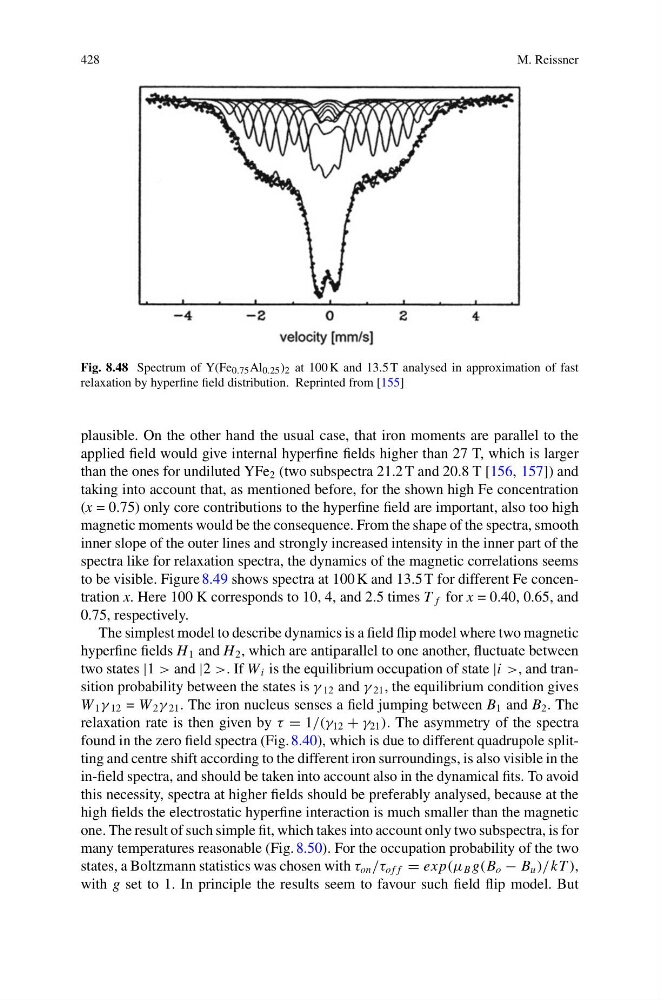
Fig. 8.48 Spectrum of Y(Fe 0.75 Al 0.25 ) 2 at 100 K and 13.5 T analysed in approximation of fast
relaxation by hyperfine field distribution. Reprinted from [155]
plausible. On the other hand the usual case, that iron moments are parallel to the
applied field would give internal hyperfine fields higher than 27 T, which is larger
than the ones for undiluted YFe 2 (two subspectra 21.2 T and 20.8 T [156, 157]) and
taking into account that, as mentioned before, for the shown high Fe concentration
(x = 0.75) only core contributions to the hyperfine field are important, also too high
magnetic moments would be the consequence. From the shape of the spectra, smooth
inner slope of the outer lines and strongly increased intensity in the inner part of the
spectra like for relaxation spectra, the dynamics of the magnetic correlations seems
to be visible. Figure 8.49 shows spectra at 100 K and 13.5 T for different Fe concentration x. Here 100 K corresponds to 10, 4, and 2.5 times T f for x = 0.40, 0.65, and
0.75, respectively.
The simplest model to describe dynamics is a field flip model where two magnetic
hyperfine fields H 1 and H 2 , which are antiparallel to one another, fluctuate between
two states |1 > and |2 >. If W i is the equilibrium occupation of state |i >, and transition probability between the states is γ 12 and γ 21 , the equilibrium condition gives
W 1 γ 12 = W 2 γ 21 . The iron nucleus senses a field jumping between B 1 and B 2 . The
relaxation rate is then given by τ = 1/(γ 12 + γ 21 ). The asymmetry of the spectra
found in the zero field spectra (Fig. 8.40), which is due to different quadrupole splitting and centre shift according to the different iron surroundings, is also visible in the
in-field spectra, and should be taken into account also in the dynamical fits. To avoid
this necessity, spectra at higher fields should be preferably analysed, because at the
high fields the electrostatic hyperfine interaction is much smaller than the magnetic
one. The result of such simple fit, which takes into account only two subspectra, is for
many temperatures reasonable (Fig. 8.50). For the occupation probability of the two
states, a Boltzmann statistics was chosen with τ on /τ of f = ex p(μ B g(B o − B u )/kT ),
with g set to 1. In principle the results seem to favour such field flip model. But
M. Reissner
Fig. 8.48 Spectrum of Y(Fe 0.75 Al 0.25 ) 2 at 100 K and 13.5 T analysed in approximation of fast
relaxation by hyperfine field distribution. Reprinted from [155]
plausible. On the other hand the usual case, that iron moments are parallel to the
applied field would give internal hyperfine fields higher than 27 T, which is larger
than the ones for undiluted YFe 2 (two subspectra 21.2 T and 20.8 T [156, 157]) and
taking into account that, as mentioned before, for the shown high Fe concentration
(x = 0.75) only core contributions to the hyperfine field are important, also too high
magnetic moments would be the consequence. From the shape of the spectra, smooth
inner slope of the outer lines and strongly increased intensity in the inner part of the
spectra like for relaxation spectra, the dynamics of the magnetic correlations seems
to be visible. Figure 8.49 shows spectra at 100 K and 13.5 T for different Fe concentration x. Here 100 K corresponds to 10, 4, and 2.5 times T f for x = 0.40, 0.65, and
0.75, respectively.
The simplest model to describe dynamics is a field flip model where two magnetic
hyperfine fields H 1 and H 2 , which are antiparallel to one another, fluctuate between
two states |1 > and |2 >. If W i is the equilibrium occupation of state |i >, and transition probability between the states is γ 12 and γ 21 , the equilibrium condition gives
W 1 γ 12 = W 2 γ 21 . The iron nucleus senses a field jumping between B 1 and B 2 . The
relaxation rate is then given by τ = 1/(γ 12 + γ 21 ). The asymmetry of the spectra
found in the zero field spectra (Fig. 8.40), which is due to different quadrupole splitting and centre shift according to the different iron surroundings, is also visible in the
in-field spectra, and should be taken into account also in the dynamical fits. To avoid
this necessity, spectra at higher fields should be preferably analysed, because at the
high fields the electrostatic hyperfine interaction is much smaller than the magnetic
one. The result of such simple fit, which takes into account only two subspectra, is for
many temperatures reasonable (Fig. 8.50). For the occupation probability of the two
states, a Boltzmann statistics was chosen with τ on /τ of f = ex p(μ B g(B o − B u )/kT ),
with g set to 1. In principle the results seem to favour such field flip model. But