

424
M. Reissner
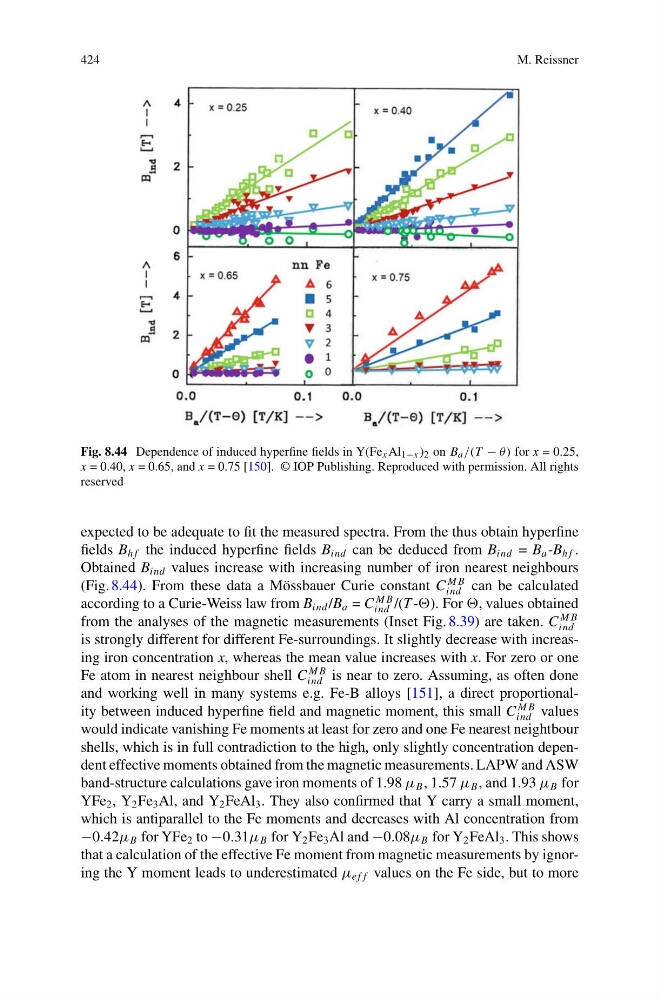
Fig. 8.44 Dependence of induced hyperfine fields in Y(Fe x Al 1−x ) 2 on B a /(T − θ) for x = 0.25,
x = 0.40, x = 0.65, and x = 0.75 [150]. © IOP Publishing. Reproduced with permission. All rights
reserved
expected to be adequate to fit the measured spectra. From the thus obtain hyperfine
fields B h f the induced hyperfine fields B ind can be deduced from B ind = B a -B h f .
Obtained B ind values increase with increasing number of iron nearest neighbours
(Fig. 8.44). From these data a Mössbauer Curie constant C
M B
ind can be calculated
according to a Curie-Weiss law from B ind /B a = C
M B
ind /(T -). For , values obtained
from the analyses of the magnetic measurements (Inset Fig. 8.39) are taken. C
M B
ind
is strongly different for different Fe-surroundings. It slightly decrease with increasing iron concentration x, whereas the mean value increases with x. For zero or one
Fe atom in nearest neighbour shell C
M B
ind is near to zero. Assuming, as often done
and working well in many systems e.g. Fe-B alloys [151], a direct proportionality between induced hyperfine field and magnetic moment, this small C
M B
ind values
would indicate vanishing Fe moments at least for zero and one Fe nearest neightbour
shells, which is in full contradiction to the high, only slightly concentration dependent effective moments obtained from the magnetic measurements. LAPW and ASW
band-structure calculations gave iron moments of 1.98 μ B , 1.57 μ B , and 1.93 μ B for
YFe 2 , Y 2 Fe 3 Al, and Y 2 FeAl 3 . They also confirmed that Y carry a small moment,
which is antiparallel to the Fe moments and decreases with Al concentration from
−0.42μ B for YFe 2 to −0.31μ B for Y 2 Fe 3 Al and −0.08μ B for Y 2 FeAl 3 . This shows
that a calculation of the effective Fe moment from magnetic measurements by ignoring the Y moment leads to underestimated μ e f f values on the Fe side, but to more
M. Reissner
Fig. 8.44 Dependence of induced hyperfine fields in Y(Fe x Al 1−x ) 2 on B a /(T − θ) for x = 0.25,
x = 0.40, x = 0.65, and x = 0.75 [150]. © IOP Publishing. Reproduced with permission. All rights
reserved
expected to be adequate to fit the measured spectra. From the thus obtain hyperfine
fields B h f the induced hyperfine fields B ind can be deduced from B ind = B a -B h f .
Obtained B ind values increase with increasing number of iron nearest neighbours
(Fig. 8.44). From these data a Mössbauer Curie constant C
M B
ind can be calculated
according to a Curie-Weiss law from B ind /B a = C
M B
ind /(T -). For , values obtained
from the analyses of the magnetic measurements (Inset Fig. 8.39) are taken. C
M B
ind
is strongly different for different Fe-surroundings. It slightly decrease with increasing iron concentration x, whereas the mean value increases with x. For zero or one
Fe atom in nearest neighbour shell C
M B
ind is near to zero. Assuming, as often done
and working well in many systems e.g. Fe-B alloys [151], a direct proportionality between induced hyperfine field and magnetic moment, this small C
M B
ind values
would indicate vanishing Fe moments at least for zero and one Fe nearest neightbour
shells, which is in full contradiction to the high, only slightly concentration dependent effective moments obtained from the magnetic measurements. LAPW and ASW
band-structure calculations gave iron moments of 1.98 μ B , 1.57 μ B , and 1.93 μ B for
YFe 2 , Y 2 Fe 3 Al, and Y 2 FeAl 3 . They also confirmed that Y carry a small moment,
which is antiparallel to the Fe moments and decreases with Al concentration from
−0.42μ B for YFe 2 to −0.31μ B for Y 2 Fe 3 Al and −0.08μ B for Y 2 FeAl 3 . This shows
that a calculation of the effective Fe moment from magnetic measurements by ignoring the Y moment leads to underestimated μ e f f values on the Fe side, but to more