

8 Mössbauer Spectroscopy in External Magnetic Fields
423
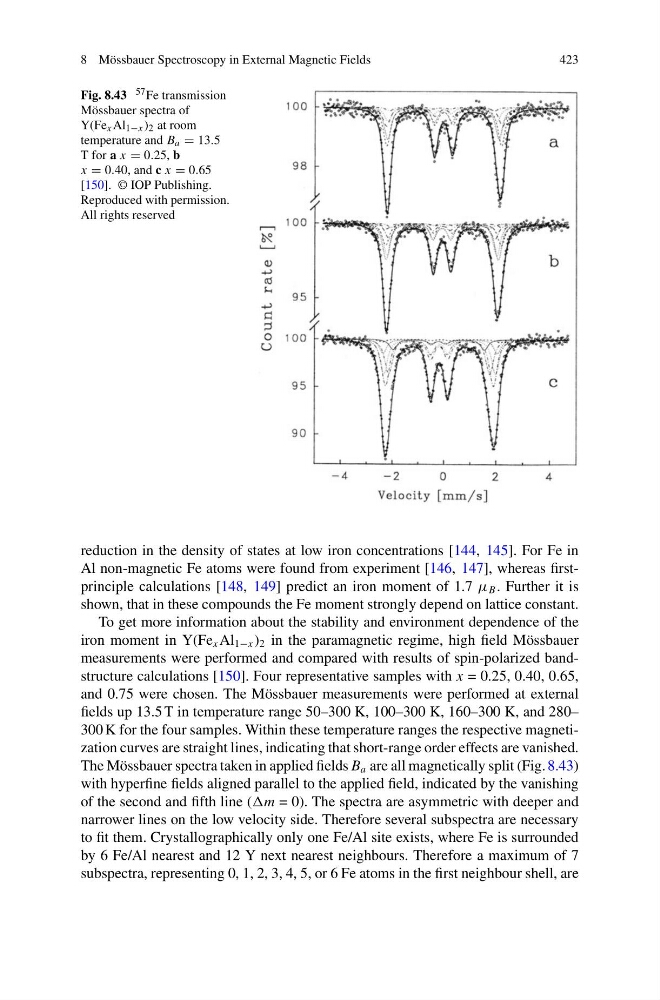
Fig. 8.43 57 Fe transmission
Mössbauer spectra of
Y(Fe x Al 1−x ) 2 at room
temperature and B a = 13.5
T for a x = 0.25, b
x = 0.40, and c x = 0.65
[150]. © IOP Publishing.
Reproduced with permission.
All rights reserved
reduction in the density of states at low iron concentrations [144, 145]. For Fe in
Al non-magnetic Fe atoms were found from experiment [146, 147], whereas firstprinciple calculations [148, 149] predict an iron moment of 1.7 μ B . Further it is
shown, that in these compounds the Fe moment strongly depend on lattice constant.
To get more information about the stability and environment dependence of the
iron moment in Y(Fe x Al 1−x ) 2 in the paramagnetic regime, high field Mössbauer
measurements were performed and compared with results of spin-polarized bandstructure calculations [150]. Four representative samples with x = 0.25, 0.40, 0.65,
and 0.75 were chosen. The Mössbauer measurements were performed at external
fields up 13.5 T in temperature range 50–300 K, 100–300 K, 160–300 K, and 280–
300 K for the four samples. Within these temperature ranges the respective magnetization curves are straight lines, indicating that short-range order effects are vanished.
The Mössbauer spectra taken in applied fields B a are all magnetically split (Fig. 8.43)
with hyperfine fields aligned parallel to the applied field, indicated by the vanishing
of the second and fifth line (m = 0). The spectra are asymmetric with deeper and
narrower lines on the low velocity side. Therefore several subspectra are necessary
to fit them. Crystallographically only one Fe/Al site exists, where Fe is surrounded
by 6 Fe/Al nearest and 12 Y next nearest neighbours. Therefore a maximum of 7
subspectra, representing 0, 1, 2, 3, 4, 5, or 6 Fe atoms in the first neighbour shell, are
423
Fig. 8.43 57 Fe transmission
Mössbauer spectra of
Y(Fe x Al 1−x ) 2 at room
temperature and B a = 13.5
T for a x = 0.25, b
x = 0.40, and c x = 0.65
[150]. © IOP Publishing.
Reproduced with permission.
All rights reserved
reduction in the density of states at low iron concentrations [144, 145]. For Fe in
Al non-magnetic Fe atoms were found from experiment [146, 147], whereas firstprinciple calculations [148, 149] predict an iron moment of 1.7 μ B . Further it is
shown, that in these compounds the Fe moment strongly depend on lattice constant.
To get more information about the stability and environment dependence of the
iron moment in Y(Fe x Al 1−x ) 2 in the paramagnetic regime, high field Mössbauer
measurements were performed and compared with results of spin-polarized bandstructure calculations [150]. Four representative samples with x = 0.25, 0.40, 0.65,
and 0.75 were chosen. The Mössbauer measurements were performed at external
fields up 13.5 T in temperature range 50–300 K, 100–300 K, 160–300 K, and 280–
300 K for the four samples. Within these temperature ranges the respective magnetization curves are straight lines, indicating that short-range order effects are vanished.
The Mössbauer spectra taken in applied fields B a are all magnetically split (Fig. 8.43)
with hyperfine fields aligned parallel to the applied field, indicated by the vanishing
of the second and fifth line (m = 0). The spectra are asymmetric with deeper and
narrower lines on the low velocity side. Therefore several subspectra are necessary
to fit them. Crystallographically only one Fe/Al site exists, where Fe is surrounded
by 6 Fe/Al nearest and 12 Y next nearest neighbours. Therefore a maximum of 7
subspectra, representing 0, 1, 2, 3, 4, 5, or 6 Fe atoms in the first neighbour shell, are