

8 Mössbauer Spectroscopy in External Magnetic Fields
401
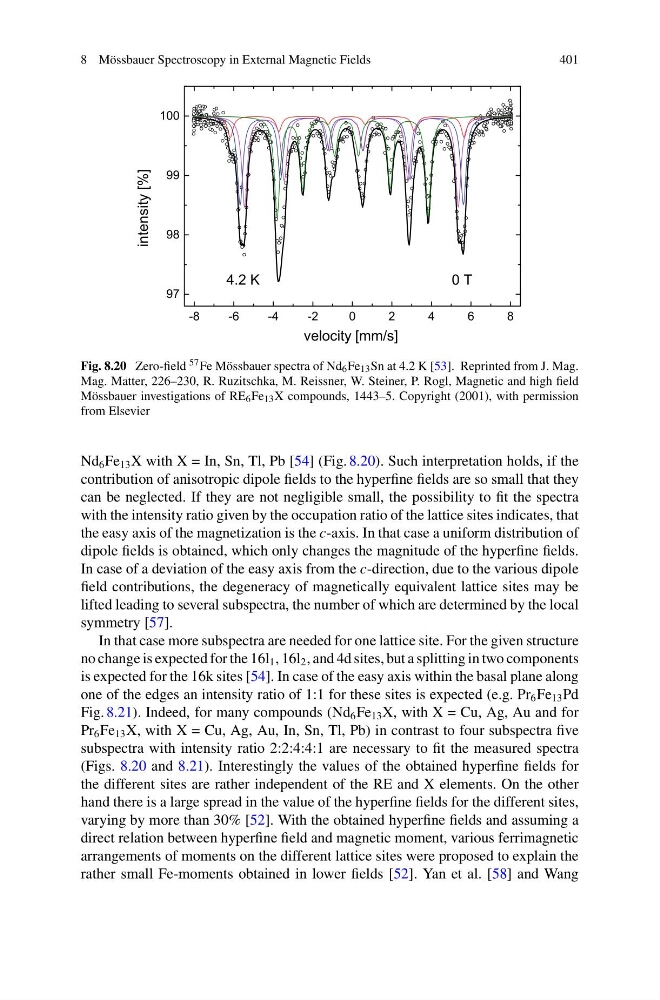
Fig. 8.20 Zero-field 57 Fe Mössbauer spectra of Nd 6 Fe 13 Sn at 4.2 K [53]. Reprinted from J. Mag.
Mag. Matter, 226–230, R. Ruzitschka, M. Reissner, W. Steiner, P. Rogl, Magnetic and high field
Mössbauer investigations of RE 6 Fe 13 X compounds, 1443–5. Copyright (2001), with permission
from Elsevier
Nd 6 Fe 13 X with X = In, Sn, Tl, Pb [54] (Fig. 8.20). Such interpretation holds, if the
contribution of anisotropic dipole fields to the hyperfine fields are so small that they
can be neglected. If they are not negligible small, the possibility to fit the spectra
with the intensity ratio given by the occupation ratio of the lattice sites indicates, that
the easy axis of the magnetization is the c-axis. In that case a uniform distribution of
dipole fields is obtained, which only changes the magnitude of the hyperfine fields.
In case of a deviation of the easy axis from the c-direction, due to the various dipole
field contributions, the degeneracy of magnetically equivalent lattice sites may be
lifted leading to several subspectra, the number of which are determined by the local
symmetry [57].
In that case more subspectra are needed for one lattice site. For the given structure
no change is expected for the 16l 1 , 16l 2 , and 4d sites, but a splitting in two components
is expected for the 16k sites [54]. In case of the easy axis within the basal plane along
one of the edges an intensity ratio of 1:1 for these sites is expected (e.g. Pr 6 Fe 13 Pd
Fig. 8.21). Indeed, for many compounds (Nd 6 Fe 13 X, with X = Cu, Ag, Au and for
Pr 6 Fe 13 X, with X = Cu, Ag, Au, In, Sn, Tl, Pb) in contrast to four subspectra five
subspectra with intensity ratio 2:2:4:4:1 are necessary to fit the measured spectra
(Figs. 8.20 and 8.21). Interestingly the values of the obtained hyperfine fields for
the different sites are rather independent of the RE and X elements. On the other
hand there is a large spread in the value of the hyperfine fields for the different sites,
varying by more than 30% [52]. With the obtained hyperfine fields and assuming a
direct relation between hyperfine field and magnetic moment, various ferrimagnetic
arrangements of moments on the different lattice sites were proposed to explain the
rather small Fe-moments obtained in lower fields [52]. Yan et al. [58] and Wang
401
Fig. 8.20 Zero-field 57 Fe Mössbauer spectra of Nd 6 Fe 13 Sn at 4.2 K [53]. Reprinted from J. Mag.
Mag. Matter, 226–230, R. Ruzitschka, M. Reissner, W. Steiner, P. Rogl, Magnetic and high field
Mössbauer investigations of RE 6 Fe 13 X compounds, 1443–5. Copyright (2001), with permission
from Elsevier
Nd 6 Fe 13 X with X = In, Sn, Tl, Pb [54] (Fig. 8.20). Such interpretation holds, if the
contribution of anisotropic dipole fields to the hyperfine fields are so small that they
can be neglected. If they are not negligible small, the possibility to fit the spectra
with the intensity ratio given by the occupation ratio of the lattice sites indicates, that
the easy axis of the magnetization is the c-axis. In that case a uniform distribution of
dipole fields is obtained, which only changes the magnitude of the hyperfine fields.
In case of a deviation of the easy axis from the c-direction, due to the various dipole
field contributions, the degeneracy of magnetically equivalent lattice sites may be
lifted leading to several subspectra, the number of which are determined by the local
symmetry [57].
In that case more subspectra are needed for one lattice site. For the given structure
no change is expected for the 16l 1 , 16l 2 , and 4d sites, but a splitting in two components
is expected for the 16k sites [54]. In case of the easy axis within the basal plane along
one of the edges an intensity ratio of 1:1 for these sites is expected (e.g. Pr 6 Fe 13 Pd
Fig. 8.21). Indeed, for many compounds (Nd 6 Fe 13 X, with X = Cu, Ag, Au and for
Pr 6 Fe 13 X, with X = Cu, Ag, Au, In, Sn, Tl, Pb) in contrast to four subspectra five
subspectra with intensity ratio 2:2:4:4:1 are necessary to fit the measured spectra
(Figs. 8.20 and 8.21). Interestingly the values of the obtained hyperfine fields for
the different sites are rather independent of the RE and X elements. On the other
hand there is a large spread in the value of the hyperfine fields for the different sites,
varying by more than 30% [52]. With the obtained hyperfine fields and assuming a
direct relation between hyperfine field and magnetic moment, various ferrimagnetic
arrangements of moments on the different lattice sites were proposed to explain the
rather small Fe-moments obtained in lower fields [52]. Yan et al. [58] and Wang