

400
M. Reissner
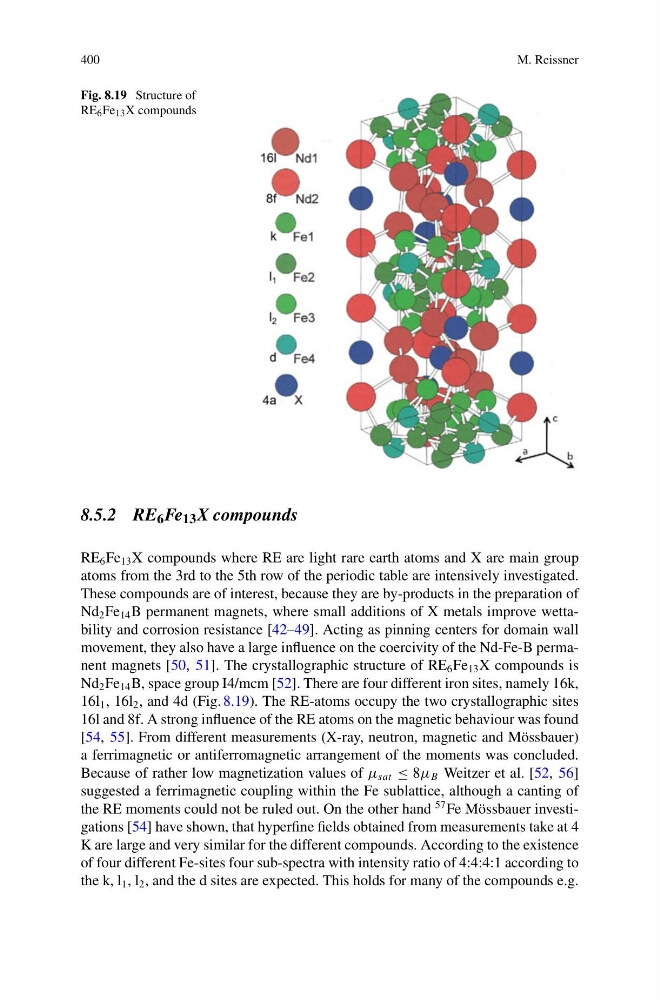
Fig. 8.19 Structure of
RE 6 Fe 13 X compounds
8.5.2 RE 6 Fe 13 X compounds
RE 6 Fe 13 X compounds where RE are light rare earth atoms and X are main group
atoms from the 3rd to the 5th row of the periodic table are intensively investigated.
These compounds are of interest, because they are by-products in the preparation of
Nd 2 Fe 14 B permanent magnets, where small additions of X metals improve wettability and corrosion resistance [42–49]. Acting as pinning centers for domain wall
movement, they also have a large influence on the coercivity of the Nd-Fe-B permanent magnets [50, 51]. The crystallographic structure of RE 6 Fe 13 X compounds is
Nd 2 Fe 14 B, space group I4/mcm [52]. There are four different iron sites, namely 16k,
16l 1 , 16l 2 , and 4d (Fig. 8.19). The RE-atoms occupy the two crystallographic sites
16l and 8f. A strong influence of the RE atoms on the magnetic behaviour was found
[54, 55]. From different measurements (X-ray, neutron, magnetic and Mössbauer)
a ferrimagnetic or antiferromagnetic arrangement of the moments was concluded.
Because of rather low magnetization values of μ sat ≤ 8μ B Weitzer et al. [52, 56]
suggested a ferrimagnetic coupling within the Fe sublattice, although a canting of
the RE moments could not be ruled out. On the other hand
57 Fe Mössbauer investigations [54] have shown, that hyperfine fields obtained from measurements take at 4
K are large and very similar for the different compounds. According to the existence
of four different Fe-sites four sub-spectra with intensity ratio of 4:4:4:1 according to
the k, l 1 , l 2 , and the d sites are expected. This holds for many of the compounds e.g.
M. Reissner
Fig. 8.19 Structure of
RE 6 Fe 13 X compounds
8.5.2 RE 6 Fe 13 X compounds
RE 6 Fe 13 X compounds where RE are light rare earth atoms and X are main group
atoms from the 3rd to the 5th row of the periodic table are intensively investigated.
These compounds are of interest, because they are by-products in the preparation of
Nd 2 Fe 14 B permanent magnets, where small additions of X metals improve wettability and corrosion resistance [42–49]. Acting as pinning centers for domain wall
movement, they also have a large influence on the coercivity of the Nd-Fe-B permanent magnets [50, 51]. The crystallographic structure of RE 6 Fe 13 X compounds is
Nd 2 Fe 14 B, space group I4/mcm [52]. There are four different iron sites, namely 16k,
16l 1 , 16l 2 , and 4d (Fig. 8.19). The RE-atoms occupy the two crystallographic sites
16l and 8f. A strong influence of the RE atoms on the magnetic behaviour was found
[54, 55]. From different measurements (X-ray, neutron, magnetic and Mössbauer)
a ferrimagnetic or antiferromagnetic arrangement of the moments was concluded.
Because of rather low magnetization values of μ sat ≤ 8μ B Weitzer et al. [52, 56]
suggested a ferrimagnetic coupling within the Fe sublattice, although a canting of
the RE moments could not be ruled out. On the other hand
57 Fe Mössbauer investigations [54] have shown, that hyperfine fields obtained from measurements take at 4
K are large and very similar for the different compounds. According to the existence
of four different Fe-sites four sub-spectra with intensity ratio of 4:4:4:1 according to
the k, l 1 , l 2 , and the d sites are expected. This holds for many of the compounds e.g.