

390
M. Reissner
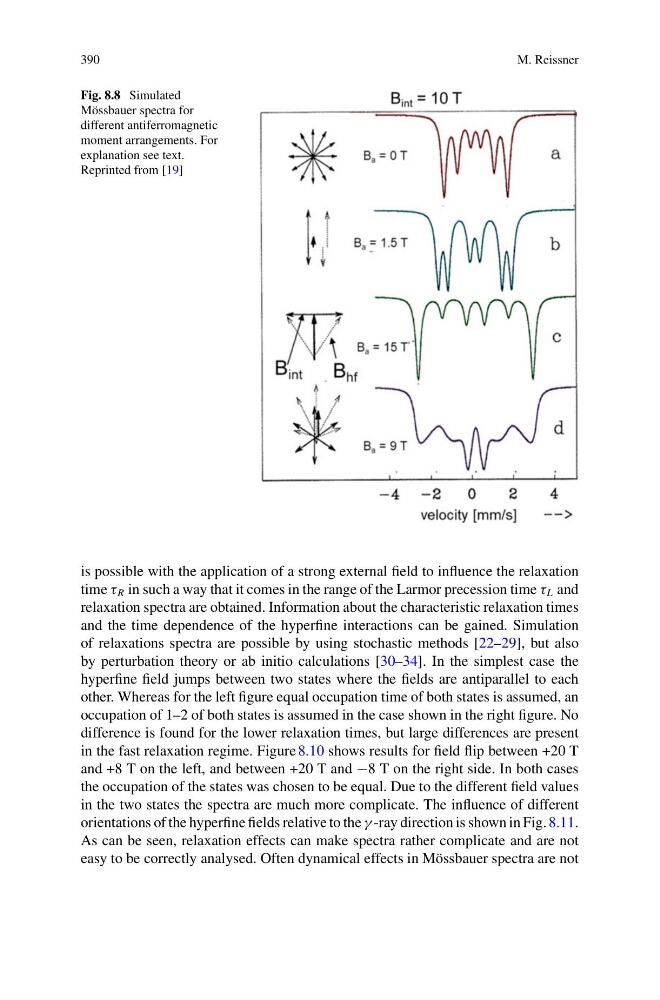
Fig. 8.8 Simulated
Mössbauer spectra for
different antiferromagnetic
moment arrangements. For
explanation see text.
Reprinted from [19]
is possible with the application of a strong external field to influence the relaxation
time τ R in such a way that it comes in the range of the Larmor precession time τ L and
relaxation spectra are obtained. Information about the characteristic relaxation times
and the time dependence of the hyperfine interactions can be gained. Simulation
of relaxations spectra are possible by using stochastic methods [22–29], but also
by perturbation theory or ab initio calculations [30–34]. In the simplest case the
hyperfine field jumps between two states where the fields are antiparallel to each
other. Whereas for the left figure equal occupation time of both states is assumed, an
occupation of 1–2 of both states is assumed in the case shown in the right figure. No
difference is found for the lower relaxation times, but large differences are present
in the fast relaxation regime. Figure 8.10 shows results for field flip between +20 T
and +8 T on the left, and between +20 T and −8 T on the right side. In both cases
the occupation of the states was chosen to be equal. Due to the different field values
in the two states the spectra are much more complicate. The influence of different
orientations of the hyperfine fields relative to the γ -ray direction is shown in Fig. 8.11.
As can be seen, relaxation effects can make spectra rather complicate and are not
easy to be correctly analysed. Often dynamical effects in Mössbauer spectra are not
M. Reissner
Fig. 8.8 Simulated
Mössbauer spectra for
different antiferromagnetic
moment arrangements. For
explanation see text.
Reprinted from [19]
is possible with the application of a strong external field to influence the relaxation
time τ R in such a way that it comes in the range of the Larmor precession time τ L and
relaxation spectra are obtained. Information about the characteristic relaxation times
and the time dependence of the hyperfine interactions can be gained. Simulation
of relaxations spectra are possible by using stochastic methods [22–29], but also
by perturbation theory or ab initio calculations [30–34]. In the simplest case the
hyperfine field jumps between two states where the fields are antiparallel to each
other. Whereas for the left figure equal occupation time of both states is assumed, an
occupation of 1–2 of both states is assumed in the case shown in the right figure. No
difference is found for the lower relaxation times, but large differences are present
in the fast relaxation regime. Figure 8.10 shows results for field flip between +20 T
and +8 T on the left, and between +20 T and −8 T on the right side. In both cases
the occupation of the states was chosen to be equal. Due to the different field values
in the two states the spectra are much more complicate. The influence of different
orientations of the hyperfine fields relative to the γ -ray direction is shown in Fig. 8.11.
As can be seen, relaxation effects can make spectra rather complicate and are not
easy to be correctly analysed. Often dynamical effects in Mössbauer spectra are not