

6 Molecular Magnetism of Metal Complexes and Light-Induced …
299
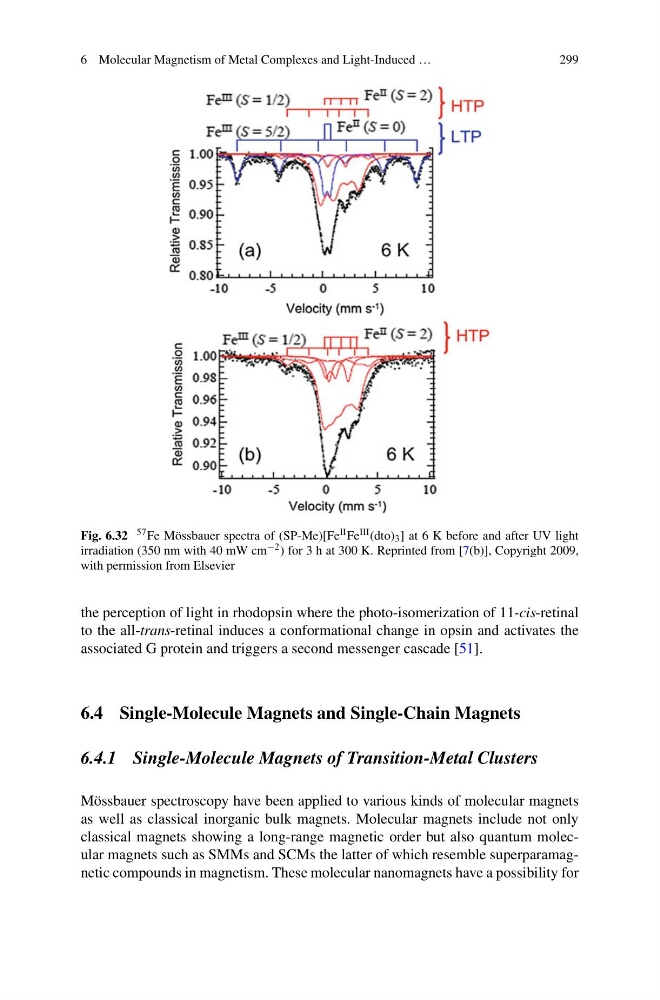
Fig. 6.32 57 Fe Mössbauer spectra of (SP-Me)[Fe II Fe III (dto) 3 ] at 6 K before and after UV light
irradiation (350 nm with 40 mW cm −2 ) for 3 h at 300 K. Reprinted from [7(b)], Copyright 2009,
with permission from Elsevier
the perception of light in rhodopsin where the photo-isomerization of 11-cis-retinal
to the all-trans-retinal induces a conformational change in opsin and activates the
associated G protein and triggers a second messenger cascade [51].
6.4 Single-Molecule Magnets and Single-Chain Magnets
6.4.1 Single-Molecule Magnets of Transition-Metal Clusters
Mössbauer spectroscopy have been applied to various kinds of molecular magnets
as well as classical inorganic bulk magnets. Molecular magnets include not only
classical magnets showing a long-range magnetic order but also quantum molecular magnets such as SMMs and SCMs the latter of which resemble superparamagnetic compounds in magnetism. These molecular nanomagnets have a possibility for
299
Fig. 6.32 57 Fe Mössbauer spectra of (SP-Me)[Fe II Fe III (dto) 3 ] at 6 K before and after UV light
irradiation (350 nm with 40 mW cm −2 ) for 3 h at 300 K. Reprinted from [7(b)], Copyright 2009,
with permission from Elsevier
the perception of light in rhodopsin where the photo-isomerization of 11-cis-retinal
to the all-trans-retinal induces a conformational change in opsin and activates the
associated G protein and triggers a second messenger cascade [51].
6.4 Single-Molecule Magnets and Single-Chain Magnets
6.4.1 Single-Molecule Magnets of Transition-Metal Clusters
Mössbauer spectroscopy have been applied to various kinds of molecular magnets
as well as classical inorganic bulk magnets. Molecular magnets include not only
classical magnets showing a long-range magnetic order but also quantum molecular magnets such as SMMs and SCMs the latter of which resemble superparamagnetic compounds in magnetism. These molecular nanomagnets have a possibility for