

278
N. Kojima and A. Okazawa
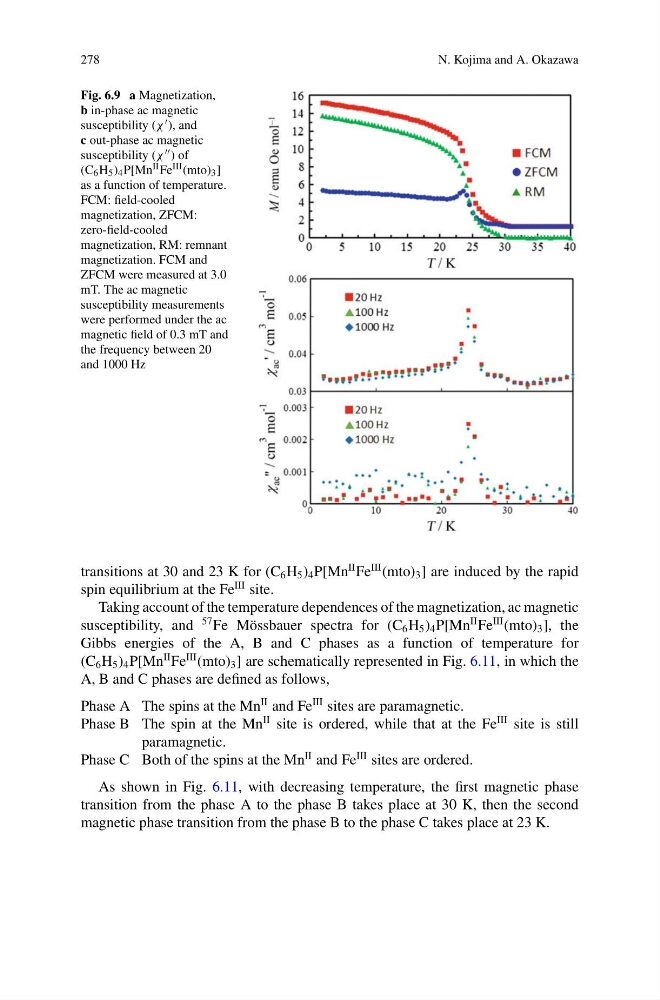
Fig. 6.9 a Magnetization,
b in-phase ac magnetic
susceptibility (χ ), and
c out-phase ac magnetic
susceptibility (χ ) of
(C 6 H 5 ) 4 P[Mn II Fe III (mto) 3 ]
as a function of temperature.
FCM: field-cooled
magnetization, ZFCM:
zero-field-cooled
magnetization, RM: remnant
magnetization. FCM and
ZFCM were measured at 3.0
mT. The ac magnetic
susceptibility measurements
were performed under the ac
magnetic field of 0.3 mT and
the frequency between 20
and 1000 Hz
transitions at 30 and 23 K for (C 6 H 5 ) 4 P[Mn
II Fe
III (mto) 3 ] are induced by the rapid
spin equilibrium at the Fe
III site.
Taking account of the temperature dependences of the magnetization, ac magnetic
susceptibility, and
57 Fe Mössbauer spectra for (C 6 H 5 ) 4 P[Mn
II Fe
III (mto) 3 ], the
Gibbs energies of the A, B and C phases as a function of temperature for
(C 6 H 5 ) 4 P[Mn
II Fe
III (mto) 3 ] are schematically represented in Fig. 6.11, in which the
A, B and C phases are defined as follows,
Phase A The spins at the Mn
II and Fe
III sites are paramagnetic.
Phase B The spin at the Mn
II site is ordered, while that at the Fe
III site is still
paramagnetic.
Phase C Both of the spins at the Mn
II and Fe
III sites are ordered.
As shown in Fig. 6.11, with decreasing temperature, the first magnetic phase
transition from the phase A to the phase B takes place at 30 K, then the second
magnetic phase transition from the phase B to the phase C takes place at 23 K.
N. Kojima and A. Okazawa
Fig. 6.9 a Magnetization,
b in-phase ac magnetic
susceptibility (χ ), and
c out-phase ac magnetic
susceptibility (χ ) of
(C 6 H 5 ) 4 P[Mn II Fe III (mto) 3 ]
as a function of temperature.
FCM: field-cooled
magnetization, ZFCM:
zero-field-cooled
magnetization, RM: remnant
magnetization. FCM and
ZFCM were measured at 3.0
mT. The ac magnetic
susceptibility measurements
were performed under the ac
magnetic field of 0.3 mT and
the frequency between 20
and 1000 Hz
transitions at 30 and 23 K for (C 6 H 5 ) 4 P[Mn
II Fe
III (mto) 3 ] are induced by the rapid
spin equilibrium at the Fe
III site.
Taking account of the temperature dependences of the magnetization, ac magnetic
susceptibility, and
57 Fe Mössbauer spectra for (C 6 H 5 ) 4 P[Mn
II Fe
III (mto) 3 ], the
Gibbs energies of the A, B and C phases as a function of temperature for
(C 6 H 5 ) 4 P[Mn
II Fe
III (mto) 3 ] are schematically represented in Fig. 6.11, in which the
A, B and C phases are defined as follows,
Phase A The spins at the Mn
II and Fe
III sites are paramagnetic.
Phase B The spin at the Mn
II site is ordered, while that at the Fe
III site is still
paramagnetic.
Phase C Both of the spins at the Mn
II and Fe
III sites are ordered.
As shown in Fig. 6.11, with decreasing temperature, the first magnetic phase
transition from the phase A to the phase B takes place at 30 K, then the second
magnetic phase transition from the phase B to the phase C takes place at 23 K.