

6 Molecular Magnetism of Metal Complexes and Light-Induced …
277
(n-C n H 2n+1 ) 4 N[Mn
II Fe
III (ox) 3 ] with Mn
II (S = 5/2) and Fe
III (S = 5/2) has been
reported [26], in which T N was estimated at 27–28 K.
Therefore, if the spin state of the Fe
III site in the [Mn
II Fe
III (mto) 3 ] system behaves
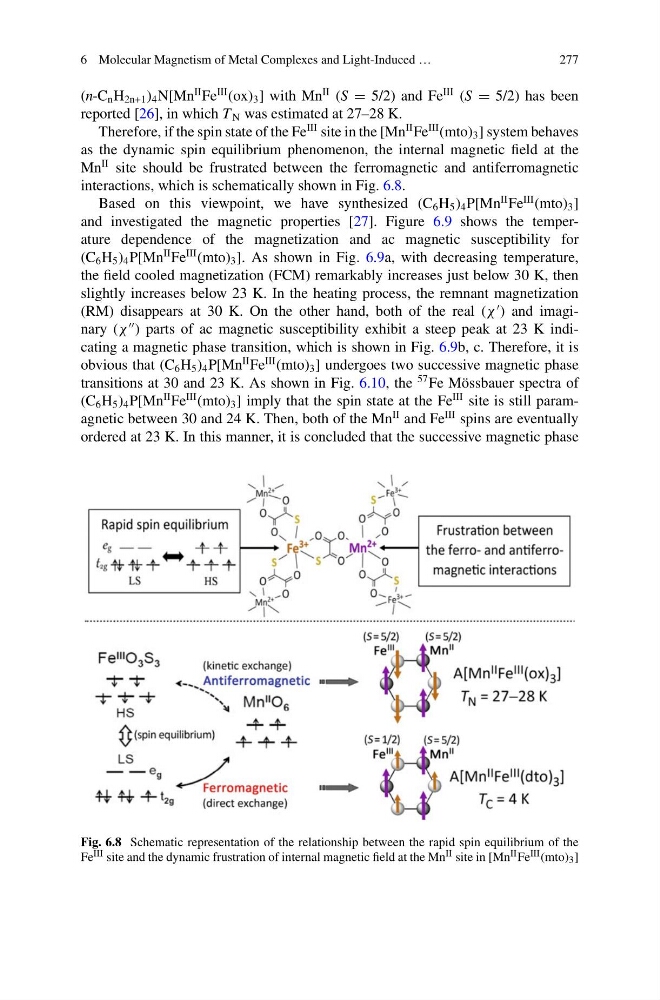
as the dynamic spin equilibrium phenomenon, the internal magnetic field at the
Mn
II site should be frustrated between the ferromagnetic and antiferromagnetic
interactions, which is schematically shown in Fig. 6.8.
Based on this viewpoint, we have synthesized (C 6 H 5 ) 4 P[Mn
II Fe
III (mto) 3 ]
and investigated the magnetic properties [27]. Figure 6.9 shows the temperature dependence of the magnetization and ac magnetic susceptibility for
(C 6 H 5 ) 4 P[Mn
II Fe
III (mto) 3 ]. As shown in Fig. 6.9a, with decreasing temperature,
the field cooled magnetization (FCM) remarkably increases just below 30 K, then
slightly increases below 23 K. In the heating process, the remnant magnetization
(RM) disappears at 30 K. On the other hand, both of the real (χ
) and imaginary (χ
) parts of ac magnetic susceptibility exhibit a steep peak at 23 K indicating a magnetic phase transition, which is shown in Fig. 6.9b, c. Therefore, it is
obvious that (C 6 H 5 ) 4 P[Mn
II Fe
III (mto) 3 ] undergoes two successive magnetic phase
transitions at 30 and 23 K. As shown in Fig. 6.10, the
57 Fe Mössbauer spectra of
(C 6 H 5 ) 4 P[Mn
II Fe
III (mto) 3 ] imply that the spin state at the Fe
III site is still paramagnetic between 30 and 24 K. Then, both of the Mn
II and Fe
III spins are eventually
ordered at 23 K. In this manner, it is concluded that the successive magnetic phase
Fig. 6.8 Schematic representation of the relationship between the rapid spin equilibrium of the
Fe III site and the dynamic frustration of internal magnetic field at the Mn II site in [Mn II Fe III (mto) 3 ]
277
(n-C n H 2n+1 ) 4 N[Mn
II Fe
III (ox) 3 ] with Mn
II (S = 5/2) and Fe
III (S = 5/2) has been
reported [26], in which T N was estimated at 27–28 K.
Therefore, if the spin state of the Fe
III site in the [Mn
II Fe
III (mto) 3 ] system behaves
as the dynamic spin equilibrium phenomenon, the internal magnetic field at the
Mn
II site should be frustrated between the ferromagnetic and antiferromagnetic
interactions, which is schematically shown in Fig. 6.8.
Based on this viewpoint, we have synthesized (C 6 H 5 ) 4 P[Mn
II Fe
III (mto) 3 ]
and investigated the magnetic properties [27]. Figure 6.9 shows the temperature dependence of the magnetization and ac magnetic susceptibility for
(C 6 H 5 ) 4 P[Mn
II Fe
III (mto) 3 ]. As shown in Fig. 6.9a, with decreasing temperature,
the field cooled magnetization (FCM) remarkably increases just below 30 K, then
slightly increases below 23 K. In the heating process, the remnant magnetization
(RM) disappears at 30 K. On the other hand, both of the real (χ
) and imaginary (χ
) parts of ac magnetic susceptibility exhibit a steep peak at 23 K indicating a magnetic phase transition, which is shown in Fig. 6.9b, c. Therefore, it is
obvious that (C 6 H 5 ) 4 P[Mn
II Fe
III (mto) 3 ] undergoes two successive magnetic phase
transitions at 30 and 23 K. As shown in Fig. 6.10, the
57 Fe Mössbauer spectra of
(C 6 H 5 ) 4 P[Mn
II Fe
III (mto) 3 ] imply that the spin state at the Fe
III site is still paramagnetic between 30 and 24 K. Then, both of the Mn
II and Fe
III spins are eventually
ordered at 23 K. In this manner, it is concluded that the successive magnetic phase
Fig. 6.8 Schematic representation of the relationship between the rapid spin equilibrium of the
Fe III site and the dynamic frustration of internal magnetic field at the Mn II site in [Mn II Fe III (mto) 3 ]