

5 Mössbauer Spectroscopy with High Spatial Resolution …
227
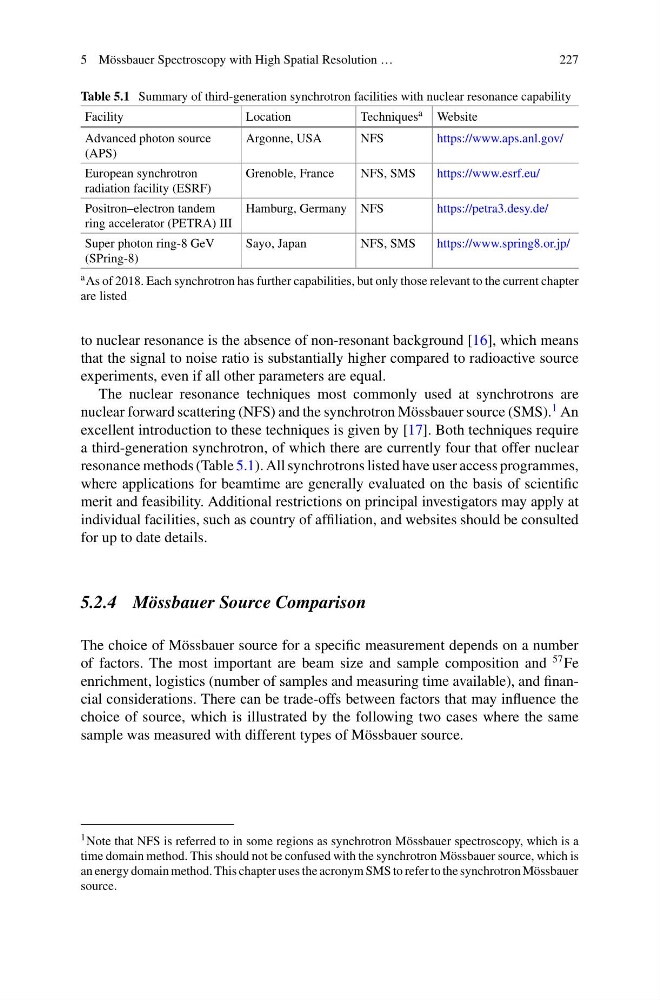
Table 5.1 Summary of third-generation synchrotron facilities with nuclear resonance capability
Facility
Location
Techniques a Website
Advanced photon source
(APS)
Argonne, USA
NFS
https://www.aps.anl.gov/
European synchrotron
radiation facility (ESRF)
Grenoble, France
NFS, SMS
https://www.esrf.eu/
Positron–electron tandem
ring accelerator (PETRA) III
Hamburg, Germany NFS
https://petra3.desy.de/
Super photon ring-8 GeV
(SPring-8)
Sayo, Japan
NFS, SMS
https://www.spring8.or.jp/
a As of 2018. Each synchrotron has further capabilities, but only those relevant to the current chapter
are listed
to nuclear resonance is the absence of non-resonant background [16], which means
that the signal to noise ratio is substantially higher compared to radioactive source
experiments, even if all other parameters are equal.
The nuclear resonance techniques most commonly used at synchrotrons are
nuclear forward scattering (NFS) and the synchrotron Mössbauer source (SMS).
1 An
excellent introduction to these techniques is given by [17]. Both techniques require
a third-generation synchrotron, of which there are currently four that offer nuclear
resonance methods (Table 5.1). All synchrotrons listed have user access programmes,
where applications for beamtime are generally evaluated on the basis of scientific
merit and feasibility. Additional restrictions on principal investigators may apply at
individual facilities, such as country of affiliation, and websites should be consulted
for up to date details.
5.2.4 Mössbauer Source Comparison
The choice of Mössbauer source for a specific measurement depends on a number
of factors. The most important are beam size and sample composition and
57 Fe
enrichment, logistics (number of samples and measuring time available), and financial considerations. There can be trade-offs between factors that may influence the
choice of source, which is illustrated by the following two cases where the same
sample was measured with different types of Mössbauer source.
1 Note that NFS is referred to in some regions as synchrotron Mössbauer spectroscopy, which is a
time domain method. This should not be confused with the synchrotron Mössbauer source, which is
an energy domain method. This chapter uses the acronym SMS to refer to the synchrotron Mössbauer
source.
227
Table 5.1 Summary of third-generation synchrotron facilities with nuclear resonance capability
Facility
Location
Techniques a Website
Advanced photon source
(APS)
Argonne, USA
NFS
https://www.aps.anl.gov/
European synchrotron
radiation facility (ESRF)
Grenoble, France
NFS, SMS
https://www.esrf.eu/
Positron–electron tandem
ring accelerator (PETRA) III
Hamburg, Germany NFS
https://petra3.desy.de/
Super photon ring-8 GeV
(SPring-8)
Sayo, Japan
NFS, SMS
https://www.spring8.or.jp/
a As of 2018. Each synchrotron has further capabilities, but only those relevant to the current chapter
are listed
to nuclear resonance is the absence of non-resonant background [16], which means
that the signal to noise ratio is substantially higher compared to radioactive source
experiments, even if all other parameters are equal.
The nuclear resonance techniques most commonly used at synchrotrons are
nuclear forward scattering (NFS) and the synchrotron Mössbauer source (SMS).
1 An
excellent introduction to these techniques is given by [17]. Both techniques require
a third-generation synchrotron, of which there are currently four that offer nuclear
resonance methods (Table 5.1). All synchrotrons listed have user access programmes,
where applications for beamtime are generally evaluated on the basis of scientific
merit and feasibility. Additional restrictions on principal investigators may apply at
individual facilities, such as country of affiliation, and websites should be consulted
for up to date details.
5.2.4 Mössbauer Source Comparison
The choice of Mössbauer source for a specific measurement depends on a number
of factors. The most important are beam size and sample composition and
57 Fe
enrichment, logistics (number of samples and measuring time available), and financial considerations. There can be trade-offs between factors that may influence the
choice of source, which is illustrated by the following two cases where the same
sample was measured with different types of Mössbauer source.
1 Note that NFS is referred to in some regions as synchrotron Mössbauer spectroscopy, which is a
time domain method. This should not be confused with the synchrotron Mössbauer source, which is
an energy domain method. This chapter uses the acronym SMS to refer to the synchrotron Mössbauer
source.