

226
C. McCammon
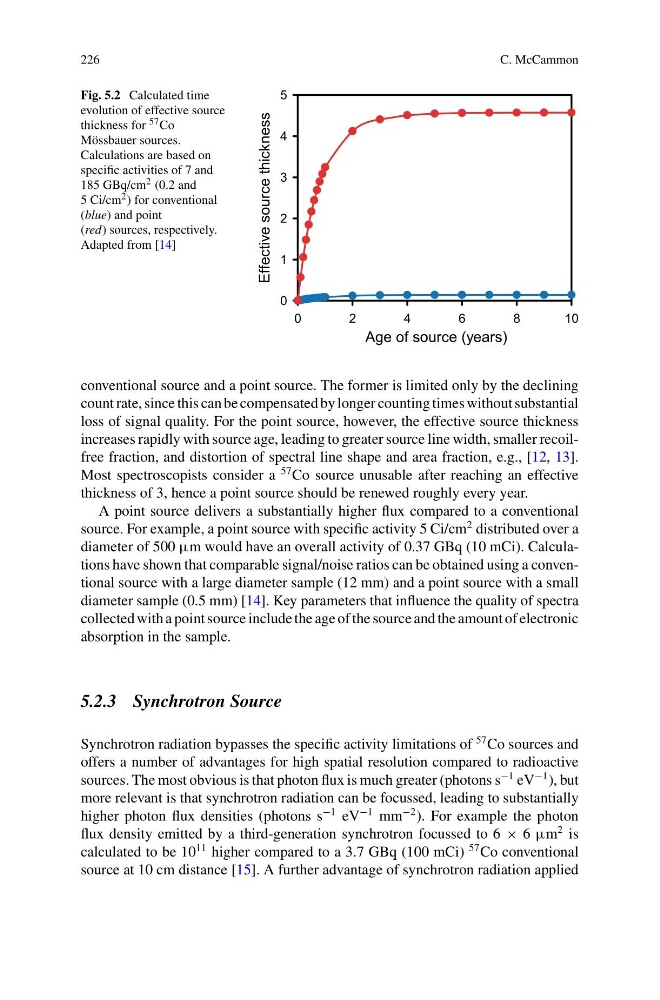
Fig. 5.2 Calculated time
evolution of effective source
thickness for 57 Co
Mössbauer sources.
Calculations are based on
specific activities of 7 and
185 GBq/cm 2 (0.2 and
5 Ci/cm 2 ) for conventional
(blue) and point
(red) sources, respectively.
Adapted from [14]
conventional source and a point source. The former is limited only by the declining
count rate, since this can be compensated by longer counting times without substantial
loss of signal quality. For the point source, however, the effective source thickness
increases rapidly with source age, leading to greater source line width, smaller recoilfree fraction, and distortion of spectral line shape and area fraction, e.g., [12, 13].
Most spectroscopists consider a
57 Co source unusable after reaching an effective
thickness of 3, hence a point source should be renewed roughly every year.
A point source delivers a substantially higher flux compared to a conventional
source. For example, a point source with specific activity 5 Ci/cm
2 distributed over a
diameter of 500 μm would have an overall activity of 0.37 GBq (10 mCi). Calculations have shown that comparable signal/noise ratios can be obtained using a conventional source with a large diameter sample (12 mm) and a point source with a small
diameter sample (0.5 mm) [14]. Key parameters that influence the quality of spectra
collected with a point source include the age of the source and the amount of electronic
absorption in the sample.
5.2.3 Synchrotron Source
Synchrotron radiation bypasses the specific activity limitations of
57 Co sources and
offers a number of advantages for high spatial resolution compared to radioactive
sources. The most obvious is that photon flux is much greater (photons s
−1 eV
−1 ), but
more relevant is that synchrotron radiation can be focussed, leading to substantially
higher photon flux densities (photons s
−1 eV
−1 mm
−2 ). For example the photon
flux density emitted by a third-generation synchrotron focussed to 6 × 6 μm
2 is
calculated to be 10
11 higher compared to a 3.7 GBq (100 mCi)
57 Co conventional
source at 10 cm distance [15]. A further advantage of synchrotron radiation applied
C. McCammon
Fig. 5.2 Calculated time
evolution of effective source
thickness for 57 Co
Mössbauer sources.
Calculations are based on
specific activities of 7 and
185 GBq/cm 2 (0.2 and
5 Ci/cm 2 ) for conventional
(blue) and point
(red) sources, respectively.
Adapted from [14]
conventional source and a point source. The former is limited only by the declining
count rate, since this can be compensated by longer counting times without substantial
loss of signal quality. For the point source, however, the effective source thickness
increases rapidly with source age, leading to greater source line width, smaller recoilfree fraction, and distortion of spectral line shape and area fraction, e.g., [12, 13].
Most spectroscopists consider a
57 Co source unusable after reaching an effective
thickness of 3, hence a point source should be renewed roughly every year.
A point source delivers a substantially higher flux compared to a conventional
source. For example, a point source with specific activity 5 Ci/cm
2 distributed over a
diameter of 500 μm would have an overall activity of 0.37 GBq (10 mCi). Calculations have shown that comparable signal/noise ratios can be obtained using a conventional source with a large diameter sample (12 mm) and a point source with a small
diameter sample (0.5 mm) [14]. Key parameters that influence the quality of spectra
collected with a point source include the age of the source and the amount of electronic
absorption in the sample.
5.2.3 Synchrotron Source
Synchrotron radiation bypasses the specific activity limitations of
57 Co sources and
offers a number of advantages for high spatial resolution compared to radioactive
sources. The most obvious is that photon flux is much greater (photons s
−1 eV
−1 ), but
more relevant is that synchrotron radiation can be focussed, leading to substantially
higher photon flux densities (photons s
−1 eV
−1 mm
−2 ). For example the photon
flux density emitted by a third-generation synchrotron focussed to 6 × 6 μm
2 is
calculated to be 10
11 higher compared to a 3.7 GBq (100 mCi)
57 Co conventional
source at 10 cm distance [15]. A further advantage of synchrotron radiation applied